Fundamentals that never expire

Learn how codeactually runs.

Memory, pointers, data structures and object-oriented C++ — the foundation every other language sits on and the syllabus your university exams are built from.

 3–4 monthsClassroom & online batchesBeginner to job ready
Explore course
4.8/5
Student rating
500+
Students trained
6+
Industry projects
Yes
Placement support
A C and C++ development workspace — an editor, a compiler and the tooling the course builds on

Admissions open

Free demo class & counselling

Batch slots

  • Weekday
  • Evening
  • Weekend
Talk to a counsellor

Course overview

The C and C++ course in Ludhiana that builds the foundation

Looking for the best C Programming course in Ludhiana — or a C++ course in Ludhiana that actually builds job-ready programming skills? techcadd teaches both as one course, because C is where the logic is built and C++ is where it becomes object-oriented. It is designed for students, graduates, and beginners who want strong coding fundamentals, not just theory.

C is the backbone of computer science — mastering it makes it easier to learn C++, Java, Python, Data Structures, and even the core concepts used in embedded systems and competitive coding. As a trusted C++ training institute in Ludhiana, techcadd covers core programming logic, object-oriented programming (OOP), data structures, memory management, and real-world coding projects using industry-standard practices.

The C Programming classes in Ludhiana combine practical, hands-on coding sessions with real-world logic-building exercises, live doubt-solving, and structured assignments. Whether you’re a 12th-pass student exploring programming for the first time, a BCA/MCA/B.Tech student strengthening fundamentals, or a job seeker preparing for technical interviews and government IT exams, this course takes you from zero to confident, independent coder.

With experienced trainers, a Ludhiana-based learning centre, flexible batch timings, and a strong focus on placement readiness, techcadd is one of the most trusted names for programming education in Ludhiana — practical, affordable, and beginner-friendly from day one.
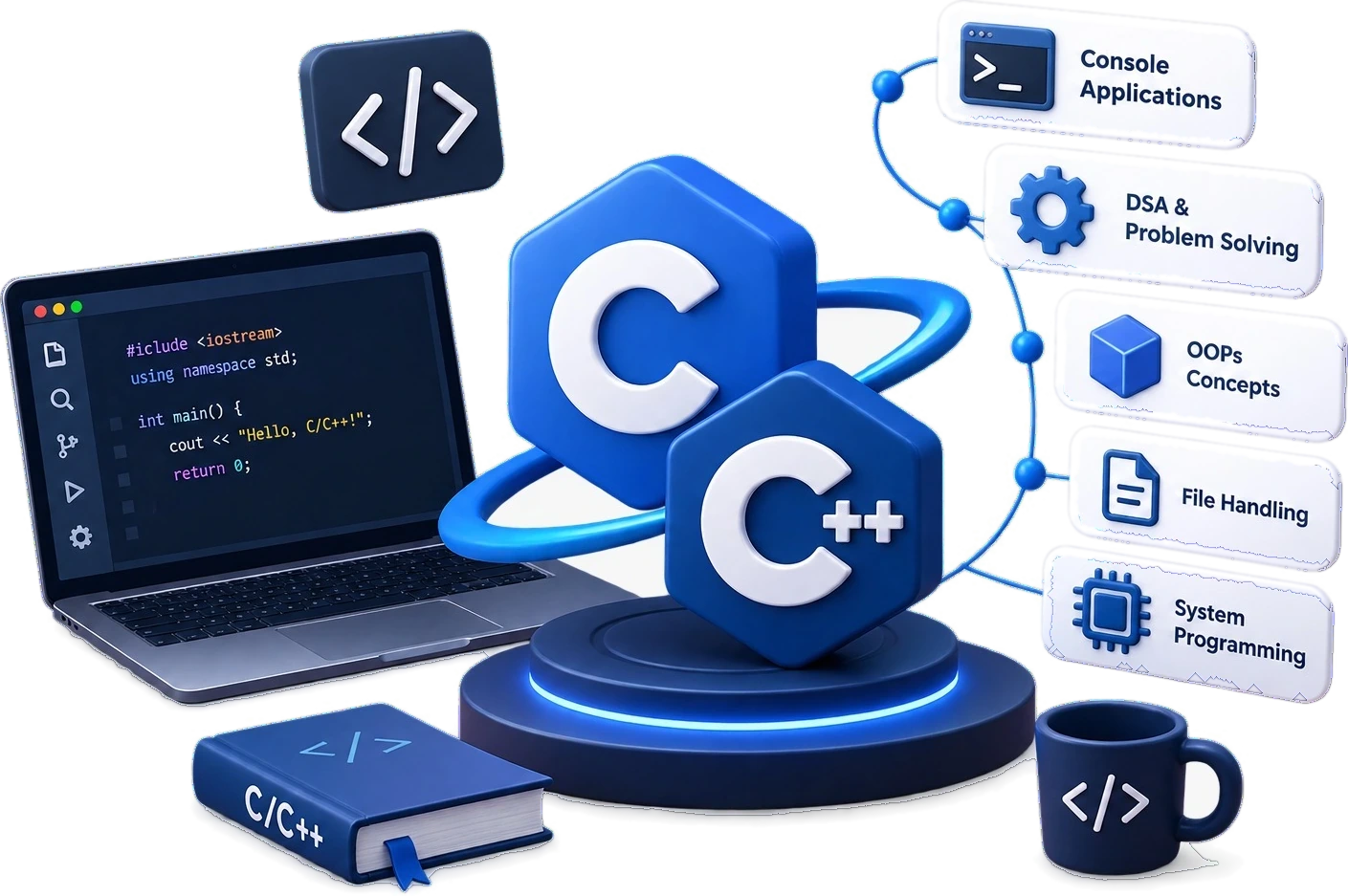

  • Pointers and memory taught until they click
  • Data structures written from scratch
  • University syllabus fully covered

Curriculum

A path from first steps to shipped work

5 modules and 28 topics across 3–4 months, in the order they are taught. Each one closes with something that works before the next one opens.

5 learning modules01 / 05
Module 01 · Weeks 1–3

C Fundamentals

Compilation, types, control flow and functions — how a C program becomes a running binary.

Topics covered

  • Compilation model
  • Data types
  • Operators
  • Loops & branching
  • Functions
  • Recursion

Tools & libraries

  • GCC
  • VS Code
  • Make

You finish with

A menu-driven matrix calculator that handles bad input gracefully.

Module 02 · Weeks 4–6

Pointers, Memory & Files

The part most students skip and most interviews ask about: addresses, allocation and lifetimes.

Topics covered

  • Pointers & arithmetic
  • Dynamic memory
  • Structures & unions
  • File I/O
  • Command-line arguments

Tools & libraries

  • GCC
  • GDB
  • Valgrind

You finish with

A student database in C that stores records in a binary file and frees every byte it takes.

Module 03 · Weeks 7–9

Data Structures in C

Build the structures yourself before any library hands them to you.

Topics covered

  • Linked lists
  • Stacks & queues
  • Trees
  • Hashing
  • Sorting & searching
  • Complexity analysis

Tools & libraries

  • GCC
  • GDB

You finish with

A working implementation of every core data structure, with test cases.

Module 04 · Weeks 10–12

Object-Oriented C++

Classes, constructors, operator overloading and inheritance done the C++ way.

Topics covered

  • Classes & objects
  • Constructors & destructors
  • Operator overloading
  • Inheritance
  • Virtual functions
  • Templates

Tools & libraries

  • g++
  • CMake

You finish with

A bank account hierarchy with polymorphic behaviour and RAII-safe resources.

Module 05 · Weeks 13–16

STL & Competitive Practice

The Standard Template Library and the problem patterns that appear in placement rounds.

Topics covered

  • Vectors & maps
  • Iterators & algorithms
  • Smart pointers
  • Exception handling
  • Problem patterns

Tools & libraries

  • STL
  • CMake
  • Git

You finish with

A capstone console application plus a solved practice set for placement rounds.

What you learn

What you’ll learn and the tools you’ll master

The course is structured to take you step by step from absolute basics to confident, independent coding — C first, because that is where the logic and the memory model are learned, then C++ on top of it. Here is what the curriculum covers and the tools you’ll work with.

  1. Programming Fundamentals & Logic Building

    You’ll start with the building blocks: what a compiler does, how a program is structured, variables, data types (int, float, char, double), constants, and operators — arithmetic, relational, logical and assignment. More importantly, you learn to think in logic before syntax, which is the part that carries into every language afterward.

  2. Control Flow & Decision Making

    How programs make decisions and repeat actions — if-else, nested conditions, switch-case, and the for, while and do-while loops. This is where students write their first real logic-based programs: calculators, pattern printing, and number-checking problems.

  3. Functions & Modular Programming

    Break large problems into smaller, reusable pieces — function declaration, definition, calling, parameters, return values, recursion, function overloading, and the difference between call by value and call by reference. This builds the habit of writing organized code instead of one long block.

  4. Arrays & Strings

    Single and multi-dimensional arrays, array manipulation, and string handling using character arrays and the standard string library — strlen, strcpy, strcmp, strcat and the rest. Students practice sorting, searching and string reversal, all common in college exams and technical interviews.

  5. Pointers & Memory Addresses

    The most important — and most feared — topic in C, taught step by step: pointer basics, pointer arithmetic, pointers with arrays, pointers with functions, and pointers to pointers. Trainers focus heavily here, because a strong grasp of pointers makes memory management and every later language significantly easier.

  6. Structures & Unions

    Group different data types together using structures and unions, along with nested structures, arrays of structures, and passing structures to functions — essential for building more complex, real-world programs.

  7. Object-Oriented Programming (OOP) in C++

    This is where C++ moves beyond C and becomes genuinely powerful. You’ll master classes and objects, encapsulation, abstraction, inheritance, and polymorphism — the concepts that define how real-world software is structured, and the ones most frequently tested in technical interviews and university exams.

  8. Memory Management & Dynamic Allocation

    How memory allocation actually works — malloc, calloc, realloc and free in C, new and delete in C++, plus constructors and destructors. You learn to avoid the common memory bugs, leaks and dangling pointers, which is the skill that separates serious programmers from beginners.

  9. File Handling

    Reading from and writing to files programmatically, so programs can store and retrieve data — fopen, fclose, fread, fwrite, fprintf and fscanf, and the C++ stream equivalents. A key concept for real-world applications, from simple record-keepers to larger software systems.

  10. Introduction to Data Structures

    A foundational introduction to arrays, linked lists, stacks and queues, implemented by hand before any library hands them to you — preparing you directly for a dedicated Data Structures and Algorithms course, which is essential for software development and coding interviews.

  11. Standard Template Library (STL) Basics

    An introduction to STL components like vectors, maps, and the standard algorithms — the pre-built tools professional C++ developers use daily instead of writing everything from scratch.

  12. Debugging & Problem-Solving

    A major differentiator of this course is hands-on debugging practice — reading compiler errors, tracing logic bugs, and using debugging tools effectively. Employers actively test for this, and classroom-only learning rarely develops it.

  13. Tools & Software Covered

    Code::Blocks, Turbo C or the GCC/G++ compiler for writing, compiling and running programs; VS Code and command-line basics so you understand the compilation and execution flow; debugging tools for finding syntax and logic errors; and basic IDE navigation — project structure, file management and build processes.

  14. Mini Projects & Practical Coding

    Toward the end of the course you apply everything to small real-world projects — a student record management system, a simple calculator, a library management mini-project, simple games, or pattern-based logic programs — giving you concrete work to discuss in interviews and college submissions.

Tools you’ll work with

  • GCC / G++ compiler
  • Code::Blocks
  • Turbo C
  • VS Code
  • GDB debugger
  • Command line / terminal
  • STL
  • Git & GitHub

By the end you will not just recognise C and C++ syntax — you will have written, compiled, debugged and shipped programs of your own, which is the only thing an exam, a viva or a technical interview can actually test.

Find your pace

What you can do, phase by phase

The C & C++ syllabus in the order you meet it, and what you are able to do by the end of each stretch of it. Every row is a capability, not a topic you sat through.

Every capability in the C & C++ syllabus, and the phase it is covered in
CapabilityFoundationsAppliedProfessional
Compilation modelC FundamentalsCovered in FoundationsCovered in AppliedCovered in Professional
Data typesC FundamentalsCovered in FoundationsCovered in AppliedCovered in Professional
OperatorsC FundamentalsCovered in FoundationsCovered in AppliedCovered in Professional
Loops & branchingC FundamentalsCovered in FoundationsCovered in AppliedCovered in Professional
FunctionsC FundamentalsCovered in FoundationsCovered in AppliedCovered in Professional
RecursionC FundamentalsCovered in FoundationsCovered in AppliedCovered in Professional
Pointers & arithmeticPointers, Memory & FilesCovered in FoundationsCovered in AppliedCovered in Professional
Dynamic memoryPointers, Memory & FilesCovered in FoundationsCovered in AppliedCovered in Professional
Structures & unionsPointers, Memory & FilesCovered in FoundationsCovered in AppliedCovered in Professional
File I/OPointers, Memory & FilesCovered in FoundationsCovered in AppliedCovered in Professional
Command-line argumentsPointers, Memory & FilesCovered in FoundationsCovered in AppliedCovered in Professional
Linked listsData Structures in CNot yet covered in FoundationsCovered in AppliedCovered in Professional
Stacks & queuesData Structures in CNot yet covered in FoundationsCovered in AppliedCovered in Professional
TreesData Structures in CNot yet covered in FoundationsCovered in AppliedCovered in Professional
HashingData Structures in CNot yet covered in FoundationsCovered in AppliedCovered in Professional
Sorting & searchingData Structures in CNot yet covered in FoundationsCovered in AppliedCovered in Professional
Complexity analysisData Structures in CNot yet covered in FoundationsCovered in AppliedCovered in Professional
Classes & objectsObject-Oriented C++Not yet covered in FoundationsCovered in AppliedCovered in Professional
Constructors & destructorsObject-Oriented C++Not yet covered in FoundationsCovered in AppliedCovered in Professional
Operator overloadingObject-Oriented C++Not yet covered in FoundationsCovered in AppliedCovered in Professional
InheritanceObject-Oriented C++Not yet covered in FoundationsCovered in AppliedCovered in Professional
Virtual functionsObject-Oriented C++Not yet covered in FoundationsCovered in AppliedCovered in Professional
TemplatesObject-Oriented C++Not yet covered in FoundationsCovered in AppliedCovered in Professional
Vectors & mapsSTL & Competitive PracticeNot yet covered in FoundationsNot yet covered in AppliedCovered in Professional
Iterators & algorithmsSTL & Competitive PracticeNot yet covered in FoundationsNot yet covered in AppliedCovered in Professional
Smart pointersSTL & Competitive PracticeNot yet covered in FoundationsNot yet covered in AppliedCovered in Professional
Exception handlingSTL & Competitive PracticeNot yet covered in FoundationsNot yet covered in AppliedCovered in Professional
Problem patternsSTL & Competitive PracticeNot yet covered in FoundationsNot yet covered in AppliedCovered in Professional

The full programme runs 3–4 months. Where you finish is a question of pace rather than of syllabus — everyone covers all of it.

The case for it

Your months should build more than a certificate.

A course is worth the time you give it only if you finish with work you can show and skills you can defend. That is the standard this programme is designed against.

12+Practical learning areasfrom fundamentals to delivery
  • You learn C and C++ the way it is used in production, with the workflow, tooling and standards a working team expects. Nothing in the syllabus exists only to fill hours.

  • Sessions are hands-on. You do every example, break it, and fix it. Each module closes with a lab task that has to work before you move on.

  • Four shipped finished projects — the kind of work an interviewer can open, click through and question you on.

  • A structured final phase: portfolio review, profile cleanup, aptitude and role-specific practice, mock interviews and placement support.

Why this course

Why should you choose this course?

Six things we hold ourselves to for every C & C++ batch that starts in Ludhiana.

  • 01

    Industry-focused curriculum

    Syllabus built around what C and C++ teams actually ship — no filler modules, no theory that never reaches your hands.

  • 02

    Practical learning

    Every concept lands in the tool the same day. You work in C and C++ during each class, not just in your notes.

  • 03

    Real-world projects

    Build with real requirements, real data and real problems — from the first task to a finished, reviewable deliverable.

  • 04

    Mentor guidance

    Trainers who work with C and C++ daily review your work, your logic and your approach line by line.

  • 05

    Career preparation

    Resume, portfolio, aptitude rounds and interview practice built into the last phase of the course.

  • 06

    Placement support

    Interview referrals, mock rounds and continued doubt support after the course ends.

Eligibility

Who can do this C and C++ course

One of the biggest myths around programming courses is that you need a computer science background to even attempt them. That is not true — and this C Programming course in Ludhiana is built specifically to prove it. You don’t need any prior coding background to get started, and the course is structured to meet you exactly where you are.

  • 12th Pass Students (Any Stream)

    You don’t need to have taken Computer Science in school to start. Whether you’re from a Science, Commerce, or Arts background, the course breaks C down from the absolute basics — variables, loops, functions — before moving into object-oriented C++. Many students in Ludhiana join right after school to get a head start before enrolling in BCA or B.Tech, and some join alongside their degree to stay ahead of the college syllabus.

    Any stream
  • BCA, B.Tech, MCA, B.Sc IT & Diploma Students

    If you’re already in a technical degree, your syllabus probably covers C and C++ theoretically but gives you limited hands-on lab time. This course fills that exact gap: practical coding, step-by-step logic building, and doubt clearing, so you walk into semester exams and viva sessions with real confidence rather than memorized definitions. It also strengthens the base for Data Structures, Algorithms and OOP later in the curriculum.

    Exam & viva ready
  • Job Seekers Preparing for Technical Interviews

    C and C++ remain among the most commonly tested languages in technical interviews, coding rounds, and government IT exams across India. If you’re preparing for software roles, IT support positions, or competitive exams that test programming aptitude, the course sharpens exactly what you’ll be evaluated on — logic building, problem-solving, and writing clean code under pressure.

    Interview prep
  • Complete Beginners with Zero Coding Background

    You don’t need to have written a single line of code before walking in. Trainers start from the fundamentals of programming logic itself — what a variable is, how a loop works, why functions matter — and gradually build to pointers, file handling, classes, inheritance and polymorphism. Each concept is explained with real examples and hands-on practice, not theory on a whiteboard.

    Start from zero
  • Career Switchers

    If you’re currently working in a non-technical field and want to move into IT, software testing, technical support, or software development, C is often the recommended starting language because it teaches you exactly how a computer thinks — memory, logic flow, and structured problem-solving. The job-seeker-focused batches are designed with placement preparation in mind, including interview-style coding questions and logic-building drills.

    Start from zero
  • Working Professionals Pivoting into Tech

    If you’re currently in a non-tech role and considering a shift toward software development, IT support, or technical roles, a strong grip on C and C++ fundamentals is often the first credibility marker recruiters look for. Evening and flexible batch timings make this accessible even alongside a full-time job.

    Evening batches
  • Anyone Planning to Learn Java, Python or DSA Next

    C++ is widely considered the strongest foundation for learning other languages and, critically, for Data Structures and Algorithms — a core requirement for software development roles. Many students in Ludhiana take this course specifically as a stepping stone before moving into Java, Python, or a dedicated DSA course, because the logic-building skills transfer directly.

    Foundation for DSA
  • School Students Wanting a Head Start

    Students in classes 9th to 12th who are interested in computer science, coding competitions, or simply curious about how software works can also join. Learning C early builds strong problem-solving habits that help in academics, coding olympiads, and every technical subject that comes later.

    From class 9
  • Anyone Preparing for Government or Technical Exams

    Certain competitive and technical exams include programming fundamentals or logic-based sections. A structured C and C++ course helps build the analytical thinking needed for these assessments, alongside general aptitude preparation.

    Aptitude & logic

What you actually need before day one

3–4 months · Classroom & online batches

  • A laptop or desktop — we help you set it up in the first session
  • A stable internet connection for the online batches
  • None. This is the course most students take first — it assumes you have never written a line of code.
  • Basic English reading — the tools and their documentation are in English
  • About 6-8 hours a week outside class for practice
  • Willingness to finish the lab task before the next class

In short — this course isn’t reserved for “coding types”. It is built for anyone in Ludhiana ready to put in the effort, and nobody in the room is ahead of you on day one. Ask about C & C++

Technology ecosystem

One discipline.
A mesh of real tools.

C & C++ is the centre. These are the tools you use around it in a working team.

  • Compiler toolchain
  • Debugging
  • Standard containers
  • Build system
  • Memory checking
  • Build automation
  • Version control
  • Development environment
  • GCC / g++Compiler toolchain
  • GDBDebugging
  • STLStandard containers
  • CMakeBuild system
  • ValgrindMemory checking
  • MakeBuild automation
  • GitVersion control
  • LinuxDevelopment environment

Hands-on projects

Projects you actually ship,
not just follow along with.

Each one lands in your portfolio with the working files, the process and something a reviewer can open.

Capstone project

Mini Database Engine

A record store written in C++ with its own B-tree index, disk persistence, a simple query parser and a REPL. You handle allocation, file layout and error paths yourself — the project that proves you understand what a database is doing underneath.

  • C++
  • B-tree
  • File I/O
  • STL
Difficulty
Advanced
Status
Portfolio ready
View project brief

Certification

Get certified in C & C++

A verifiable techcadd certificate, an internship letter for the live-project phase, and — the part a technical interviewer actually opens — the C and C++ projects behind it, with the code.

  • Course completion certificate

    Issued in your name on completion of the C & C++ syllabus, with a reference number an employer can verify with us.

  • Project certificate

    A separate certificate for the capstone you submit, naming the project so the work is attached to the credential.

  • Internship letter

    Students who complete the live-project phase receive an internship letter covering the duration and the work delivered.

  • Portfolio you own

    Every file, repository and deployed link stays yours — the part of the credential a reviewer can actually open.

techcadd has been training in Ludhiana since 2007. The certificate carries that record; the C and C++ work you did carries the rest.

Course completion

This is to certify that

has successfully completed the C & C++ programme

C & C++ Programming Course

Ref TC-XXXX-XXXX
Project & internship

This is to certify that

for project work delivered under supervision in Ludhiana

C & C++ capstone

Ref TC-PRJ-XXXX

Where it takes you

Where this course takes you

The route from your first module to the roles C & C++ opens — and the work that has to exist at each step.

  1. 01Learning
  2. 02Projects
  3. 03Portfolio
  4. 04Industry readiness
  5. 05Career opportunities
  • Software Developer

    Write performance-sensitive application code where control over memory matters.

  • Embedded Engineer

    Program microcontrollers and firmware where C is still the working language.

  • Systems Programmer

    Work close to the operating system — drivers, tooling and services.

  • Game Developer

    Move into engines like Unreal, where C++ is the day-to-day language.

  • Placement Candidate

    Clear the DSA and aptitude rounds that gate most campus and product interviews.

  • Junior Engineer

    Enter any engineering team with fundamentals that transfer to every language.

Salary outlook

What C and C++ pay, and what they are really for

C and C++ are rarely the whole job. They are the foundation that makes every later language easier and the reason candidates clear placement rounds — read the table with that in mind.

Indicative annual packages by role and market
RoleLudhiana & PunjabDelhi NCR & BengaluruRemote & freelance
Software Developer (C/C++)Entry₹2.4–4.2 LPA₹4–9 LPA—
Embedded EngineerEntry to mid₹2.6–4.8 LPA₹4.5–10 LPA₹30k–80k / project
Systems ProgrammerEntry to mid₹3.0–5.5 LPA₹5.5–12 LPA—
Senior C++ DeveloperMid (2–4 yrs)₹5.5–10 LPA₹10–22 LPA₹80k–2L / project

Ranges are indicative, drawn from what our own students report and from openings we see through the placement cell. Actual offers depend on your portfolio, the interview and the company — nobody can promise you a number, and we do not.

  • Both. Embedded and systems roles hire for it directly, and every campus placement test and government technical exam is written around it. Most students take this course for the foundation and the placement rounds, then specialise elsewhere — which is a perfectly good reason to take it.

  • Slower to start and unusually durable. Engineers who understand memory and pointers properly debug faster in every language they touch afterwards, and that shows up in reviews long before it shows up in a job title.

  • Limited. Embedded work needs hardware and systems work tends to be in-house. This is the one course in the column where we would not sell you a freelance story.

  • Auto-component and machine-tool manufacturers around Ludhiana adding embedded control, instrumentation and testing firms, IT services companies for their systems work, and the defence and PSU exams that a good number of Punjab students sit for.

  • It is the single most useful preparation for M.Tech entrance papers, GATE and campus tests. Everything in those papers assumes C-level thinking about memory and complexity.

Why this programme

Why this program

Choosing the right place to learn C and C++ in Ludhiana matters more than most students realize. These are not just “another subject” — they are the foundation every serious programmer builds on. Here is why techcadd’s approach stands out.

  1. Logic-First Teaching, Not Just Syntax

    Many institutes rush through C as a checkbox before moving to “more exciting” languages, and teach C++ as a list of definitions. Here the philosophy is different: this is treated as the most important course you will take, because it teaches how to think like a programmer — breaking problems into steps, understanding memory, writing efficient logic. That mindset carries into every language and framework you learn afterward.

  2. Full Coverage: From C Fundamentals to Advanced OOP

    The course does not skip steps. It starts with core C-level fundamentals — variables, data types, operators, control structures, arrays, pointers and functions — before transitioning into C++-specific concepts: classes and objects, encapsulation, abstraction, inheritance and polymorphism. By the end students are not just comfortable writing procedural code; they can apply OOP confidently in real projects and interviews.

  3. Hands-On, Practice-Heavy Format

    Reading about pointers and actually debugging a pointer error before an assignment deadline are two very different experiences. Classes are built around writing and debugging real code in every session — not watching a trainer code on a projector. Students leave each class having actually built something, which is the only way fundamentals genuinely stick.

  4. Small Batches, Individual Attention

    Ludhiana students often mention that large college classes make it hard to ask questions or get individual feedback on code. Batch sizes here are kept manageable so trainers can actually review your code, point out mistakes, and explain why something works — not just tell you to memorize the fix.

  5. Doubt-Solving and One-on-One Support

    Programming is a subject where being stuck for 20 minutes on a single missing semicolon can kill motivation fast. Structured doubt-solving sessions and one-on-one guidance mean students are not left stuck between classes with no way forward — the most common reason beginners abandon programming courses midway.

  6. Bridges the Gap Between College Theory and Real Coding

    If you are a BCA, B.Tech or MCA student, this program complements rather than repeats what you study in college. The focus is on making sure you can actually write working code confidently — for exams, vivas, projects and technical interviews — instead of only being able to explain definitions on paper.

  7. A Genuine Stepping Stone, Not a Dead End

    This is deliberately positioned as a foundation, not a finish line. Students who complete it are prepared to move directly into Data Structures and Algorithms, Java, Python, embedded systems or competitive programming — because the logic-building transfers into every one of those. Students often choose this course specifically because it sets up everything that comes next.

  8. Placement & Interview Readiness

    For job seekers, the course includes practice with commonly asked interview coding questions and logic-building exercises that technical recruiters look for — so you walk into interviews with real problem-solving confidence rather than theoretical knowledge.

  9. Locally Accessible, Practically Priced

    Being based in Ludhiana means flexible batch timings that work around school, college or job schedules, and in-person doubt-clearing support — without travelling to Chandigarh or relocating, and at a price built for students and job seekers rather than corporate training budgets.

  10. Trainers Who Focus on Understanding, Not Memorization

    The trainers emphasise why code works the way it does, rather than providing solutions to copy. That builds genuine problem-solving ability — the skill that actually matters in exams, interviews, and real development work.

If you are comparing institutes in Ludhiana, the real differentiator is not the syllabus outline — most look similar on paper. It is whether the course builds genuine problem-solving ability or just gets you through the semester exam. This program is built for the former, because that is what holds up in interviews, real jobs and further learning.

Why techcadd

Why choose techcadd

With dozens of institutes across Ludhiana offering “C/C++ training”, choosing the right one comes down to a few things that actually affect whether you learn — not just attend. Here is why students consistently choose techcadd for their programming journey.

  1. Beginners Need Clarity, Not Jargon

    A lot of programming courses overwhelm beginners with technical terms before they have understood the basics. Here every concept — from variables and loops to pointers, classes and file handling — is broken down into simple, practical steps with real coding examples, so students build genuine understanding instead of surface-level memorization.

  2. Certified, Experienced Trainers

    Learning from someone who understands programming logic deeply — not someone reading from a slide deck — is the difference between confusion and clarity. techcadd’s trainers bring real, hands-on programming experience into the classroom: practical explanations, live debugging demonstrations, and answers grounded in how code actually behaves.

  3. 100% Practical, Project-Based Training

    Students do not just watch concepts explained — they implement them immediately, make mistakes, fix them, and build the muscle memory lecture-only learning cannot produce. This matters especially for C and C++, where pointers and memory management are genuinely learned by doing.

  4. Proven Track Record with Ludhiana & Punjab Students

    techcadd has trained thousands of students across Ludhiana and the surrounding Punjab region — from 12th pass beginners to working professionals switching into IT. That local experience means trainers already understand the common gaps students bring from school and college, and teach in a way that addresses them directly.

  5. Approachable Trainers Who Mentor

    techcadd’s trainers are known for patiently explaining concepts multiple times, encouraging students to ask “silly” questions, and creating an environment where beginners do not feel embarrassed about not knowing something yet.

  6. Beginner-Friendly Without Being Basic

    The course is accessible to complete beginners with zero coding background, but it does not stay shallow. It runs all the way through object-oriented programming and into data structures and the STL, so students finish with genuinely advanced, interview-ready skills rather than an introduction.

  7. Flexible Batches for Every Schedule

    Students come from different schedules — school, college, or jobs — so batch timings include weekend and evening options, and accommodate those preparing for semester exams or juggling part-time work, without compromising on depth.

  8. Practical Skill-Building Over Certificates

    techcadd does provide course completion certification, but the emphasis is on making sure students can actually do the work — write functioning programs, debug logic errors, and explain their code confidently in interviews or vivas. That competence is what matters to colleges, recruiters and employers.

  9. Support Beyond the Classroom

    Placement guidance and continued support do not stop the day the course ends. The approach is built around helping students actually use what they have learned — acing a college viva, clearing a technical interview, or continuing into the next course in their tech journey.

  10. Curriculum Designed Around Real Coding, Not Just Theory

    Instead of rushing through chapters to “complete a syllabus”, the course is structured around actual problem-solving — writing programs, debugging them, and understanding why errors happen. Students leave able to write code confidently, not just recognise it on paper during exams.

  11. A Foundation That Sets Up Future Learning

    Because C and C++ are treated as the foundation for everything else — Data Structures, Java, and beyond — students who complete this course often find themselves significantly better prepared for advanced programming courses, whether they continue at techcadd or move on elsewhere.

  12. Career-Focused Curriculum

    The course is not designed in isolation from what comes next. It is structured as a genuine stepping stone toward Data Structures and Algorithms, Java, Python, and software development roles — so students are not learning C and C++ for their own sake, but building a foundation that supports their next career or academic move.

  13. Local Accessibility Without Compromising Quality

    Students do not need to travel to Chandigarh, Delhi, or other metro cities for quality programming education. techcadd brings a structured, industry-relevant C and C++ course right to Ludhiana, with an in-person, doubt-clearing learning environment that online-only courses often cannot replicate.

Plenty of institutes in Ludhiana teach the C and C++ syllabus. Fewer teach students to actually think in code. This course is built around that second, harder goal — because that is what holds up months later, in an interview room or a real coding task, long after the certificate has been filed away.

Future scope

The road ahead for C and C++

A course ends; the field does not. Here is the honest version of what the next few years look like for C and C++ — where the roles go, and what is shifting underneath them while you learn.

  1. Year 0–1

    Get in on proof of work

    Entry roles such as Software Developer open as soon as you have projects that run. At this stage nobody is asking about your marks — they are asking you to walk through something you built.

  2. Year 2–4

    Specialise and get paid for it

    The generalists plateau; the specialists do not. Depth in one part of C and C++ — the part your first job leans on hardest — is what moves you towards embedded engineer work.

  3. Year 5+

    Own the decisions

    Architecture, standards, hiring and mentoring. The technical skill is assumed by now; what you are paid for is judgement, and judgement only comes from having shipped things that mattered.

Sectors hiring for this skill set

  • IT services
  • Product startups
  • Banking & fintech
  • Healthcare
  • E-commerce
  • Manufacturing
  • EdTech
  • Government & PSUs

The comparison

Why students pick techcadd for C & C++

Every institute in Ludhiana claims industry training and placement support. These are the differences you can actually check on a demo visit — ask any of them of anyone, including us.

techcadd compared with a typical institute, feature by feature
What to ask abouttechcaddTypical institute
Who teachesTrainers who still do C and C++ work outside the classroomFull-time faculty teaching from a fixed deck
1-on-1 classesOne-to-one teaching available on every course — the pace is yours, and your work is looked at by nameOne group class moving at one pace, whoever that pace happens to suit
Project work5 real projects plus a capstone you deploy and defendGuided exercises copied from the board
CurriculumReviewed every batch against what working teams shipUpdated when the printed syllabus is reprinted
How a module endsA lab task that has to run before you move onNotes to revise before an exam
Doubt supportTrainer sits with your code; open lab hours between classesAsk at the end of class if there is time left
What you leave withCompletion certificate, project certificate, internship letter — all verifiableOne printed certificate
After the coursePortfolio review, mock interviews, referrals, continued doubt supportThe course ends and so does the contact

Written about the market, not about any particular institute in it. Visit two or three, sit through a demo class at each, and ask all eight of these questions — that is the only version of this table worth trusting.

Student Voices

What C & C++ learners say

Feedback from students who completed the C & C++ programme at techcadd Ludhiana.

Google Reviews4.8from 181 Google reviewsGoogle Verified
MS

Manpreet Singh

C & C++ / BCA student, Ludhiana

I joined techcadd right after my 1st semester because college classes moved too fast and I was lost with pointers. The trainers here explained everything with proper examples, and now I actually enjoy solving logic problems. My exam and viva both went really well this time.

Posted on Google
RS

Ramanpreet Singh

C & C++ / 12th pass, Model Town, Ludhiana

I had zero coding background before joining. Honestly, I was scared of pointers when everyone talked about them. But the way the trainers broke things down step by step, I actually started enjoying debugging by the end. Now I’m confident enough to take up Java next.

Posted on Google
SK

Simran Kaur

C & C++ / BCA student, GNE College

My college covers C++ theoretically but we barely get lab time. techcadd filled that gap completely. I used what I learned here directly in my semester practicals and my viva went so much smoother because I could actually explain my code, not just recite it.

Posted on Google
SK

Simran Kaur

C & C++ / 12th pass, Model Town, Ludhiana

I had zero coding background before this course. I was honestly scared of programming, but the way they started from the very basics made it so easy to follow. Now I’m confident enough to take up B.Tech CSE next year.

Posted on Google
AS

Ananya Sharma

C & C++ / B.Tech CSE, 2nd year

OOP concepts finally clicked for me here. Inheritance and polymorphism always felt abstract in textbooks, but working through actual class hierarchies in projects made it real. Best decision before my placement season starts.

Posted on Google
HK

Harpreet Kaur

C & C++ / Working professional, Ludhiana

I was working in a non-tech job and wanted to shift into IT. It felt intimidating at first, but the step-by-step teaching made it manageable even with my job schedule. The pointers module was tough but the trainer didn’t move ahead until we all understood.

Posted on Google
RS

Rohit Sharma

C & C++ / B.Tech CSE, PAU Road, Ludhiana

Best decision to join alongside my college semester. My college covers theory fast, but here I actually got to write and debug real code. Only thing I’d say is batch timings can get a bit tight during exam season, but trainers were flexible when I asked.

Posted on Google
KS

Karanveer Singh

C & C++ / B.Tech student, Ferozepur Road, Ludhiana

I came here specifically to strengthen my pointers and structures concepts before my Data Structures subject started. It made a huge difference — DS felt so much easier because my fundamentals were already solid.

Posted on Google
KK

Kirandeep Kaur

C & C++ / Job seeker preparing for interviews

Pointers and memory management used to terrify me. After the mini projects here, I can actually explain dynamic memory allocation in an interview without freezing up. That confidence alone was worth the course.

Posted on Google
AV

Aman Verma

C & C++ / Diploma student, Chandigarh Road, Ludhiana

Compared to my polytechnic classes, this was way more practical. We actually wrote programs every single class instead of just copying notes. My logic building has improved a lot, and I’m way more confident with loops and arrays now.

Posted on Google
PV

Priya Verma

C & C++ / 12th pass (Commerce), Sarabha Nagar

Everyone assumes commerce students can’t code. techcadd proved that wrong for me. I started this course to explore options and ended up genuinely liking programming logic. Planning to continue into Python next.

Posted on Google
JB

Jasleen Bhullar

C & C++ / BCA fresher, Sarabha Nagar, Ludhiana

Genuinely one of the better coding institutes in Ludhiana. Trainers are patient and don’t make you feel dumb for asking basic questions, which honestly matters a lot when you’re a complete beginner like I was.

Posted on Google
AM

Aditya Mehta

C & C++ / B.Sc IT, Ludhiana

The mini projects — the calculator, the student record system — sound basic on paper but building them from scratch taught me more than a semester of lectures did. I finally understand why we learn what we learn.

Posted on Google
GS

Gurjot Singh

C & C++ / MCA student, Civil Lines, Ludhiana

Solid course for anyone wanting to actually understand the language instead of just memorizing programs for exams. File handling and dynamic memory sections were explained really well with proper real-life examples.

Posted on Google
HS

Harpreet Singh

C & C++ / Job seeker, Civil Lines, Ludhiana

I was preparing for government IT exams and needed to brush up on fundamentals. The doubt-solving sessions were a lifesaver — I’d get stuck on something and instead of losing a whole evening, I’d get it sorted the next class.

Posted on Google
NK

Navdeep Kaur

C & C++ / Job seeker, Ludhiana

I was preparing for technical interviews and needed strong programming fundamentals. This course helped me get comfortable with commonly asked coding questions. Got selected in a technical support role recently and I genuinely think it helped build my confidence.

Posted on Google
GS

Gurpreet Singh

C & C++ / Working professional, IT support background

Switching into a more technical role at 27 felt intimidating, but the evening batch worked around my job. The trainers never made me feel behind just because I started later than the college students in my batch.

Posted on Google
MS

Manpreet Singh

C & C++ / MCA student, Chandigarh

I travel from Chandigarh a couple of times a week because the practical approach here is worth it. Most institutes near me just cover syntax; this course actually builds problem-solving ability.

Posted on Google
PM

Priya Mehta

C & C++ / 12th pass, Chandigarh

I used to travel from Chandigarh for weekend batches since I’d heard good things about the teaching style. Totally worth the commute — the practical, hands-on approach here is different from typical coaching classes.

Posted on Google
NK

Navjot Kaur

C & C++ / Complete beginner, career switcher

I’m not from a tech background at all — I was in retail before this. Starting from literally “what is a variable” felt embarrassing at first, but nobody made me feel that way here. Three months in, I’m writing programs I never thought I could.

Posted on Google
RK

Rohit Kumar

C & C++ / 12th pass, preparing for BCA entrance

Took this course over summer break before starting BCA. Genuinely glad I did — my first semester feels less overwhelming because I already know the fundamentals everyone else is learning from scratch.

Posted on Google
IC

Ishaan Chopra

C & C++ / School student, class 11, Dugri, Ludhiana

Started learning early because I’m interested in coding competitions. The trainers made it fun instead of boring, and I actually look forward to practicing programs at home now.

Posted on Google

Real, unedited feedback from techcadd learners on Google.

Frequently asked questions

Questions before you enrol

The 20 things people ask most often about the C & C++ course at techcadd Ludhiana.

  • techcadd’s C Programming course in Ludhiana — which covers C++ in the same programme — is a strong choice for students, graduates and beginners, because of its practical, project-based training, experienced trainers, and beginner-friendly, step-by-step curriculum.

  • Because that is the order they are learned in. C is where the logic, the memory model and pointers are built; C++ adds object-oriented programming on top of that same base. Splitting them would mean teaching the fundamentals twice, and most students need both anyway — for their syllabus, for interviews, and before moving on to Data Structures.

  • The programme typically runs from around 1–2 months for the C fundamentals to 3–4 months for the full C and C++ track, depending on the batch type — regular, fast-track, or weekend. Exact duration and batch schedules are shared during enrolment or a free demo session.

  • No. The course is designed for absolute beginners as well as students with some coding exposure. It starts from basic concepts like variables and loops before moving to pointers, file handling, and object-oriented programming.

  • Yes. Many BCA, B.Tech, MCA and B.Sc IT students join to strengthen concepts taught in college — especially pointers, structures, recursion and OOP, which are often rushed through in regular classes.

  • Yes. The hands-on, practical approach ensures students can confidently write and explain code rather than memorize theory, which directly helps with semester exams, practicals and viva sessions.

  • Programming fundamentals, control structures, functions, arrays, strings, pointers, structures and unions, file handling, dynamic memory management, object-oriented programming (classes, inheritance, polymorphism), an introduction to data structures, and STL basics.

  • Students work with compilers such as Code::Blocks, Turbo C or GCC/G++, along with VS Code, basic command-line usage, and debugging tools to write, compile and test programs.

  • Yes. Flexible batch options, including weekend and evening batches, are available to accommodate school, college and working professionals in Ludhiana.

  • Yes. It includes practice with commonly asked interview coding questions and logic-building exercises, helping job seekers build the problem-solving confidence recruiters look for. C and C++ remain among the most commonly tested languages in coding rounds and government IT exams.

  • Yes. Many students join right after completing 12th, regardless of stream. The course is beginner-friendly and does not require a prior computer science background.

  • Yes. Evening and weekend batch options make it accessible for working professionals looking to strengthen their programming skills or pivot into a technical role.

  • Yes. Toward the end of the course students build small practical projects — a student record management system, a simple calculator, a library management mini-project, simple games, or pattern-based logic programs — to apply what they have learned.

  • Yes. Classes and objects, encapsulation, abstraction, inheritance and polymorphism are covered in detail, since these are core to both technical interviews and real-world software development.

  • Yes. C and C++ are considered the foundation of most modern programming languages, and C++ in particular is the usual starting point for Data Structures and Algorithms. A strong grasp here makes Java, Python and DSA significantly easier to pick up.

  • Yes, students receive a course completion certificate from techcadd after finishing the programme, along with hands-on project work they can showcase.

  • techcadd’s training centre is based in Ludhiana. Classes are designed primarily for local students, though the institute has also trained students commuting from nearby areas including Chandigarh and other parts of Punjab.

  • Yes. techcadd offers guidance including doubt-solving support during the course and assistance preparing for technical interviews and further coding tracks.

  • Graduates are better prepared for technical interviews, government IT exams, university placements, and further study in Data Structures and Algorithms, Java, or Python — key requirements for most software development roles.

  • techcadd focuses on hands-on, project-based learning, logic-building before syntax memorization, structured doubt-solving sessions, and positioning C and C++ as a genuine stepping stone into DSA and further programming languages — rather than theory-only, syntax-only training.

Talk to our experts

Start your coding journey today

Build the strongest foundation in programming with hands-on, beginner-friendly C and C++ training designed for students, graduates, and job seekers in Ludhiana. Whether you’re preparing for exams, interviews, or your first tech job — this is where confident coders begin.

  • CourseC & C++ Programming Course
  • Duration3–4 months
  • ModeClassroom & online batches
  • Centretechcadd Ludhiana

Would rather talk now? +91 98881 22667

Taken from the page you are on — this enquiry reaches the C & C++ counsellor directly.

Loading the security check…

We never share your number. Expect a call within working hours.

Ready to get started?

Start building your career today.

Talk to a counsellor today. One call is usually enough to know which track fits your degree, your schedule and the job you want.

Call now+91 98881 22667
  • Free career counselling
  • No registration fee
  • Placement support included
Services