Grounded AI on your own data

Ground the model.Stop the guessing.

Chunking, embeddings, vector search, reranking and evaluation — the architecture behind every AI assistant that answers from a company's own documents.

 6–8 weeksClassroom & online batchesBeginner to job ready
Explore course
4.8/5
Student rating
500+
Students trained
6+
Industry projects
Yes
Placement support
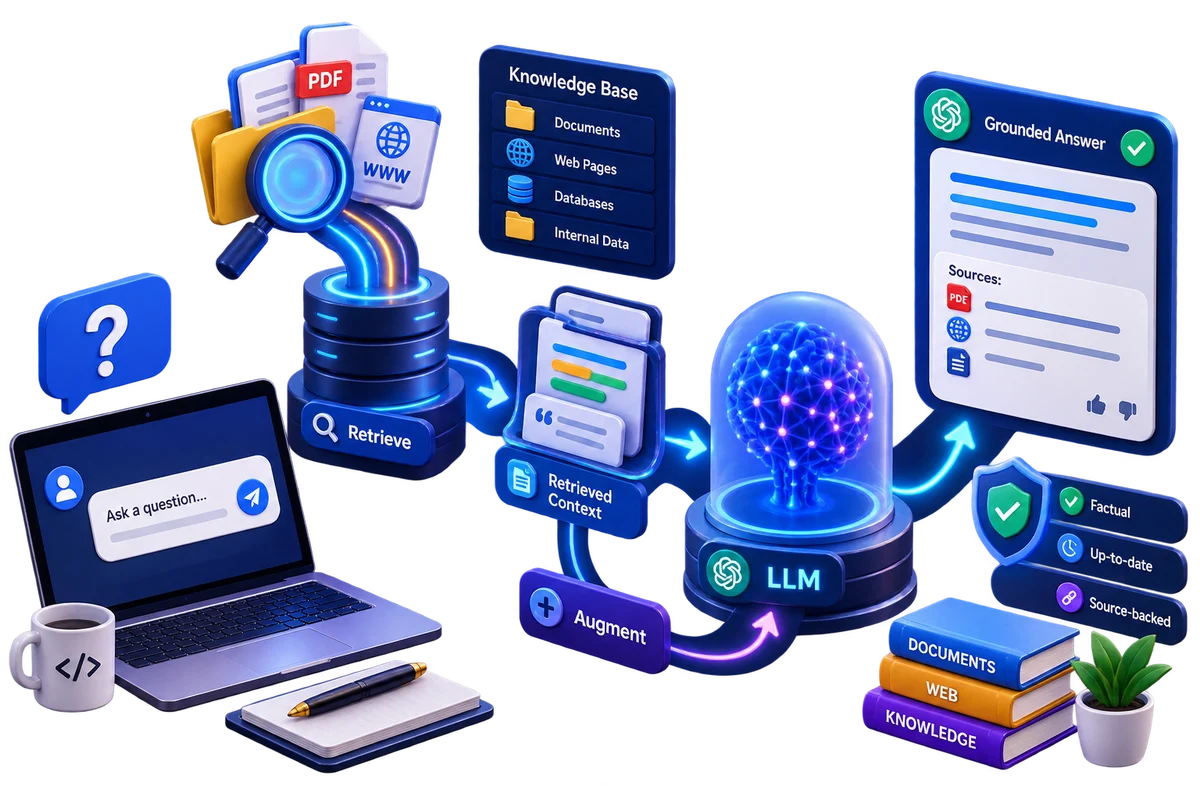
A retrieval-augmented generation flow — a question retrieving from a knowledge base, augmenting the context, and a grounded answer coming back

Admissions open

Free demo class & counselling

Batch slots

  • Weekday
  • Evening
  • Weekend
Talk to a counsellor

Course overview

The RAG course in Ludhiana that is really a course in retrieval quality

The RAG course in Ludhiana at techcadd covers Retrieval-Augmented Generation end to end — chunking, embeddings, vector databases, hybrid search, reranking, citations, refusal behaviour and evaluation — because a grounded assistant is only ever as good as what it retrieves.

Retrieval-Augmented Generation is the most requested AI feature in business right now: point a model at your own documents so it answers from them instead of inventing something. Building one that demos well takes an afternoon. Building one an organisation can rely on is a different job, and it is almost entirely a retrieval problem rather than a model problem.

So that is where this course lives. You will work through chunking strategies and why the obvious one fails on tables and contracts, embedding choice, hybrid keyword-plus-vector search, reranking, metadata filtering, citation handling, and a refusal path for when the corpus genuinely has no answer. Then you measure it — recall, MRR and faithfulness on your own document set — because "it seems better" is not a finding.

Prerequisite is Python plus some experience calling an LLM API. This is the natural next course after Generative AI, and students often take the two back to back.
  • Retrieval quality measured, not assumed
  • Citations and refusal paths built in
  • Cost and latency budgeted per query

Curriculum

A path from first steps to shipped work

4 modules and 23 topics across 6–8 weeks, in the order they are taught. Each one closes with something that works before the next one opens.

4 learning modules01 / 04
Module 01 · Week 1

Why RAG, and When Not To

The failure mode RAG solves, and the cases where fine-tuning or plain prompting is the better answer.

Topics covered

  • Hallucination causes
  • RAG vs fine-tuning
  • Architecture overview
  • Cost trade-offs
  • Scoping a corpus

Tools & libraries

  • Python
  • Claude API

You finish with

A written architecture decision for a real use case, with the alternatives ruled out.

Module 02 · Weeks 2–3

Ingestion, Chunking & Embeddings

The unglamorous half that determines whether retrieval works at all.

Topics covered

  • Document parsing
  • Chunking strategies
  • Metadata design
  • Embedding models
  • Batch indexing
  • Incremental updates

Tools & libraries

  • LlamaIndex
  • Unstructured
  • sentence-transformers

You finish with

An ingestion pipeline handling PDFs, HTML and spreadsheets into a searchable index.

Module 03 · Weeks 4–5

Vector Search & Reranking

Dense search, keyword search, hybrid retrieval and the reranking step that fixes most bad results.

Topics covered

  • Vector databases
  • Similarity metrics
  • Hybrid BM25 + dense
  • Cross-encoder reranking
  • Filtering by metadata
  • Query rewriting

Tools & libraries

  • FAISS
  • Pinecone
  • Elasticsearch
  • Cohere Rerank

You finish with

A hybrid retriever measurably outperforming a naive vector search on your corpus.

Module 04 · Weeks 6–8

Generation, Citations & Evaluation

Answering from retrieved context, citing sources, refusing when there is nothing — and proving it works.

Topics covered

  • Context assembly
  • Citation formatting
  • Refusal handling
  • Retrieval metrics
  • Answer faithfulness
  • Latency & cost tuning

Tools & libraries

  • Claude API
  • RAGAS
  • FastAPI
  • Streamlit

You finish with

A deployed RAG service with an evaluation report covering recall, faithfulness and cost.

Where projects die

Why most RAG projects quietly fail

Every failure below is common, fixable, and covered in the syllabus. Together they are the reason this course spends more time on retrieval than on prompting.

  1. Chunking chosen by default

    Fixed 500-character splits cut tables in half, separate a clause from its heading, and strip the context that made a paragraph meaningful. Chunking strategy is a design decision per document type, not a config value.

  2. Vector search alone

    Pure embedding search misses exact identifiers — part numbers, invoice references, section numbers — precisely the things people search for. Hybrid retrieval with a keyword component fixes most of it.

  3. No reranking, so the top result is noise

    Retrieving twenty candidates and passing the first three unranked wastes the retrieval. A reranking pass is the single highest-return change in most projects.

  4. No refusal path

    An assistant that cannot say "that is not in these documents" will invent something instead, once, in front of the client. The refusal path is not a nicety; it is what makes the system trustworthy.

  5. Nobody measured anything

    Without recall, MRR and faithfulness on a real question set, every change is a guess and every review is an argument. You build the evaluation harness before you tune anything.

Fixing these five is, in practice, the job. It is also the whole interview.

Find your pace

What you can do, phase by phase

The RAG Systems syllabus in the order you meet it, and what you are able to do by the end of each stretch of it. Every row is a capability, not a topic you sat through.

Every capability in the RAG Systems syllabus, and the phase it is covered in
CapabilityFoundationsAppliedProfessional
Hallucination causesWhy RAG, and When Not ToCovered in FoundationsCovered in AppliedCovered in Professional
RAG vs fine-tuningWhy RAG, and When Not ToCovered in FoundationsCovered in AppliedCovered in Professional
Architecture overviewWhy RAG, and When Not ToCovered in FoundationsCovered in AppliedCovered in Professional
Cost trade-offsWhy RAG, and When Not ToCovered in FoundationsCovered in AppliedCovered in Professional
Scoping a corpusWhy RAG, and When Not ToCovered in FoundationsCovered in AppliedCovered in Professional
Document parsingIngestion, Chunking & EmbeddingsCovered in FoundationsCovered in AppliedCovered in Professional
Chunking strategiesIngestion, Chunking & EmbeddingsCovered in FoundationsCovered in AppliedCovered in Professional
Metadata designIngestion, Chunking & EmbeddingsCovered in FoundationsCovered in AppliedCovered in Professional
Embedding modelsIngestion, Chunking & EmbeddingsCovered in FoundationsCovered in AppliedCovered in Professional
Batch indexingIngestion, Chunking & EmbeddingsCovered in FoundationsCovered in AppliedCovered in Professional
Incremental updatesIngestion, Chunking & EmbeddingsCovered in FoundationsCovered in AppliedCovered in Professional
Vector databasesVector Search & RerankingNot yet covered in FoundationsCovered in AppliedCovered in Professional
Similarity metricsVector Search & RerankingNot yet covered in FoundationsCovered in AppliedCovered in Professional
Hybrid BM25 + denseVector Search & RerankingNot yet covered in FoundationsCovered in AppliedCovered in Professional
Cross-encoder rerankingVector Search & RerankingNot yet covered in FoundationsCovered in AppliedCovered in Professional
Filtering by metadataVector Search & RerankingNot yet covered in FoundationsCovered in AppliedCovered in Professional
Query rewritingVector Search & RerankingNot yet covered in FoundationsCovered in AppliedCovered in Professional
Context assemblyGeneration, Citations & EvaluationNot yet covered in FoundationsNot yet covered in AppliedCovered in Professional
Citation formattingGeneration, Citations & EvaluationNot yet covered in FoundationsNot yet covered in AppliedCovered in Professional
Refusal handlingGeneration, Citations & EvaluationNot yet covered in FoundationsNot yet covered in AppliedCovered in Professional
Retrieval metricsGeneration, Citations & EvaluationNot yet covered in FoundationsNot yet covered in AppliedCovered in Professional
Answer faithfulnessGeneration, Citations & EvaluationNot yet covered in FoundationsNot yet covered in AppliedCovered in Professional
Latency & cost tuningGeneration, Citations & EvaluationNot yet covered in FoundationsNot yet covered in AppliedCovered in Professional

The full programme runs 6–8 weeks. Where you finish is a question of pace rather than of syllabus — everyone covers all of it.

The case for it

The model is not the hard part. The retrieval is.

Almost every failed RAG project failed at retrieval and blamed the model. Learning to measure and fix that is the difference between a demo that impresses a manager and a system a company keeps.

3Metrics you will report onrecall, MRR and faithfulness — on your own corpus
  • You learn retrieval-augmented generation the way it is used in production, with the workflow, tooling and standards a working team expects. Nothing in the syllabus exists only to fill hours.

  • Sessions are hands-on. You do every example, break it, and fix it. Each module closes with a lab task that has to work before you move on.

  • Four shipped finished projects — the kind of work an interviewer can open, click through and question you on.

  • A structured final phase: portfolio review, profile cleanup, aptitude and role-specific practice, mock interviews and placement support.

Why this course

Why should you choose this course?

Six things we hold ourselves to for every RAG Systems batch that starts in Ludhiana.

  • 01

    Industry-focused curriculum

    Syllabus built around what retrieval-augmented generation teams actually ship — no filler modules, no theory that never reaches your hands.

  • 02

    Practical learning

    Every concept lands in the tool the same day. You work in retrieval-augmented generation during each class, not just in your notes.

  • 03

    Real-world projects

    Build with real requirements, real data and real problems — from the first task to a finished, reviewable deliverable.

  • 04

    Mentor guidance

    Trainers who work with retrieval-augmented generation daily review your work, your logic and your approach line by line.

  • 05

    Career preparation

    Resume, portfolio, aptitude rounds and interview practice built into the last phase of the course.

  • 06

    Placement support

    Interview referrals, mock rounds and continued doubt support after the course ends.

Who can join

Who this RAG Systems course is for

Six kinds of people sit in a typical batch, and none of them arrive knowing retrieval-augmented generation. Find the one that sounds like you.

  • Students after 12th

    You have finished school and want a skill that pays before a degree does. The first module assumes you have never opened retrieval-augmented generation in your life.

    No background needed
  • College students

    BCA, B.Tech, B.Sc, BBA, B.Com — any stream. You learn retrieval-augmented generation alongside your degree and finish with projects your syllabus was never going to give you.

    Weekend batches
  • Final year and fresh graduates

    You are months away from interviews and need work to show, not marks to quote. The final phase is portfolio, mock rounds and referrals.

    Placement support
  • Working professionals

    You already have a job and want retrieval-augmented generation on top of it. Evening and weekend batches exist for exactly this, and the project work is yours to schedule.

    Evening batches
  • Career switchers

    You are coming from a different field entirely — operations, teaching, accounts, sales. Every module starts from why, not from jargon.

    Start from zero
  • Freelancers and business owners

    You want to do this work yourself instead of paying for it. You leave able to build, run and judge retrieval-augmented generation work on your own terms.

    Practical only

What you actually need before day one

6–8 weeks · Classroom & online batches

  • A laptop or desktop — we help you set it up in the first session
  • A stable internet connection for the online batches
  • Python and some experience calling an LLM API. Take the Generative AI course first if either is new to you.
  • Basic English reading — the tools and their documentation are in English
  • About 6-8 hours a week outside class for practice
  • Willingness to finish the lab task before the next class

Not sure which of these you are, or whether the timing works around what you already do? That is exactly what the call is for. Ask about RAG Systems

Technology ecosystem

One discipline.
A mesh of real tools.

RAG Systems is the centre. These are the tools you use around it in a working team.

  • Local vector search
  • Managed vector database
  • Ingestion & indexing
  • Pipeline orchestration
  • Answer generation
  • RAG evaluation
  • Keyword retrieval
  • Serving the pipeline
  • FAISSLocal vector search
  • PineconeManaged vector database
  • LlamaIndexIngestion & indexing
  • LangChainPipeline orchestration
  • Claude APIAnswer generation
  • RAGASRAG evaluation
  • ElasticsearchKeyword retrieval
  • FastAPIServing the pipeline

Hands-on projects

Projects you actually ship,
not just follow along with.

Each one lands in your portfolio with the working files, the process and something a reviewer can open.

Capstone project

Enterprise Document Assistant

A grounded assistant over a thousand-document corpus: multi-format ingestion, metadata-filtered hybrid retrieval, cross-encoder reranking, cited answers, an explicit refusal path, a RAGAS evaluation report and a per-query cost budget — served behind an API.

  • Hybrid retrieval
  • Reranking
  • RAGAS
  • FastAPI
Difficulty
Advanced
Status
Deployed
View project brief

Certification

Get certified in Retrieval-Augmented Generation

A techcadd RAG certificate, an internship letter for the live-project phase, and a deployed grounded assistant with its evaluation report — a portfolio piece that answers the technical interview before it is asked.

  • Course completion certificate

    Issued in your name on completion of the RAG Systems syllabus, with a reference number an employer can verify with us.

  • Project certificate

    A separate certificate for the capstone you submit, naming the project so the work is attached to the credential.

  • Internship letter

    Students who complete the live-project phase receive an internship letter covering the duration and the work delivered.

  • Portfolio you own

    Every file, repository and deployed link stays yours — the part of the credential a reviewer can actually open.

techcadd has been training in Ludhiana since 2007. The certificate carries that record; the retrieval-augmented generation work you did carries the rest.

Course completion

This is to certify that

has successfully completed the RAG Systems programme

RAG (Retrieval-Augmented Generation) Course

Ref TC-XXXX-XXXX
Project & internship

This is to certify that

for project work delivered under supervision in Ludhiana

RAG Systems capstone

Ref TC-PRJ-XXXX

Where it takes you

Where this course takes you

The route from your first module to the roles RAG Systems opens — and the work that has to exist at each step.

  1. 01Learning
  2. 02Projects
  3. 03Portfolio
  4. 04Industry readiness
  5. 05Career opportunities
  • RAG Engineer

    Build and tune retrieval systems behind AI assistants.

  • AI Application Developer

    Ship grounded AI features on company data.

  • Search Engineer

    Own relevance across hybrid retrieval systems.

  • LLM Engineer

    Combine retrieval, prompting and serving into one product.

  • Knowledge Systems Specialist

    Make an organisation's documents genuinely searchable.

  • AI Solutions Engineer

    Deliver grounded assistants for client organisations.

Salary outlook

What RAG skills pay

RAG is rarely its own job title and almost always the reason somebody got the job. These are the roles it wins.

Indicative annual packages by role and market
RoleLudhiana & PunjabDelhi NCR & BengaluruRemote & freelance
AI Application DeveloperEntry to mid₹3.2–5.8 LPA₹6–13 LPA₹40k–1.2L / project
Generative AI EngineerEntry to mid₹3.6–6.5 LPA₹7–16 LPA₹50k–1.4L / project
Search / Retrieval EngineerMid (2–4 yrs)₹6–11 LPA₹12–26 LPA₹1L–3L / project
AI Solutions ConsultantMid (3–5 yrs)₹7–12 LPA₹13–28 LPA₹1.5L–4L / project

Ranges are indicative, drawn from what our own students report and from openings we see through the placement cell. Actual offers depend on your portfolio, the interview and the company — nobody can promise you a number, and we do not.

  • Almost always part of one. You will be hired as an AI application developer or generative AI engineer, and RAG will be the thing they actually needed. Dedicated retrieval roles exist at companies with large document estates — legal, insurance, healthcare, enterprise search.

  • Retrieval quality is measurable, which makes it unusually easy to argue for. Engineers who can show a before-and-after on recall and faithfulness for a real corpus tend to move up faster than the general AI cohort.

  • Yes — this is portfolio-first work. A deployed assistant over a public document set, with an evaluation notebook beside it, is enough to win remote contracts without a local reference.

  • Locally: legal and chartered accountancy practices, hospitals and diagnostic chains, insurance and finance offices, education groups with large syllabus archives, and manufacturers with technical documentation and compliance records. Every one of those is a corpus somebody is currently searching by hand.

  • Very relevant to information-retrieval and NLP specialisations, and the evaluation work translates directly into the methodology section of a dissertation.

Future scope

The road ahead for retrieval-augmented generation

A course ends; the field does not. Here is the honest version of what the next few years look like for retrieval-augmented generation — where the roles go, and what is shifting underneath them while you learn.

  1. Year 0–1

    Get in on proof of work

    Entry roles such as RAG Engineer open as soon as you have projects that run. At this stage nobody is asking about your marks — they are asking you to walk through something you built.

  2. Year 2–4

    Specialise and get paid for it

    The generalists plateau; the specialists do not. Depth in one part of retrieval-augmented generation — the part your first job leans on hardest — is what moves you towards ai application developer work.

  3. Year 5+

    Own the decisions

    Architecture, standards, hiring and mentoring. The technical skill is assumed by now; what you are paid for is judgement, and judgement only comes from having shipped things that mattered.

Sectors hiring for this skill set

  • IT services
  • Product startups
  • Banking & fintech
  • Healthcare
  • E-commerce
  • Manufacturing
  • EdTech
  • Government & PSUs

The comparison

Why students pick techcadd for RAG Systems

Every institute in Ludhiana claims industry training and placement support. These are the differences you can actually check on a demo visit — ask any of them of anyone, including us.

techcadd compared with a typical institute, feature by feature
What to ask abouttechcaddTypical institute
Who teachesTrainers who still do retrieval-augmented generation work outside the classroomFull-time faculty teaching from a fixed deck
1-on-1 classesOne-to-one teaching available on every course — the pace is yours, and your work is looked at by nameOne group class moving at one pace, whoever that pace happens to suit
Project work5 real projects plus a capstone you deploy and defendGuided exercises copied from the board
CurriculumReviewed every batch against what working teams shipUpdated when the printed syllabus is reprinted
How a module endsA lab task that has to run before you move onNotes to revise before an exam
Doubt supportTrainer sits with your code; open lab hours between classesAsk at the end of class if there is time left
What you leave withCompletion certificate, project certificate, internship letter — all verifiableOne printed certificate
After the coursePortfolio review, mock interviews, referrals, continued doubt supportThe course ends and so does the contact

Written about the market, not about any particular institute in it. Visit two or three, sit through a demo class at each, and ask all eight of these questions — that is the only version of this table worth trusting.

Student Voices

What RAG Systems learners say

Feedback from students who completed the RAG Systems programme at techcadd Ludhiana.

Google Reviews4.8from 181 Google reviewsGoogle Verified
SK

Simranjeet Kaur

RAG Systems / B.Sc. IT graduate

I joined with no background in this. By the third month I was building retrieval-augmented generation work on my own, and the project reviews are where I actually learnt to do it properly.

Posted on Google
HS

Harman Sethi

RAG Systems / Now working as an intern in the field

The classes are practical. Every session ends with a task that has to work, so you cannot fake understanding. That habit helped me most in interviews.

Posted on Google
AV

Ankit Verma

RAG Systems / BCA final year

Doubt support was the difference for me. My trainer sat with my work, found the mistake and made me fix it myself instead of handing over the answer.

Posted on Google
NS

Navjot Singh

RAG Systems / Career switch from operations

I came for the skill and left with a portfolio — projects I could actually demo on a call, not a certificate I had to explain.

Posted on Google
SK

Simranjeet Kaur

RAG Systems / B.Sc. IT graduate

I joined with no background in this. By the third month I was building retrieval-augmented generation work on my own, and the project reviews are where I actually learnt to do it properly.

Posted on Google
HS

Harman Sethi

RAG Systems / Now working as an intern in the field

The classes are practical. Every session ends with a task that has to work, so you cannot fake understanding. That habit helped me most in interviews.

Posted on Google
AV

Ankit Verma

RAG Systems / BCA final year

Doubt support was the difference for me. My trainer sat with my work, found the mistake and made me fix it myself instead of handing over the answer.

Posted on Google
NS

Navjot Singh

RAG Systems / Career switch from operations

I came for the skill and left with a portfolio — projects I could actually demo on a call, not a certificate I had to explain.

Posted on Google
SK

Simranjeet Kaur

RAG Systems / B.Sc. IT graduate

I joined with no background in this. By the third month I was building retrieval-augmented generation work on my own, and the project reviews are where I actually learnt to do it properly.

Posted on Google
HS

Harman Sethi

RAG Systems / Now working as an intern in the field

The classes are practical. Every session ends with a task that has to work, so you cannot fake understanding. That habit helped me most in interviews.

Posted on Google
AV

Ankit Verma

RAG Systems / BCA final year

Doubt support was the difference for me. My trainer sat with my work, found the mistake and made me fix it myself instead of handing over the answer.

Posted on Google
NS

Navjot Singh

RAG Systems / Career switch from operations

I came for the skill and left with a portfolio — projects I could actually demo on a call, not a certificate I had to explain.

Posted on Google

Real, unedited feedback from techcadd learners on Google.

Frequently asked questions

Questions before you enrol

The 12 things people ask most often about the RAG Systems course at techcadd Ludhiana.

  • Python, and some experience calling an LLM API. If you have not built anything with a language model yet, take the Generative AI course first — it covers RAG at an introductory depth and makes this course land properly.

  • Generative AI covers RAG as one module among five. This course is that module taken to production depth: chunking strategy, hybrid search, reranking, metadata filtering, citation handling, refusal behaviour and a full evaluation harness on your own corpus.

  • FAISS for local work and Pinecone for managed, with LangChain and LlamaIndex for the pipeline, a reranker, RAGAS-style evaluation and FastAPI for serving. The concepts transfer to Weaviate, Qdrant, pgvector or whatever your employer already runs.

  • Yes, and we encourage it — several students build their capstone on their employer's or family business's document set, which is the fastest route from course to something that gets used. We will talk through what can and cannot be brought into a classroom setting.

  • 6–10 weeks depending on batch. It is a focused specialisation rather than a broad programme, and the final phase is given over to building and measuring one system properly.

  • The complete RAG Systems programme runs for 6–8 weeks depending on the batch you choose. Weekday, weekend and fast-track options are available, along with shorter modules for students who only need the fundamentals.

  • School students after 12th, college students from any stream, graduates and working professionals changing track. The first module assumes no prior experience.

  • Python and some experience calling an LLM API. Take the Generative AI course first if either is new to you.

  • FAISS, Pinecone, LlamaIndex, LangChain, Claude API, RAGAS, Elasticsearch and FastAPI — plus the day-to-day tooling and workflow that surrounds them in a real team.

  • Yes. Each module closes with a lab project, and the course ends with a capstone you can put on your portfolio and defend in an interview.

  • Placement support includes resume and portfolio review, aptitude and role-specific practice, mock interviews and interview referrals through our hiring network.

  • Yes. You receive a techcadd RAG Systems completion certificate, and a separate project certificate for the capstone you submit.

Next batch

Ask about the RAG course in Ludhiana

Have a document set you want an assistant over — a firm's records, a syllabus archive, a technical manual? Tell us about it and we will tell you what building it would actually involve.

  • CourseRAG (Retrieval-Augmented Generation) Course
  • Duration6–8 weeks
  • ModeClassroom & online batches
  • Centretechcadd Ludhiana

Would rather talk now? +91 98881 22667

Taken from the page you are on — this enquiry reaches the RAG Systems counsellor directly.

Loading the security check…

We never share your number. Expect a call within working hours.

Ready to get started?

Start building your career today.

Talk to a counsellor today. One call is usually enough to know which track fits your degree, your schedule and the job you want.

Call now+91 98881 22667
  • Free career counselling
  • No registration fee
  • Placement support included
Services