Programming Foundations & Modern JavaScript
The JavaScript, HTML, and CSS fundamentals every MERN tool is built on.
You finish with
A responsive, interactive JavaScript-driven web page
MERN StackMost In-Demand
The full JavaScript stack Punjab’s product teams are hiring for right now.
A 3, 6, or 9-month programme that takes you from JavaScript fundamentals to deploying production-grade MERN applications. You build a portfolio of live projects, work through mentor-reviewed code at every module, and finish with the CRUD capstone, a production-grade app, or a career-launch portfolio — depending on your plan.
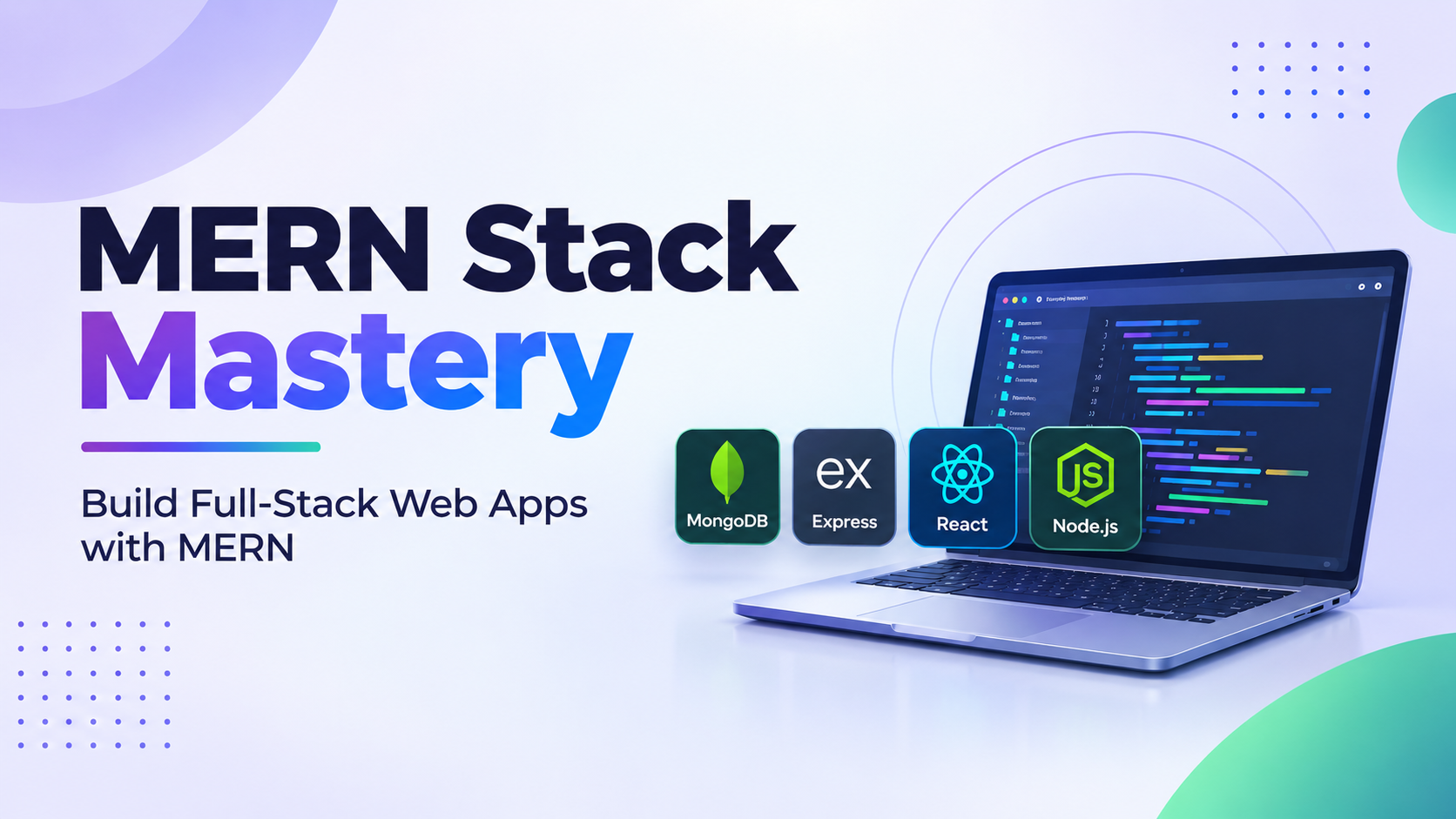
Admissions open
Free demo class & counselling
Batch slots
Course overview
This MERN Stack Development Course in Ludhiana is a 3, 6, or 9-month programme that takes you from JavaScript fundamentals to production-grade full-stack applications. The learning arc moves from foundations (JavaScript, HTML/CSS, React, Node, MongoDB) to applied work (Redux, advanced auth, Socket.io, payments, Next.js) and finally to a capstone (AI-powered features, microservices, or a career-launch portfolio). You finish with a portfolio of deployed MERN projects, a documented certificate of completion, and interview-ready proof of your work — not just a completion letter.
Curriculum
The syllabus is structured as a nested ladder. The 3-month Practitioner plan covers Modules 1–10. The 6-month Professional plan includes all ten Practitioner modules, then adds Modules 11–22. The 9-month Expert plan includes all 22 previous modules, then adds Modules 23–34. Every module ends with a deliverable you can show.
The JavaScript, HTML, and CSS fundamentals every MERN tool is built on.
You finish with
A responsive, interactive JavaScript-driven web page
How to build multi-page React applications with shared state.
You finish with
A multi-route React application
The server and database layers of the MERN stack.
You finish with
An Express API backed by a Mongoose data model
How to secure an API and wire React to Express to MongoDB.
You finish with
A fully integrated, authenticated MERN application
How to ship your work and add real-time, state-managed features.
You finish with
A deployed MERN app with a real-time feature
How to build, test, and deploy a complete production-grade application.
You finish with
A deployed, production-grade MERN application
Every module includes hands-on practice on a real application or a real deliverable, not a slide demonstration.
What you learn
The MERN Stack Development Course in Ludhiana at techcadd is designed to take you from JavaScript fundamentals to a deployed, production-grade full-stack application.
Variables, functions, ES6+, async/await, and the DOM — the base every MERN tool depends on.
JSX, state, props, useEffect, and routing, building toward application-level state.
Server-side JavaScript, middleware, routing, and building working REST endpoints.
Schema design, models, CRUD queries, and aggregation for real data workloads.
JWT, bcrypt, protected routes, and role-based access to secure your back end.
Wiring React to Express to MongoDB into a single end-to-end application.
Memoisation, code splitting, custom hooks, and predictable app-wide state.
WebSockets, rooms, and events for live-updating applications.
Checkout flows, webhooks, and external API integration.
Server-side rendering, static generation, and file-based routing.
Unit and integration tests, automated pipelines, and shipping to a live server.
LLM API integration, microservices, multi-tenant SaaS, and security hardening in the Expert plan.
Tools you’ll work with
Every module ends with a deliverable, and every plan ends with a deployed capstone — so you finish with working applications you can show, not just concepts you can repeat.
The case for it
A course is worth the time you give it only if you finish with work you can show and skills you can defend. Every Techcadd plan ends with a deployed application, a Git history, and a capstone you can walk an interviewer through — not a completion letter.
The Practitioner capstone is a deployed full MERN CRUD app; the Professional capstone is a production-grade application; the Expert capstone is a portfolio and career launch.
Mentors who still build client projects review your component architecture and API design at the end of every module.
MongoDB, Express, React, and Node are covered end to end, with Redux Toolkit, Socket.io, Next.js, and CI/CD added in the Professional plan.
A deployed application, a documented certificate of completion, and a portfolio you can defend in an interview.
Why this course
Six things we hold ourselves to for every MERN Stack Development Course in Ludhiana batch that starts in Ludhiana.
You build and deploy a full MERN CRUD application in the 3-month plan alone.
Every module deliverable is reviewed by a mentor who still works on client projects.
You build and secure REST APIs with Node, Express, and MongoDB.
You work with hooks, Redux Toolkit, and Next.js across the Professional plan.
Why TechCadd
Techcadd’s MERN programme is built around one difference: you ship a working application in every plan, not just in the final month.
Your mentors work on client projects, so they teach the current JavaScript ecosystem, not a frozen textbook.
Your architecture and code are reviewed per module, not just your attendance.
You get direct mentor access and personal debugging support, not a recorded lecture.
You finish with live, deployed MERN applications you can show in an interview.
You receive an industry-recognised certificate that validates your skills.
Who can join
This course is built for anyone starting from zero or levelling up into full-stack JavaScript, with a clear ladder to professional level.
You get a structured path from JavaScript basics to a deployed MERN CRUD app, so you have a portfolio before your first interview.
You add React, Node, and MongoDB to your current skillset on weekends, without leaving your job.
You build real MERN applications in a mentored environment, giving you the proof of work a resume alone cannot provide.
You learn to build and deploy your own web applications, from customer-facing React front ends to Node back ends and MongoDB databases.
Not sure which of these you are, or whether the timing works around what you already do? That is exactly what the call is for. Ask about MERN Stack Development Course in Ludhiana
Technology ecosystem
MERN Stack Development Course in Ludhiana is the centre. These are the tools you use around it in a working team.
Hands-on projects
Each one lands in your portfolio with the working files, the process and something a reviewer can open.
Certification
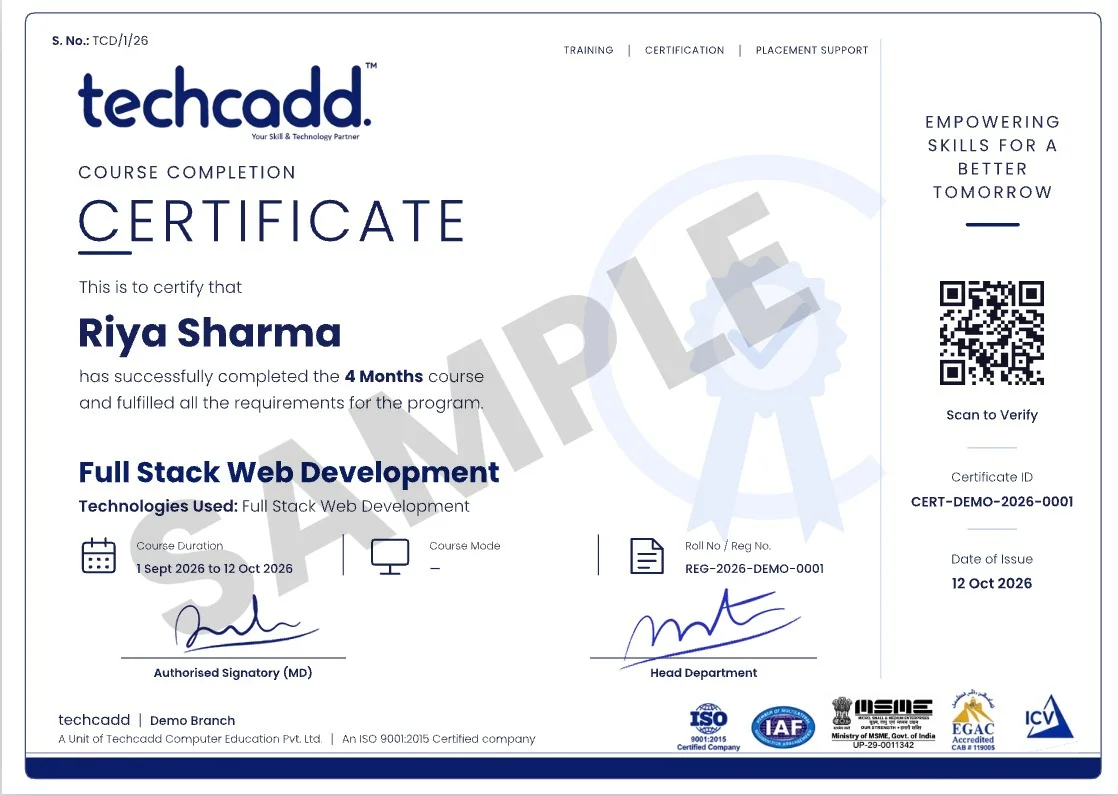
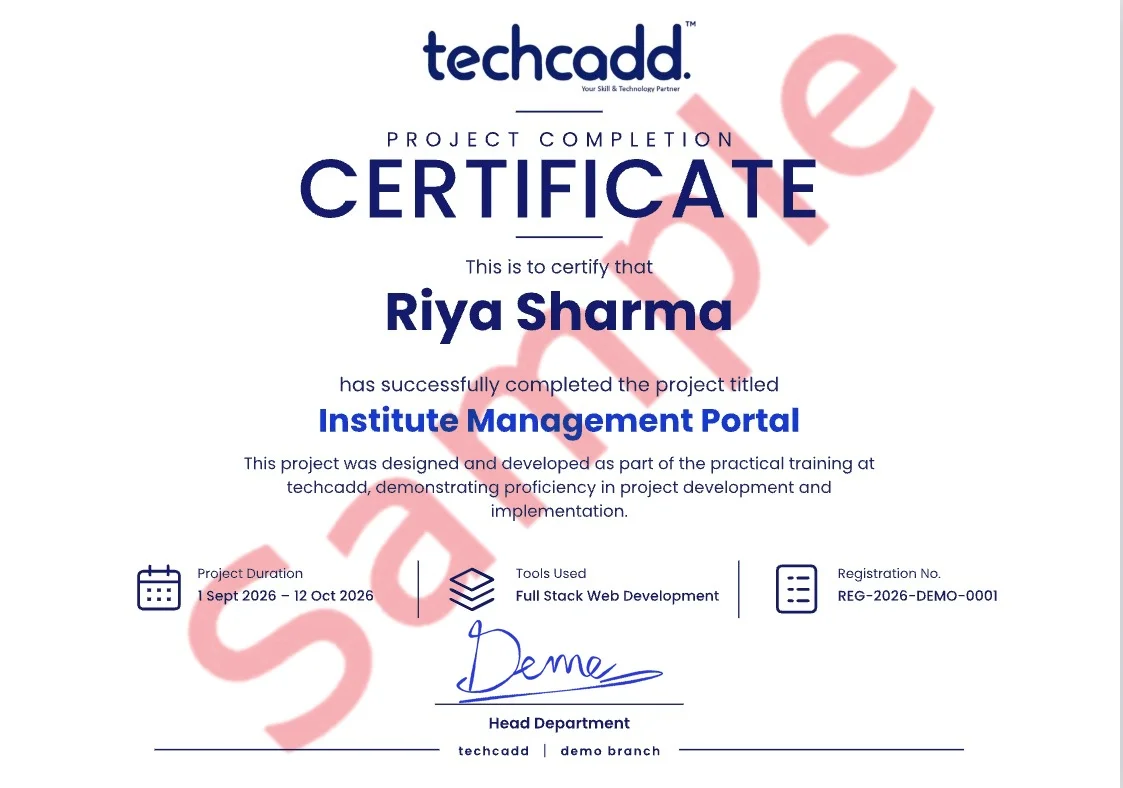
Finish the MERN Stack Development Course in Ludhiana programme at techcadd Ludhiana and you leave with more than a line on a CV — a verifiable certificate, and the project work that makes it mean something in an interview.
Issued in your name on completion of the MERN Stack Development Course in Ludhiana syllabus, with a reference number an employer can verify with us.
A separate certificate for the capstone you submit, naming the project so the work is attached to the credential.
Students who complete the live-project phase receive an internship letter covering the duration and the work delivered.
Every file, repository and deployed link stays yours — the part of the credential a reviewer can actually open.
techcadd has been training in Ludhiana since 2007. The certificate carries that record; the MERN Stack Development Course in Ludhiana work you did carries the rest.
Where it takes you
The route from your first module to the roles MERN Stack Development Course in Ludhiana opens — and the work that has to exist at each step.
Employers check your ability to build and deploy a complete MERN application, which you prove with your capstone.
Employers check your understanding of hooks, routing, and state management, which you build across Modules 3, 4, and 11–12.
Employers check your REST API and authentication skills, which you build in Modules 7, 13, and 15.
Employers check your ability to move between front end and back end in one language, which the full MERN integration module proves.
Employers check your ability to integrate LLM APIs into a web app, which you build in Module 24 of the Expert plan.
Salary outlook
Indicative ranges for the roles this course opens — what a fresher out of Ludhiana is offered, what the metro and remote markets pay for the same skills, and how that moves with two or three years of work behind you.
| Role | Ludhiana & Punjab | Delhi NCR & Bengaluru | Remote & freelance |
|---|---|---|---|
| MERN Stack DeveloperEntry | ₹2.4–4.2 LPA | ₹4–8 LPA | ₹20k–45k / project |
| Frontend Developer (React)Entry to mid | ₹3.6–6.5 LPA | ₹6.5–14 LPA | ₹35k–90k / project |
| Backend Developer (Node/Express) Entry to mid | ₹3.6–6.5 LPA | ₹6.5–14 LPA | ₹35k–90k / project |
| Full-Stack JavaScript DeveloperMid | ₹3.6–6.5 LPA | ₹6.5–14 LPA | ₹35k–90k / project |
Ranges are indicative, drawn from what our own students report and from openings we see through the placement cell. Actual offers depend on your portfolio, the interview and the company — nobody can promise you a number, and we do not.
MERN Stack Developer, Frontend Developer (React), Backend Developer (Node/Express) , Full-Stack JavaScript Developer and related positions, depending on which part of the syllabus you go deepest on.
The first jump usually comes at 18–24 months, once you have shipped work you can point to. Depth in one area moves it faster than breadth across many.
Yes, and a good number of our students do. Remote and contract work is the reason Ludhiana candidates now compete for the same briefs as metro ones — the portfolio travels, the address does not matter.
IT services, manufacturing and export units running automation, e-commerce and D2C brands, healthcare, education, and the agencies serving all of them. Punjab hiring is broader than it looks from a job board.
It helps with the practical half. The projects and tooling carry into an M.Tech, MCA or a specialisation abroad, and the portfolio is often what separates two applicants with the same marks.
Future scope
A course ends; the field does not. Here is the honest version of what the next few years look like for MERN Stack Development Course in Ludhiana — where the roles go, and what is shifting underneath them while you learn.
Entry roles such as MERN Stack Developer open as soon as you have projects that run. At this stage nobody is asking about your marks — they are asking you to walk through something you built.
The generalists plateau; the specialists do not. Depth in one part of MERN Stack Development Course in Ludhiana — the part your first job leans on hardest — is what moves you towards frontend developer (react) work.
Architecture, standards, hiring and mentoring. The technical skill is assumed by now; what you are paid for is judgement, and judgement only comes from having shipped things that mattered.
Teams expect MERN Stack Development Course in Ludhiana work to be done alongside AI tooling. It raises the floor on output and raises the bar on what counts as a junior — which is exactly why the fundamentals in this course are taught the hard way.
What used to be one narrow role now touches data, deployment and the product decision behind it. Every extra layer of MERN Stack Development Course in Ludhiana you understand is another kind of room you get invited into.
Remote and hybrid hiring means Ludhiana, Jalandhar and Chandigarh candidates now compete for the same roles as Bengaluru ones. Location has stopped being the ceiling it used to be.
Hiring has moved to portfolios, take-home tasks and live problem solving. A certificate opens a shortlist; work that runs is what gets you through the round after it.
Hiring across
The comparison
This comparison covers the core differences between Techcadd’s MERN programme and typical course offerings.
| What to ask about | techcadd | Typical institute |
|---|---|---|
| Live project work | Every module, from week one | Often only at the end, if at all |
| Mentor review | Code and architecture reviewed per module | Feedback limited to attendance or tests |
| Deployment | Every deliverable deployed to a live server | Often simulated or not covered |
| Real-time features | Socket.io covered in the Professional plan | Rarely taught |
| Batch size | Small, capped batches | Large, lecture-style groups |
| Capstone | Portfolio-grade app in every plan | Often a single demo project |
Every comparison here is about substance, not marketing language.
Student Voices
Feedback from students who completed the MERN Stack Development Course in Ludhiana programme at techcadd Ludhiana.
Simranjeet Kaur
MERN Stack Development Course in Ludhiana / B.Sc. IT graduate
I joined with no background in this. By the third month I was building MERN Stack Development Course in Ludhiana work on my own, and the project reviews are where I actually learnt to do it properly.
Harman Sethi
MERN Stack Development Course in Ludhiana / Now working as an intern in the field
The classes are practical. Every session ends with a task that has to work, so you cannot fake understanding. That habit helped me most in interviews.
Ankit Verma
MERN Stack Development Course in Ludhiana / BCA final year
Doubt support was the difference for me. My trainer sat with my work, found the mistake and made me fix it myself instead of handing over the answer.
Navjot Singh
MERN Stack Development Course in Ludhiana / Career switch from operations
I came for the skill and left with a portfolio — projects I could actually demo on a call, not a certificate I had to explain.
Real, unedited feedback from techcadd learners on Google.
Frequently asked questions
The 24 things people ask most often about the MERN Stack Development Course in Ludhiana course at techcadd Ludhiana.
MERN Stack development offers career opportunities in frontend, backend, and full-stack development. Skilled developers can work on web applications, SaaS products, e-commerce platforms, dashboards, and startup projects.
The salary of a MERN Stack developer varies based on experience, skills, location, company, and project expertise. Strong knowledge of JavaScript, React, Node.js, databases, APIs, and deployment can improve career opportunities.
Yes, you can learn MERN Stack without a computer science degree. Practical programming skills, consistent practice, project experience, and a strong portfolio are important for becoming a MERN Stack developer.
CRUD stands for Create, Read, Update, and Delete. These operations are commonly used in MERN applications to create, retrieve, modify, and remove data from a MongoDB database through backend APIs.
React handles the frontend interface, Node.js runs the server, Express.js manages backend routes and APIs, and MongoDB stores application data. These technologies communicate through APIs to create a complete web application.
A REST API allows the frontend and backend of a MERN application to communicate using HTTP methods such as GET, POST, PUT, PATCH, and DELETE. It is commonly used to exchange application data.
Authentication in MERN applications can be implemented using techniques such as JWT, sessions, cookies, password hashing, and protected routes. These methods help verify users and control access to application features.
JWT, or JSON Web Token, is commonly used to authenticate users in MERN applications. After successful login, a token can be issued and used to verify the user's identity when accessing protected resources.
React communicates with the Node.js and Express.js backend through HTTP requests to API endpoints. The backend processes the request, interacts with MongoDB when required, and sends a response back to React.
Middleware is a function that runs during the request-response cycle of an Express.js application. It can be used for authentication, logging, validation, error handling, parsing requests, and other backend tasks.
MongoDB can be connected to a Node.js application using the MongoDB driver or libraries such as Mongoose. The connection allows the backend to perform database operations such as creating, reading, updating, and deleting documents.
Mongoose is an ODM library for MongoDB and Node.js. It helps developers define schemas, validate data, create models, and perform database operations in a structured way.
State management is the process of handling and updating data that can change within a React application. React state can be managed using hooks such as useState and Context API, while larger applications may use libraries such as Redux.
React Hooks are functions that allow developers to use features such as state and lifecycle behavior in functional components. Common hooks include useState, useEffect, useContext, useRef, useMemo, and useCallback.
Git is used for version control, while GitHub provides a platform for storing and collaborating on code repositories. They help developers track changes, manage branches, collaborate with teams, and maintain project history.
A MERN application can be deployed by hosting the React frontend and Node.js backend on suitable cloud platforms and connecting them to a production MongoDB database. Environment variables and CORS settings should also be configured correctly.
Environment variables store configuration values such as database connection strings, API keys, secret tokens, and application URLs outside the source code. They help keep sensitive configuration secure and make applications easier to configure for different environments.
MERN applications can be secured by validating user input, hashing passwords, protecting API routes, using secure authentication methods, configuring CORS correctly, managing environment variables, and applying proper error handling.
Yes, MERN Stack applications can support real-time features such as chat, live notifications, online status, and real-time updates. Technologies such as Socket.IO can be integrated with Node.js and React for real-time communication.
A strong MERN portfolio should include several practical projects that demonstrate frontend, backend, database, authentication, API integration, and deployment skills. Each project should clearly explain its features, technology stack, and your contribution.
To become job-ready, practice JavaScript fundamentals, React components and hooks, REST APIs, Node.js, Express.js, MongoDB, authentication, Git, deployment, debugging, and real-world project development. Regular coding practice and project building are essential.
Yes, MERN Stack is suitable for beginners because it allows developers to use JavaScript throughout the development process. Learning HTML, CSS, JavaScript, and basic programming concepts first can make the MERN learning journey easier.
Yes. MERN Stack is specifically designed for full-stack JavaScript development, allowing developers to work on frontend interfaces, backend APIs, server-side logic, and database operations within one technology ecosystem.
MERN Stack development involves building complete web applications using JavaScript across both frontend and backend. Developers can create user interfaces, APIs, databases, authentication systems, and other web application features.
Next batch
Send this form and a counsellor calls you back about this course specifically — batch dates, fees and whether it fits what you already know.
Would rather talk now? +91 98881 22667
Ready to get started?
Talk to a counsellor today. One call is usually enough to know which track fits your degree, your schedule and the job you want.
Call now+91 98881 22667