MongoDB · Express · Angular · Node

Angular front.Node behind it.

TypeScript-first full stack development with Angular, RxJS and a Node API — the structure enterprise teams pick when a codebase has to last.

 5–6 monthsClassroom & online batchesBeginner to job ready
Explore course
4.8/5
Student rating
500+
Students trained
6+
Industry projects
Yes
Placement support
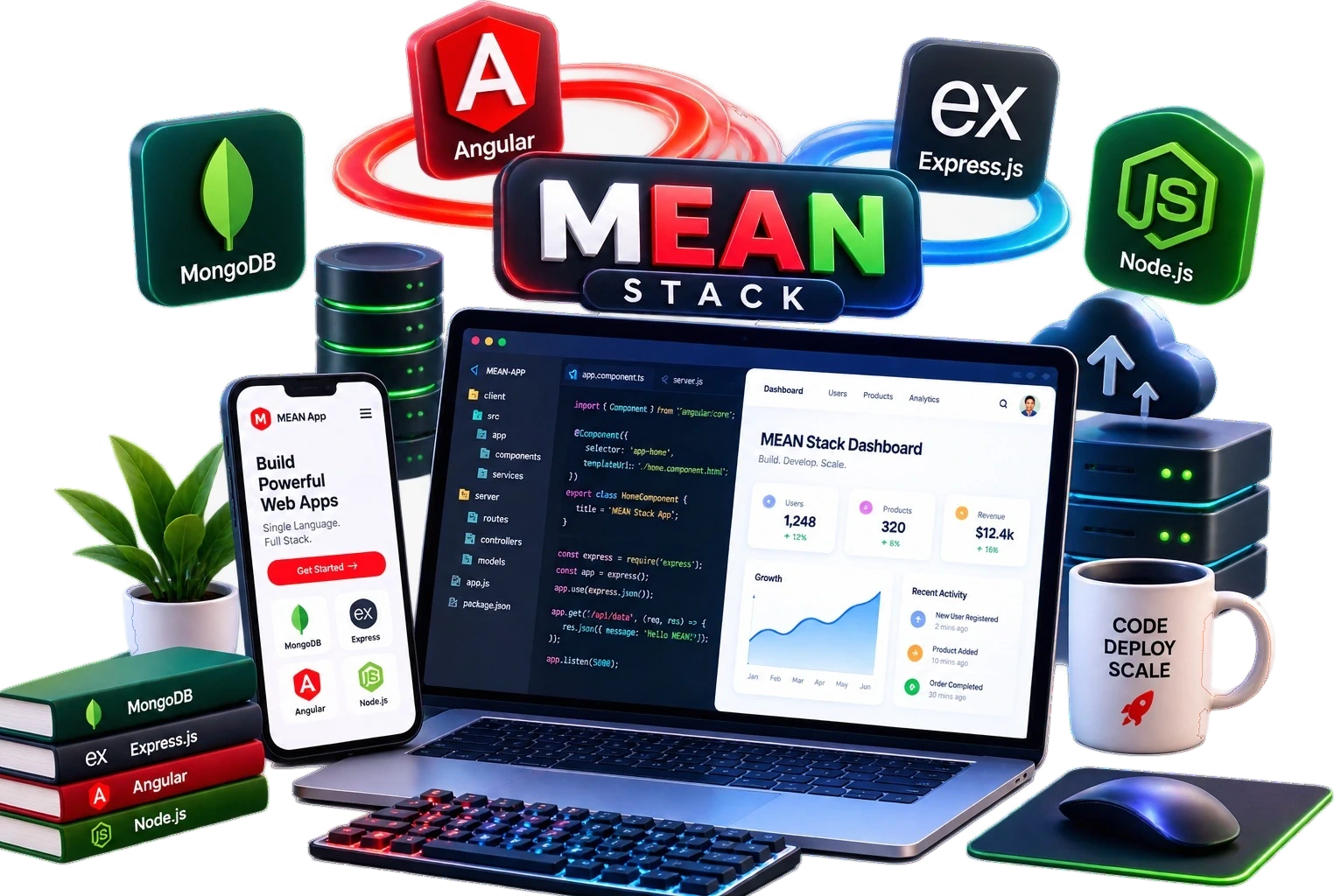
A MEAN stack workspace — an Angular interface, a Node API and the MongoDB data behind them

Admissions open

Free demo class & counselling

Batch slots

  • Weekday
  • Evening
  • Weekend
Talk to a counsellor

Course overview

The MEAN Stack course in Ludhiana that builds full-stack developers

The MEAN Stack Course in Ludhiana at techcadd is designed for students, graduates, beginners, and aspiring web developers who want to build a strong career in modern full-stack development. MEAN stands for MongoDB, Express.js, Angular and Node.js — four technologies that work together to develop dynamic, responsive, database-driven web applications.

This course focuses on practical learning rather than only theoretical concepts. Students can learn how to create front-end interfaces with Angular, develop server-side applications using Node.js and Express.js, and manage application data with MongoDB. The curriculum can also include JavaScript and TypeScript fundamentals, REST APIs, authentication, database operations, Git and GitHub, testing, deployment, and project development.

For students searching for a MEAN Stack Training in Ludhiana, a full stack development course, or Angular and Node.js training, techcadd provides a career-focused learning path aimed at developing practical coding and problem-solving skills.

Through assignments and real-world projects, learners can build portfolio-ready applications and gain confidence for internships, developer roles, freelance projects, and further technical growth.

  • TypeScript from the first file
  • Angular architecture, not just components
  • Enterprise patterns: DI, guards, interceptors

Curriculum

A path from first steps to shipped work

5 modules and 30 topics across 5–6 months, in the order they are taught. Each one closes with something that works before the next one opens.

5 learning modules01 / 05
Module 01 · Weeks 1–4

TypeScript & JavaScript Core

Types, interfaces, generics and the async model Angular depends on.

Topics covered

  • Types & interfaces
  • Generics
  • Decorators
  • Modules
  • async/await
  • Tooling

Tools & libraries

  • TypeScript
  • Node
  • npm
  • Git

You finish with

A typed utility library with strict compiler settings and no `any`.

Module 02 · Weeks 5–9

Angular Fundamentals

Components, templates, dependency injection and the Angular CLI workflow.

Topics covered

  • Components & templates
  • Data binding
  • Directives & pipes
  • Services & DI
  • Routing
  • Lifecycle hooks

Tools & libraries

  • Angular
  • Angular CLI
  • Angular Material

You finish with

A routed Angular application with shared services and a Material design layer.

Module 03 · Weeks 10–13

RxJS, Forms & State

Reactive streams, reactive forms and keeping application state predictable.

Topics covered

  • Observables & operators
  • Reactive forms
  • Guards & interceptors
  • NgRx basics
  • Lazy loading
  • Error handling

Tools & libraries

  • RxJS
  • NgRx
  • Angular Forms

You finish with

A dashboard with reactive forms, route guards and an HTTP interceptor for auth.

Module 04 · Weeks 14–18

Node, Express & MongoDB

The API tier: REST design, validation, schemas and secured access.

Topics covered

  • Express routing
  • Mongoose models
  • JWT auth
  • Validation
  • Aggregation
  • API documentation

Tools & libraries

  • Node
  • Express
  • MongoDB
  • Swagger

You finish with

A documented, secured REST API that the Angular client consumes end to end.

Module 05 · Weeks 19–22

Testing & Enterprise Delivery

Unit tests, end-to-end tests, builds and deployment for a codebase with a long life.

Topics covered

  • Jasmine & Karma
  • Cypress
  • Build optimisation
  • Environment config
  • CI pipelines
  • Deployment

Tools & libraries

  • Jasmine
  • Cypress
  • Docker
  • GitHub Actions

You finish with

A tested, containerised MEAN capstone deployed through a CI pipeline.

What you learn

What you will learn in the MEAN Stack course

The MEAN Stack Course in Ludhiana at techcadd is designed to help learners understand the complete process of modern web application development. Instead of focusing on only one part of development, students learn how the front end, back end, server, APIs, and database work together.

  1. Web Development Fundamentals

    Students begin by understanding the fundamentals required to create modern websites and applications — HTML, CSS, responsive layouts, web structure, forms, browser functionality, and basic development workflows. These provide a foundation before moving into JavaScript-based application development.

  2. JavaScript Programming

    JavaScript is an important part of MEAN Stack development because it can be used across both front-end and back-end development. Students learn variables, data types, functions, arrays, objects, loops, conditions, DOM manipulation, events, ES6+ features, asynchronous programming, promises, and error handling.

  3. TypeScript

    Students also learn TypeScript, which is widely associated with Angular development. Topics include types, interfaces, classes, functions, objects, modules, and generics. Learning TypeScript helps students write more structured and maintainable application code.

  4. Angular Development

    Angular is the front-end technology in the MEAN stack. Students learn components, templates, directives, data binding, services, routing, forms, modules, HTTP communication, API integration, and application structure. Through practical exercises, learners understand how Angular communicates with back-end services.

  5. Node.js

    Node.js enables JavaScript to run on the server side. Students learn how to create server-side applications, handle requests and responses, work with modules, manage packages, and build scalable application structures — connecting front-end knowledge with back-end development.

  6. Express.js

    Express.js is used with Node.js to simplify server and API development. Students learn routing, middleware, request handling, response handling, error management, and REST API development. By creating APIs, learners understand how front-end applications communicate with back-end systems.

  7. MongoDB

    MongoDB is the database component of the MEAN stack. Students learn how to create databases and collections, store documents, perform CRUD operations, manage queries, and connect MongoDB with Node.js applications — understanding how real applications store and retrieve data.

  8. REST APIs and Integration

    Modern web applications frequently depend on APIs for communication between the front end and back end. Students learn how to create and consume REST APIs and work with HTTP methods such as GET, POST, PUT, and DELETE, and practise connecting Angular applications with Node.js and Express.js back-end services.

  9. Authentication and Security Basics

    Students learn basic concepts related to user authentication and application security — login and registration systems, password handling, authentication tokens, authorization, protected routes, and common web security practices. These matter when developing applications that handle user accounts and private information.

  10. Git and GitHub

    Version control is an important part of modern software development. Students learn Git fundamentals — repositories, commits, branches, merging, and collaboration workflows. GitHub can be used to store and showcase projects, helping learners create a professional development portfolio.

  11. Development Tools

    The course introduces tools commonly used during web development: Visual Studio Code, npm, Git, GitHub, Postman, MongoDB tools, browser developer tools, and the Angular CLI. Learning these makes the development workflow more efficient and mirrors a modern development project.

  12. Full-Stack Projects

    Practical projects bring all the technologies together. Students work on applications combining Angular, Node.js, Express.js, and MongoDB — planning the application, designing the interface, creating APIs, connecting the database, implementing authentication, testing functionality, fixing errors, and preparing for deployment.

  13. Deployment and Application Publishing

    Students are also introduced to the basics of deploying web applications — the difference between local development and production environments, and the general process of making an application accessible online.

Tools you’ll work with

  • MongoDB
  • Express.js
  • Angular
  • Node.js
  • TypeScript
  • Angular CLI
  • REST APIs
  • VS Code
  • npm
  • Git & GitHub
  • Postman
  • Browser DevTools

By the end you can build front-end interfaces in Angular and TypeScript, write Node and Express APIs, manage MongoDB data, handle authentication, use Git and GitHub, debug your own code and ship complete full-stack projects — a foundation for roles such as Junior Web Developer, Front-End Developer, Back-End Developer, Angular Developer, Node.js Developer or Full-Stack Developer.

Find your pace

What you can do, phase by phase

The MEAN Stack syllabus in the order you meet it, and what you are able to do by the end of each stretch of it. Every row is a capability, not a topic you sat through.

Every capability in the MEAN Stack syllabus, and the phase it is covered in
CapabilityFoundationsAppliedProfessional
Types & interfacesTypeScript & JavaScript CoreCovered in FoundationsCovered in AppliedCovered in Professional
GenericsTypeScript & JavaScript CoreCovered in FoundationsCovered in AppliedCovered in Professional
DecoratorsTypeScript & JavaScript CoreCovered in FoundationsCovered in AppliedCovered in Professional
ModulesTypeScript & JavaScript CoreCovered in FoundationsCovered in AppliedCovered in Professional
async/awaitTypeScript & JavaScript CoreCovered in FoundationsCovered in AppliedCovered in Professional
ToolingTypeScript & JavaScript CoreCovered in FoundationsCovered in AppliedCovered in Professional
Components & templatesAngular FundamentalsCovered in FoundationsCovered in AppliedCovered in Professional
Data bindingAngular FundamentalsCovered in FoundationsCovered in AppliedCovered in Professional
Directives & pipesAngular FundamentalsCovered in FoundationsCovered in AppliedCovered in Professional
Services & DIAngular FundamentalsCovered in FoundationsCovered in AppliedCovered in Professional
RoutingAngular FundamentalsCovered in FoundationsCovered in AppliedCovered in Professional
Lifecycle hooksAngular FundamentalsCovered in FoundationsCovered in AppliedCovered in Professional
Observables & operatorsRxJS, Forms & StateNot yet covered in FoundationsCovered in AppliedCovered in Professional
Reactive formsRxJS, Forms & StateNot yet covered in FoundationsCovered in AppliedCovered in Professional
Guards & interceptorsRxJS, Forms & StateNot yet covered in FoundationsCovered in AppliedCovered in Professional
NgRx basicsRxJS, Forms & StateNot yet covered in FoundationsCovered in AppliedCovered in Professional
Lazy loadingRxJS, Forms & StateNot yet covered in FoundationsCovered in AppliedCovered in Professional
Error handlingRxJS, Forms & StateNot yet covered in FoundationsCovered in AppliedCovered in Professional
Express routingNode, Express & MongoDBNot yet covered in FoundationsCovered in AppliedCovered in Professional
Mongoose modelsNode, Express & MongoDBNot yet covered in FoundationsCovered in AppliedCovered in Professional
JWT authNode, Express & MongoDBNot yet covered in FoundationsCovered in AppliedCovered in Professional
ValidationNode, Express & MongoDBNot yet covered in FoundationsCovered in AppliedCovered in Professional
AggregationNode, Express & MongoDBNot yet covered in FoundationsCovered in AppliedCovered in Professional
API documentationNode, Express & MongoDBNot yet covered in FoundationsCovered in AppliedCovered in Professional
Jasmine & KarmaTesting & Enterprise DeliveryNot yet covered in FoundationsNot yet covered in AppliedCovered in Professional
CypressTesting & Enterprise DeliveryNot yet covered in FoundationsNot yet covered in AppliedCovered in Professional
Build optimisationTesting & Enterprise DeliveryNot yet covered in FoundationsNot yet covered in AppliedCovered in Professional
Environment configTesting & Enterprise DeliveryNot yet covered in FoundationsNot yet covered in AppliedCovered in Professional
CI pipelinesTesting & Enterprise DeliveryNot yet covered in FoundationsNot yet covered in AppliedCovered in Professional
DeploymentTesting & Enterprise DeliveryNot yet covered in FoundationsNot yet covered in AppliedCovered in Professional

The full programme runs 5–6 months. Where you finish is a question of pace rather than of syllabus — everyone covers all of it.

The case for it

Your months should build more than a certificate.

A course is worth the time you give it only if you finish with work you can show and skills you can defend. That is the standard this programme is designed against.

12+Practical learning areasfrom fundamentals to delivery
  • You learn the MEAN stack the way it is used in production, with the workflow, tooling and standards a working team expects. Nothing in the syllabus exists only to fill hours.

  • Sessions are hands-on. You do every example, break it, and fix it. Each module closes with a lab task that has to work before you move on.

  • Five shipped finished projects — the kind of work an interviewer can open, click through and question you on.

  • A structured final phase: portfolio review, profile cleanup, aptitude and role-specific practice, mock interviews and placement support.

Why this course

Why should you choose this course?

Six things we hold ourselves to for every MEAN Stack batch that starts in Ludhiana.

  • 01

    Industry-focused curriculum

    Syllabus built around what the MEAN stack teams actually ship — no filler modules, no theory that never reaches your hands.

  • 02

    Practical learning

    Every concept lands in the tool the same day. You work in the MEAN stack during each class, not just in your notes.

  • 03

    Real-world projects

    Build with real requirements, real data and real problems — from the first task to a finished, reviewable deliverable.

  • 04

    Mentor guidance

    Trainers who work with the MEAN stack daily review your work, your logic and your approach line by line.

  • 05

    Career preparation

    Resume, portfolio, aptitude rounds and interview practice built into the last phase of the course.

  • 06

    Placement support

    Interview referrals, mock rounds and continued doubt support after the course ends.

Eligibility

Who can do a MEAN Stack course in Ludhiana?

A MEAN Stack Course in Ludhiana at techcadd can be a suitable choice for learners who want to develop practical web development skills and build a career in the IT industry. You do not necessarily need to be an experienced programmer to begin. With the right curriculum, regular practice, and project-based learning, beginners can gradually understand each technology and progress toward full-stack development.

  • 12th-Pass Students

    Students who have completed 12th and are interested in computers, websites, applications, and coding can start learning MEAN Stack development. The course can help them understand programming fundamentals and introduce them to the technologies used for creating modern web applications, alongside their academic studies.

    Any stream
  • BCA, BSc IT and Computer Students

    Students pursuing or completing BCA, BSc IT, Computer Science, or related programs can use MEAN Stack training to strengthen their practical knowledge. Academic education often provides programming concepts, while practical training helps students understand how those concepts are applied to actual websites and applications.

    Alongside your degree
  • Graduates Looking for IT Careers

    Graduates from different educational backgrounds who want to enter the software and web development field can consider MEAN Stack training. Learning JavaScript, Angular, Node.js, Express.js, and MongoDB can help learners develop a broader understanding of both front-end and back-end development.

    Any degree
  • Beginners Interested in Web Development

    If you are completely new to full-stack development, you can start with programming fundamentals before moving into advanced concepts. A structured MEAN Stack Training in Ludhiana helps beginners learn step by step, starting with JavaScript and progressing toward application development, databases, APIs, and deployment.

    Start from zero
  • Existing Web Developers

    Developers who already understand HTML, CSS, JavaScript, or basic web development can use MEAN Stack training to expand their technical skill set. Learning Angular for front-end development and Node.js with Express.js for back-end development can help them move toward full-stack development.

    Level up
  • Job Seekers

    Job seekers who want to build a career as a web developer, front-end developer, back-end developer, or full-stack developer can benefit from practical MEAN Stack learning. Building projects during training helps learners demonstrate their skills through a portfolio when applying for internships or entry-level opportunities.

    Portfolio ready
  • Freelancers and Aspiring Entrepreneurs

    People interested in freelancing or developing websites and web applications for businesses can also learn MEAN Stack technologies. Understanding both client-side and server-side development makes it easier to work on complete web application projects rather than depending on separate developers for different components.

    Build for clients
  • Professionals Wanting to Upgrade Their Skills

    Working professionals who want to move toward modern JavaScript-based development can consider a MEAN Stack course. Learning Angular, Node.js, Express.js, and MongoDB can help them expand their development capabilities and work on more complex web applications.

    Upskilling
  • Students Interested in Full-Stack Development

    MEAN Stack is particularly relevant for learners who want to understand the complete development process. Instead of focusing only on the visual side of a website, students learn how the front end communicates with the server, how APIs process requests, and how databases store application information.

    End to end
  • Anyone Ready to Practise Coding

    The most important requirement is a willingness to learn and practise. MEAN Stack development involves coding, debugging, logical thinking, and continuous problem-solving. Students who regularly practise concepts, complete assignments, and build projects can gradually develop confidence in full-stack development.

    Willing to practise

What you actually need before day one

5–6 months · Classroom & online batches

  • A laptop or desktop — we help you set it up in the first session
  • A stable internet connection for the online batches
  • No prior coding or technical background
  • Basic English reading — the tools and their documentation are in English
  • About 6-8 hours a week outside class for practice
  • Willingness to finish the lab task before the next class

The one thing that genuinely matters is regular practice. Everything else — the stream you studied, the degree you hold, whether you have coded before — the course is built to work around. Ask about MEAN Stack

Technology ecosystem

One discipline.
A mesh of real tools.

MEAN Stack is the centre. These are the tools you use around it in a working team.

  • Application framework
  • Typed JavaScript
  • Reactive streams
  • Server runtime
  • API framework
  • Document database
  • State management
  • Containerised deploys
  • AngularApplication framework
  • TypeScriptTyped JavaScript
  • RxJSReactive streams
  • NodeServer runtime
  • ExpressAPI framework
  • MongoDBDocument database
  • NgRxState management
  • DockerContainerised deploys

Hands-on projects

Projects you actually ship,
not just follow along with.

Each one lands in your portfolio with the working files, the process and something a reviewer can open.

Capstone project

Hospital Management System

An Angular + Node system with doctor, reception and admin roles, appointment scheduling with conflict detection, patient records, billing and printable reports. Built with lazy-loaded modules, route guards, NgRx state and an end-to-end Cypress suite.

  • Angular
  • NgRx
  • Express
  • Cypress
Difficulty
Advanced
Status
Deployed
View project brief

Certification

Get certified in MEAN Stack

A verifiable techcadd certificate, an internship letter for the live-project phase, and — the part a technical interviewer actually opens — the MEAN stack projects behind it, with the code.

  • Course completion certificate

    Issued in your name on completion of the MEAN Stack syllabus, with a reference number an employer can verify with us.

  • Project certificate

    A separate certificate for the capstone you submit, naming the project so the work is attached to the credential.

  • Internship letter

    Students who complete the live-project phase receive an internship letter covering the duration and the work delivered.

  • Portfolio you own

    Every file, repository and deployed link stays yours — the part of the credential a reviewer can actually open.

techcadd has been training in Ludhiana since 2007. The certificate carries that record; the the MEAN stack work you did carries the rest.

Course completion

This is to certify that

has successfully completed the MEAN Stack programme

MEAN Stack Development Course

Ref TC-XXXX-XXXX
Project & internship

This is to certify that

for project work delivered under supervision in Ludhiana

MEAN Stack capstone

Ref TC-PRJ-XXXX

Where it takes you

Where this course takes you

The route from your first module to the roles MEAN Stack opens — and the work that has to exist at each step.

  1. 01Learning
  2. 02Projects
  3. 03Portfolio
  4. 04Industry readiness
  5. 05Career opportunities
  • MEAN Stack Developer

    Deliver features across Angular and a Node API in one team.

  • Angular Developer

    Build large, typed frontends that stay maintainable over years.

  • Node.js Developer

    Own the API and data layer of an enterprise application.

  • Enterprise Application Developer

    Work on internal systems where structure and testing matter most.

  • Frontend Architect (track)

    Grow into decisions about module structure, state and performance.

  • Full Stack TypeScript Developer

    Use one typed language across the whole product.

Salary outlook

What MEAN stack developers earn

Angular hiring is narrower than React hiring and concentrated in enterprise work — fewer openings, longer tenures, and a slightly higher floor.

Indicative annual packages by role and market
RoleLudhiana & PunjabDelhi NCR & BengaluruRemote & freelance
MEAN Stack DeveloperEntry₹2.8–5.0 LPA₹5–11 LPA₹30k–90k / project
Angular DeveloperEntry₹2.6–4.8 LPA₹4.5–10 LPA₹25k–80k / project
Node.js DeveloperEntry to mid₹3.2–6.0 LPA₹6–13 LPA₹40k–1.2L / project
Enterprise Application DeveloperMid (2–4 yrs)₹6–11 LPA₹11–23 LPA₹1L–2.8L / project

Ranges are indicative, drawn from what our own students report and from openings we see through the placement cell. Actual offers depend on your portfolio, the interview and the company — nobody can promise you a number, and we do not.

  • MERN if you want startups, agencies and the widest freelance market. MEAN if you want enterprise and services work, where Angular and TypeScript are standard and teams are larger. Counsellors will give you the same answer on the phone — neither is a wrong choice, they open different doors.

  • Predictable rather than explosive. Enterprise Angular work rewards depth in TypeScript, RxJS and testing, and pay tends to track years plus certification more closely than in startup hiring.

  • Full-time remote roles are common; short freelance briefs are rarer than with MERN, because enterprise applications are not usually contracted in pieces.

  • IT services companies across Mohali, Chandigarh and Ludhiana, ERP and internal-tools vendors serving local manufacturing, banking and insurance back offices, and the healthcare and education platforms that favour Angular for large forms and dashboards.

  • The TypeScript and architecture material is directly useful for an MCA or a software-engineering specialisation.

Why techcadd

Why choose the MEAN Stack program at techcadd?

Choosing the right training institute can make a significant difference when you are learning full-stack development. The MEAN Stack Course in Ludhiana at techcadd is designed for learners who want to move beyond basic coding and understand how modern web applications are planned, developed, tested, and deployed.

  1. Practical Learning Approach

    MEAN Stack development cannot be mastered through theory alone. Students need regular coding practice to understand how different technologies work together. The training focuses on practical exercises, coding assignments, debugging tasks, and application development — creating web interfaces, developing APIs, connecting applications with databases, handling user requests, managing application data, and building complete web applications.

  2. Learn the Complete MEAN Stack

    One major advantage of learning MEAN is that students explore both front-end and back-end development within one technology ecosystem: MongoDB for database management, Express.js for server-side application development, Angular for dynamic front-end applications, and Node.js for JavaScript-based server-side development. Understanding these together helps students see how a complete web application works rather than learning technologies in isolation.

  3. Beginner-Friendly Learning Path

    Students often hesitate to enter web development because they think programming is difficult. A structured approach makes it easier: beginners start with JavaScript fundamentals and gradually move toward TypeScript, Angular, Node.js, Express.js, MongoDB, APIs, authentication, and complete projects — understanding concepts before moving to more advanced tasks.

  4. Project-Based Development

    Instead of only completing small coding exercises, students work toward developing functional web applications. Projects help learners understand practical development challenges such as database connectivity, user authentication, API integration, responsive interfaces, form handling, data management, and application testing — and a portfolio of them gives students something concrete to demonstrate at interviews.

  5. Build Job-Oriented Technical Skills

    The objective is not simply to learn the names of different technologies but to use them to solve development problems. Students develop skills in front-end development, back-end development, database management, REST API development, JavaScript and TypeScript programming, authentication and authorization, Git and GitHub, debugging, deployment, and full-stack project development.

  6. Suitable for Ludhiana Students

    For students searching for MEAN Stack Training in Ludhiana, local classroom-based learning provides the advantage of direct interaction with trainers and fellow learners. Students can discuss coding problems, clarify concepts, receive feedback on assignments, and practise development in a structured environment.

  7. Career Guidance and Learning Support

    Starting a career in web development involves more than completing a course. Learners also need to understand how to build a portfolio, present their projects, prepare for technical interviews, and identify suitable entry-level opportunities. Career-oriented guidance helps students understand what employers generally look for and where to keep improving.

  8. Learn Through Continuous Practice

    Coding becomes easier with consistent practice. A good training program should encourage learners to write code regularly rather than simply watch demonstrations. Students use assignments and project work to reinforce concepts learned during classes, improving logical thinking, debugging ability, coding confidence, and problem-solving skills.

  9. Foundation for Further Learning

    MEAN Stack training also provides a foundation for exploring additional technologies later. Once students understand JavaScript-based full-stack development, they can continue into cloud deployment, DevOps, advanced Angular development, additional databases, testing frameworks, and other modern web technologies.

  10. Focus on Skills, Not Just Certification

    A certificate documents that a learner completed training, but practical skills are what demonstrate technical ability. The program encourages students to focus on coding, projects, problem-solving, and understanding real development workflows.

For learners searching for a MEAN Stack Course in Ludhiana, techcadd offers a structured environment where students can work toward developing practical full-stack development skills and preparing for the next stage of their IT career.

Future scope

The road ahead for the MEAN stack

A course ends; the field does not. Here is the honest version of what the next few years look like for the MEAN stack — where the roles go, and what is shifting underneath them while you learn.

  1. Year 0–1

    Get in on proof of work

    Entry roles such as MEAN Stack Developer open as soon as you have projects that run. At this stage nobody is asking about your marks — they are asking you to walk through something you built.

  2. Year 2–4

    Specialise and get paid for it

    The generalists plateau; the specialists do not. Depth in one part of the MEAN stack — the part your first job leans on hardest — is what moves you towards angular developer work.

  3. Year 5+

    Own the decisions

    Architecture, standards, hiring and mentoring. The technical skill is assumed by now; what you are paid for is judgement, and judgement only comes from having shipped things that mattered.

Sectors hiring for this skill set

  • IT services
  • Product startups
  • Banking & fintech
  • Healthcare
  • E-commerce
  • Manufacturing
  • EdTech
  • Government & PSUs

The comparison

Why students pick techcadd for MEAN Stack

Every institute in Ludhiana claims industry training and placement support. These are the differences you can actually check on a demo visit — ask any of them of anyone, including us.

techcadd compared with a typical institute, feature by feature
What to ask abouttechcaddTypical institute
Who teachesTrainers who still do the MEAN stack work outside the classroomFull-time faculty teaching from a fixed deck
1-on-1 classesOne-to-one teaching available on every course — the pace is yours, and your work is looked at by nameOne group class moving at one pace, whoever that pace happens to suit
Project work5 real projects plus a capstone you deploy and defendGuided exercises copied from the board
CurriculumReviewed every batch against what working teams shipUpdated when the printed syllabus is reprinted
How a module endsA lab task that has to run before you move onNotes to revise before an exam
Doubt supportTrainer sits with your code; open lab hours between classesAsk at the end of class if there is time left
What you leave withCompletion certificate, project certificate, internship letter — all verifiableOne printed certificate
After the coursePortfolio review, mock interviews, referrals, continued doubt supportThe course ends and so does the contact

Written about the market, not about any particular institute in it. Visit two or three, sit through a demo class at each, and ask all eight of these questions — that is the only version of this table worth trusting.

Student Voices

What MEAN Stack learners say

Feedback from students who completed the MEAN Stack programme at techcadd Ludhiana.

Google Reviews4.8from 181 Google reviewsGoogle Verified
R

Rahul

MEAN Stack / Ludhiana

I joined the MEAN Stack Course in Ludhiana to improve my web development skills. The concepts were explained step by step, and practical coding sessions helped me understand Angular, Node.js, and MongoDB better.

Posted on Google
H

Harpreet

MEAN Stack / Ludhiana

I had basic knowledge of JavaScript before joining techcadd. The MEAN Stack training helped me understand both front-end and back-end development. The project work was especially useful.

Posted on Google
S

Simran

MEAN Stack / Ludhiana

Good learning experience for beginners. I liked the practical approach and the way doubts were explained during the classes. The training gave me more confidence in full-stack development.

Posted on Google
M

Manpreet

MEAN Stack / Ludhiana

I was looking for full-stack development training in Ludhiana and joined techcadd. The course covered Angular, Node.js, Express.js, and MongoDB in a structured way. Overall, it was a useful learning experience.

Posted on Google
G

Gagandeep

MEAN Stack / Khanna

The practical assignments helped me understand how different MEAN Stack technologies work together. I also learned how to work with APIs and databases, which was new for me.

Posted on Google
J

Jaspreet

MEAN Stack / Ludhiana

I joined as a beginner and initially found coding difficult. With regular practice and trainer guidance, I gradually became more comfortable with JavaScript and Node.js. The project work helped me apply what I learned.

Posted on Google
N

Navneet

MEAN Stack / Moga

techcadd provided a good environment for learning web development. I wanted to learn something beyond basic HTML and CSS, and the MEAN Stack course helped me explore complete application development.

Posted on Google
K

Karan

MEAN Stack / Ludhiana

The course was helpful for understanding the connection between front-end, back-end, APIs, and databases. I particularly enjoyed working on practical application projects during the training.

Posted on Google
P

Priya

MEAN Stack / Ludhiana

I was searching for MEAN Stack Training in Ludhiana and decided to join techcadd. The structured classes and practical exercises made the learning process easier for me.

Posted on Google
A

Aman

MEAN Stack / Chandigarh region

Good option for students who want to start learning full-stack development. The training introduced me to Angular, Node.js, Express.js, MongoDB, Git, and project development.

Posted on Google
R

Rahul

MEAN Stack / Ludhiana

I joined the MEAN Stack Course in Ludhiana to improve my web development skills. The concepts were explained step by step, and practical coding sessions helped me understand Angular, Node.js, and MongoDB better.

Posted on Google
H

Harpreet

MEAN Stack / Ludhiana

I had basic knowledge of JavaScript before joining techcadd. The MEAN Stack training helped me understand both front-end and back-end development. The project work was especially useful.

Posted on Google
S

Simran

MEAN Stack / Ludhiana

Good learning experience for beginners. I liked the practical approach and the way doubts were explained during the classes. The training gave me more confidence in full-stack development.

Posted on Google
M

Manpreet

MEAN Stack / Ludhiana

I was looking for full-stack development training in Ludhiana and joined techcadd. The course covered Angular, Node.js, Express.js, and MongoDB in a structured way. Overall, it was a useful learning experience.

Posted on Google
G

Gagandeep

MEAN Stack / Khanna

The practical assignments helped me understand how different MEAN Stack technologies work together. I also learned how to work with APIs and databases, which was new for me.

Posted on Google
J

Jaspreet

MEAN Stack / Ludhiana

I joined as a beginner and initially found coding difficult. With regular practice and trainer guidance, I gradually became more comfortable with JavaScript and Node.js. The project work helped me apply what I learned.

Posted on Google
N

Navneet

MEAN Stack / Moga

techcadd provided a good environment for learning web development. I wanted to learn something beyond basic HTML and CSS, and the MEAN Stack course helped me explore complete application development.

Posted on Google
K

Karan

MEAN Stack / Ludhiana

The course was helpful for understanding the connection between front-end, back-end, APIs, and databases. I particularly enjoyed working on practical application projects during the training.

Posted on Google
P

Priya

MEAN Stack / Ludhiana

I was searching for MEAN Stack Training in Ludhiana and decided to join techcadd. The structured classes and practical exercises made the learning process easier for me.

Posted on Google
A

Aman

MEAN Stack / Chandigarh region

Good option for students who want to start learning full-stack development. The training introduced me to Angular, Node.js, Express.js, MongoDB, Git, and project development.

Posted on Google

Real, unedited feedback from techcadd learners on Google.

Frequently asked questions

Questions before you enrol

The 13 things people ask most often about the MEAN Stack course at techcadd Ludhiana.

  • A MEAN Stack Course in Ludhiana teaches full-stack web development using MongoDB, Express.js, Angular and Node.js. Students learn how to develop front-end interfaces, server-side applications, APIs, databases, and complete web applications.

  • The course is suitable for 12th-pass students, graduates, BCA/MCA students, beginners, job seekers, aspiring developers, freelancers, and working professionals interested in web development.

  • Yes. Beginners can start with programming and JavaScript fundamentals before progressing to Angular, Node.js, Express.js, MongoDB, APIs, and full-stack projects. Regular coding practice is important for building confidence.

  • The four core technologies are MongoDB, Express.js, Angular, and Node.js. Training may also include JavaScript, TypeScript, HTML, CSS, REST APIs, Git, GitHub, npm, Postman, and development tools.

  • Previous professional programming experience is not essential for beginners. Basic computer knowledge and a willingness to learn and practise coding can help students start the course.

  • Students can develop skills in front-end development, back-end development, database management, REST API development, Angular, Node.js, Express.js, MongoDB, Git, and full-stack project development.

  • MEAN Stack provides exposure to both front-end and back-end development. This helps learners understand how complete web applications function, including user interfaces, servers, APIs, and databases.

  • Yes. Project-based practice is an important part of full-stack development. Students work on applications that combine Angular, Node.js, Express.js, and MongoDB and use these projects to demonstrate their practical skills.

  • Depending on their skills, experience, portfolio, and employer requirements, learners can explore opportunities such as Junior Web Developer, Front-End Developer, Back-End Developer, JavaScript Developer, Angular Developer, Node.js Developer, or Full-Stack Developer.

  • Yes. techcadd offers MEAN Stack-focused training for learners looking for full-stack development education in Ludhiana. Contact the centre directly to confirm the latest batch schedule, duration, fees, and available learning mode.

  • Yes. Full-stack development skills can be useful for freelancers who want to develop websites, dashboards, APIs, business applications, and other web-based solutions. Freelancing success also depends on portfolio quality, communication, project management, and client acquisition.

  • The database, backend and server layers are the same — MongoDB, Express.js and Node.js. The difference is the front end: MEAN uses Angular with TypeScript, which is more structured and common in enterprise teams; MERN uses React, which is more common in product startups. Both lead to full-stack roles.

  • Contact techcadd to enquire about the MEAN Stack course, including eligibility, syllabus, duration, upcoming batches, fees, available modes, and the admission process.

Talk to our experts

Start your MEAN Stack development journey

Ready to learn modern web development and work toward becoming a full-stack developer? Enquire about the MEAN Stack Course in Ludhiana — MongoDB, Express.js, Angular and Node.js, taught through coding practice, assignments and practical projects.

  • CourseMEAN Stack Development Course
  • Duration5–6 months
  • ModeClassroom & online batches
  • Centretechcadd Ludhiana

Would rather talk now? +91 98881 22667

Taken from the page you are on — this enquiry reaches the MEAN Stack counsellor directly.

Loading the security check…

We never share your number. Expect a call within working hours.

Ready to get started?

Start building your career today.

Talk to a counsellor today. One call is usually enough to know which track fits your degree, your schedule and the job you want.

Call now+91 98881 22667
  • Free career counselling
  • No registration fee
  • Placement support included
Services