Core Java to Spring Boot

Master Java.Ship enterprise software.

Core Java, OOP, collections, JDBC and Spring Boot — the stack that still runs banking, insurance and enterprise systems across India.

 5–6 monthsClassroom & online batchesBeginner to job ready
Explore course
4.8/5
Student rating
500+
Students trained
6+
Industry projects
Yes
Placement support
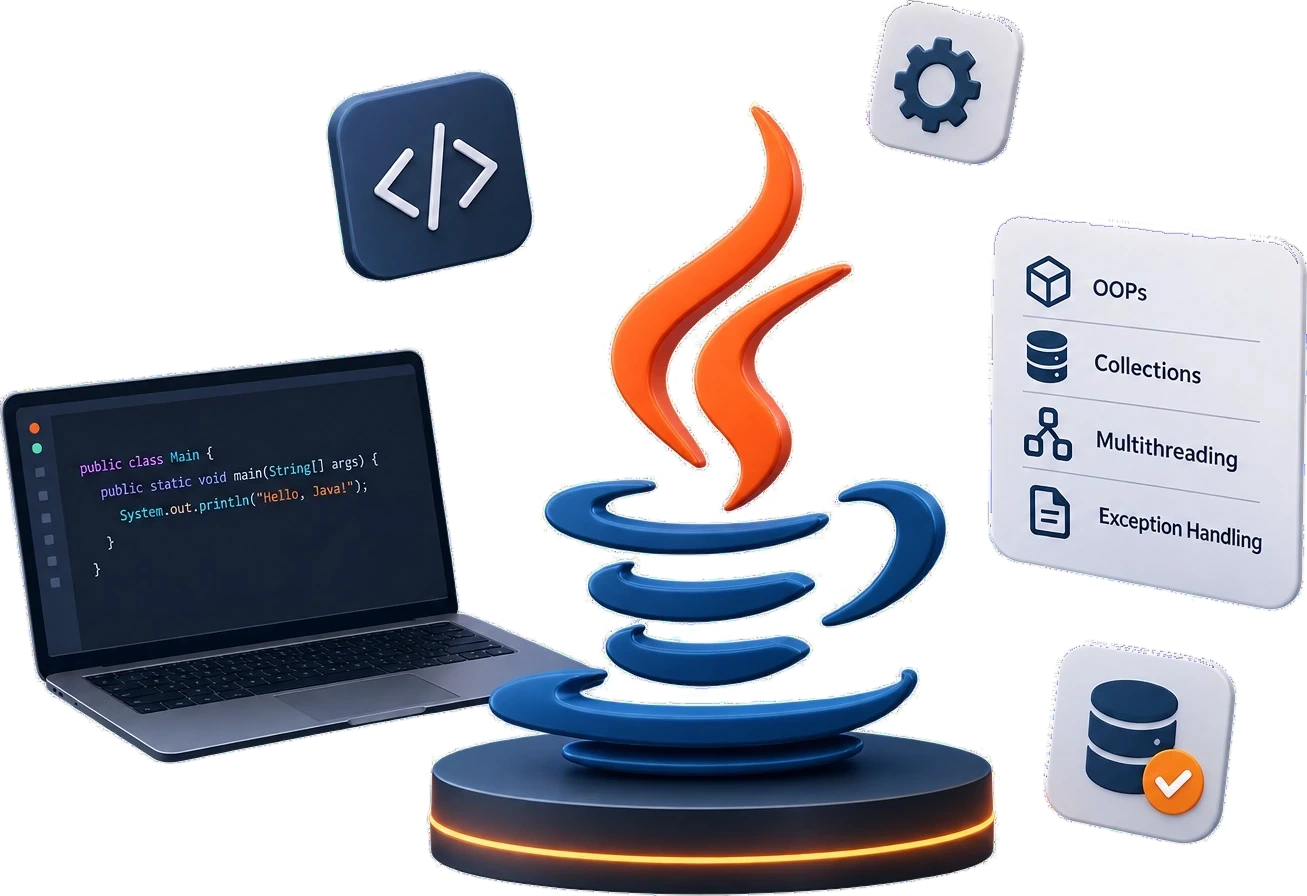
A Java development workspace — the language’s logo over an editor, a database and the enterprise tooling the course builds on

Admissions open

Free demo class & counselling

Batch slots

  • Weekday
  • Evening
  • Weekend
Talk to a counsellor

Course overview

The Java course in Ludhiana that makes you job-ready

Looking for the best Java course in Ludhiana that actually makes you job-ready? techcadd’s Java Course in Ludhiana is designed for students, graduates, and working professionals who want to learn Java through practical, industry-focused training — not just theory.

Based in Ludhiana, techcadd provides comprehensive training in Core Java, Advanced Java, OOPs, JDBC, Java frameworks, database connectivity, and the latest development practices used in the software industry.

Whether you’re a 12th-pass student starting your programming journey, a graduate preparing for a software development career, or a working professional looking to upgrade your skills, this course is designed to take you from beginner to industry-ready Java developer. With hands-on projects, experienced trainers, practical assignments, and placement support, techcadd is a trusted choice for students searching for a Java training institute in Ludhiana that focuses on real-world skills and career growth.

This course is ideal for anyone in Ludhiana, Punjab who wants to build a career in Java development, software engineering, backend development, or application development. With practical training and career-focused learning from day one, techcadd helps learners develop the technical skills and confidence needed to enter the IT industry.

  • Strong OOP foundations before any framework
  • Spring Boot REST APIs with a real database
  • DSA practice aimed at product interviews

Curriculum

A path from first steps to shipped work

5 modules and 29 topics across 5–6 months, in the order they are taught. Each one closes with something that works before the next one opens.

5 learning modules01 / 05
Module 01 · Weeks 1–4

Core Java Foundations

The JVM, syntax, types and control flow — plus how a Java project is actually compiled and run.

Topics covered

  • JVM & JDK
  • Data types
  • Operators
  • Control flow
  • Arrays
  • Methods

Tools & libraries

  • JDK 21
  • IntelliJ IDEA
  • Git

You finish with

A console banking menu that validates input and never crashes on bad data.

Module 02 · Weeks 5–8

Object-Oriented Programming

Where Java earns its reputation: classes, inheritance, interfaces and clean abstraction.

Topics covered

  • Classes & objects
  • Inheritance
  • Interfaces
  • Abstraction
  • Exception handling
  • Packages

Tools & libraries

  • JDK
  • JUnit
  • Maven

You finish with

A library system modelled with interfaces and covered by its first unit tests.

Module 03 · Weeks 9–12

Collections, Streams & JDBC

The Collections Framework, functional-style streams, and connecting Java to a real database.

Topics covered

  • List, Set, Map
  • Generics
  • Lambdas & streams
  • JDBC
  • Prepared statements
  • Multithreading basics

Tools & libraries

  • MySQL
  • JDBC
  • Maven

You finish with

A student records application backed by MySQL with proper prepared statements.

Module 04 · Weeks 13–17

Spring Boot & REST APIs

Dependency injection, controllers, JPA repositories and secured REST endpoints.

Topics covered

  • Spring Core & DI
  • Spring MVC
  • Spring Data JPA
  • Hibernate
  • REST design
  • Spring Security basics

Tools & libraries

  • Spring Boot
  • Hibernate
  • Postman
  • PostgreSQL

You finish with

A secured REST API with layered architecture, validation and API documentation.

Module 05 · Weeks 18–22

DSA & Interview Readiness

The problem-solving half of a Java interview, plus deployment of your capstone.

Topics covered

  • Time complexity
  • Arrays & strings
  • Linked lists & trees
  • Sorting & searching
  • System design basics

Tools & libraries

  • Docker
  • GitHub Actions
  • JUnit

You finish with

A deployed Spring Boot capstone and a solved problem set you can talk through.

What you learn

What you’ll learn and the tools you’ll master

techcadd’s Java course in Ludhiana is designed to take you from programming fundamentals to advanced, job-ready Java development skills. The curriculum focuses on practical coding, object-oriented programming, database connectivity, application development, and real-world projects. Here’s a detailed breakdown of what the course covers.

  1. Java Programming Fundamentals

    You’ll begin with the basics of Java programming, including variables, data types, operators, conditional statements, loops, arrays, methods, and input/output. These fundamentals create a strong foundation for understanding advanced Java development.

  2. Object-Oriented Programming (OOPs)

    A major focus of the course is Object-Oriented Programming. You’ll learn important concepts such as classes, objects, inheritance, polymorphism, abstraction, and encapsulation. These concepts are essential for developing structured and maintainable Java applications.

  3. Core Java

    You’ll develop strong knowledge of Core Java concepts, including constructors, packages, access modifiers, static and final keywords, strings, wrapper classes, and other important Java features used in professional programming.

  4. Exception Handling

    Learn how to identify, handle, and manage errors in Java applications using exception-handling techniques. You’ll work with concepts such as try-catch, finally, throw, throws, and custom exceptions to create more reliable applications.

  5. Collections Framework

    You’ll learn how to efficiently store and manage groups of objects using Java’s Collections Framework. The module covers important concepts such as List, Set, Map, ArrayList, LinkedList, HashSet, HashMap, and iterators.

  6. Multithreading

    Understand how Java handles multiple tasks at the same time through multithreading. You’ll learn about threads, thread lifecycle, synchronization, and other concepts that are useful when developing efficient applications.

  7. JDBC & Database Connectivity

    You’ll get practical training in connecting Java applications with databases using JDBC. This includes database connections, SQL queries, CRUD operations, prepared statements, and retrieving or updating data from applications.

  8. SQL & Database Basics

    Along with Java, you’ll learn essential database concepts and SQL commands required for application development. This helps you understand how Java applications store, retrieve, update, and manage data.

  9. Java GUI & Application Development

    Depending on the course structure, you’ll gain exposure to Java-based application development concepts and learn how programming components work together to create functional applications.

  10. Advanced Java Concepts

    The course introduces advanced Java development concepts that can help learners progress toward professional software development. Topics may include web application concepts, servlets, JSP, session management, and other technologies relevant to Java development.

  11. Framework & Backend Development Basics

    You’ll also get an introduction to modern Java development approaches and frameworks used for backend application development. This helps students understand how Java is applied in professional development environments.

  12. Practical Projects

    Throughout the training, you’ll work on coding assignments and real-world Java projects. These projects help you apply programming concepts, improve problem-solving abilities, and build practical experience that can be presented during interviews.

Tools you’ll work with

  • Java JDK
  • Eclipse
  • IntelliJ IDEA
  • JDBC
  • MySQL
  • SQL
  • Git
  • GitHub
  • Maven
  • Servlets & JSP
  • Spring Boot

By the end you will not just recognise Java syntax — you will have written, debugged and shipped applications of your own, which is the only thing a technical interview can actually test.

Find your pace

What you can do, phase by phase

The Java Programming syllabus in the order you meet it, and what you are able to do by the end of each stretch of it. Every row is a capability, not a topic you sat through.

Every capability in the Java Programming syllabus, and the phase it is covered in
CapabilityFoundationsAppliedProfessional
JVM & JDKCore Java FoundationsCovered in FoundationsCovered in AppliedCovered in Professional
Data typesCore Java FoundationsCovered in FoundationsCovered in AppliedCovered in Professional
OperatorsCore Java FoundationsCovered in FoundationsCovered in AppliedCovered in Professional
Control flowCore Java FoundationsCovered in FoundationsCovered in AppliedCovered in Professional
ArraysCore Java FoundationsCovered in FoundationsCovered in AppliedCovered in Professional
MethodsCore Java FoundationsCovered in FoundationsCovered in AppliedCovered in Professional
Classes & objectsObject-Oriented ProgrammingCovered in FoundationsCovered in AppliedCovered in Professional
InheritanceObject-Oriented ProgrammingCovered in FoundationsCovered in AppliedCovered in Professional
InterfacesObject-Oriented ProgrammingCovered in FoundationsCovered in AppliedCovered in Professional
AbstractionObject-Oriented ProgrammingCovered in FoundationsCovered in AppliedCovered in Professional
Exception handlingObject-Oriented ProgrammingCovered in FoundationsCovered in AppliedCovered in Professional
PackagesObject-Oriented ProgrammingCovered in FoundationsCovered in AppliedCovered in Professional
List, Set, MapCollections, Streams & JDBCNot yet covered in FoundationsCovered in AppliedCovered in Professional
GenericsCollections, Streams & JDBCNot yet covered in FoundationsCovered in AppliedCovered in Professional
Lambdas & streamsCollections, Streams & JDBCNot yet covered in FoundationsCovered in AppliedCovered in Professional
JDBCCollections, Streams & JDBCNot yet covered in FoundationsCovered in AppliedCovered in Professional
Prepared statementsCollections, Streams & JDBCNot yet covered in FoundationsCovered in AppliedCovered in Professional
Multithreading basicsCollections, Streams & JDBCNot yet covered in FoundationsCovered in AppliedCovered in Professional
Spring Core & DISpring Boot & REST APIsNot yet covered in FoundationsCovered in AppliedCovered in Professional
Spring MVCSpring Boot & REST APIsNot yet covered in FoundationsCovered in AppliedCovered in Professional
Spring Data JPASpring Boot & REST APIsNot yet covered in FoundationsCovered in AppliedCovered in Professional
HibernateSpring Boot & REST APIsNot yet covered in FoundationsCovered in AppliedCovered in Professional
REST designSpring Boot & REST APIsNot yet covered in FoundationsCovered in AppliedCovered in Professional
Spring Security basicsSpring Boot & REST APIsNot yet covered in FoundationsCovered in AppliedCovered in Professional
Time complexityDSA & Interview ReadinessNot yet covered in FoundationsNot yet covered in AppliedCovered in Professional
Arrays & stringsDSA & Interview ReadinessNot yet covered in FoundationsNot yet covered in AppliedCovered in Professional
Linked lists & treesDSA & Interview ReadinessNot yet covered in FoundationsNot yet covered in AppliedCovered in Professional
Sorting & searchingDSA & Interview ReadinessNot yet covered in FoundationsNot yet covered in AppliedCovered in Professional
System design basicsDSA & Interview ReadinessNot yet covered in FoundationsNot yet covered in AppliedCovered in Professional

The full programme runs 5–6 months. Where you finish is a question of pace rather than of syllabus — everyone covers all of it.

The case for it

Your months should build more than a certificate.

A course is worth the time you give it only if you finish with work you can show and skills you can defend. That is the standard this programme is designed against.

12+Practical learning areasfrom fundamentals to delivery
  • You learn Java the way it is used in production, with the workflow, tooling and standards a working team expects. Nothing in the syllabus exists only to fill hours.

  • Sessions are hands-on. You do every example, break it, and fix it. Each module closes with a lab task that has to work before you move on.

  • Five shipped finished projects — the kind of work an interviewer can open, click through and question you on.

  • A structured final phase: portfolio review, profile cleanup, aptitude and role-specific practice, mock interviews and placement support.

Why this course

Why should you choose this course?

Six things we hold ourselves to for every Java Programming batch that starts in Ludhiana.

  • 01

    Industry-focused curriculum

    Syllabus built around what Java teams actually ship — no filler modules, no theory that never reaches your hands.

  • 02

    Practical learning

    Every concept lands in the tool the same day. You work in Java during each class, not just in your notes.

  • 03

    Real-world projects

    Build with real requirements, real data and real problems — from the first task to a finished, reviewable deliverable.

  • 04

    Mentor guidance

    Trainers who work with Java daily review your work, your logic and your approach line by line.

  • 05

    Career preparation

    Resume, portfolio, aptitude rounds and interview practice built into the last phase of the course.

  • 06

    Placement support

    Interview referrals, mock rounds and continued doubt support after the course ends.

Eligibility

Who can do this Java course in Ludhiana

One of the biggest advantages of techcadd’s Java course in Ludhiana is that it is designed for learners from different educational backgrounds and experience levels. Whether you’re a student, graduate, job seeker, or working professional, you can learn Java from the basics and gradually develop the programming skills required for a career in the IT industry.

  • 12th Pass Students

    If you’ve recently completed 12th and want to start a career in software development, a Java course in Ludhiana after 12th can be a great starting point. You don’t need advanced programming knowledge to begin. techcadd’s training starts with programming fundamentals and gradually covers Core Java, OOPs, databases, and application development.

    No background needed
  • Graduates and Postgraduates (Any Stream)

    Students with degrees such as B.A., B.Com, B.Sc, BCA, BBA, MCA, MBA, or other qualifications can learn Java and develop practical programming skills. For graduates looking to enter the IT sector, Java training can provide a strong foundation for roles in software development, backend development, and application development.

    Any stream
  • Job Seekers and Career Switchers

    If you’re looking to move into the IT industry from another field, learning Java can help you build a new technical skill set. The course focuses on practical programming concepts, projects, database connectivity, and development techniques to help learners prepare for entry-level Java development opportunities.

    Start from zero
  • Students from Technical Backgrounds

    Students pursuing BCA, B.Tech, MCA, M.Sc IT, or other technical courses can use Java training to strengthen their programming knowledge. Practical Java projects and hands-on assignments can help students understand concepts beyond classroom theory and prepare for software development interviews.

    Beyond the syllabus
  • Working Professionals Looking to Upskill

    Working professionals who want to improve their programming knowledge or transition into software development can learn Java to expand their career opportunities. Flexible batch timings can make it easier to continue learning while managing existing professional responsibilities.

    Flexible batches
  • Aspiring Software Developers

    Anyone interested in becoming a software developer can join the course and build a strong foundation in Java. From Core Java and Object-Oriented Programming to JDBC, databases, frameworks, and real-world projects, the training is designed to develop practical skills that can be applied in professional development environments.

    Portfolio ready

What you actually need before day one

5–6 months · Classroom & online batches

  • A laptop or desktop — we help you set it up in the first session
  • A stable internet connection for the online batches
  • No prior coding or technical background
  • Basic English reading — the tools and their documentation are in English
  • About 6-8 hours a week outside class for practice
  • Willingness to finish the lab task before the next class

In short: there is no need to be an experienced programmer to start. If you’re motivated to learn coding and build a career in software development, techcadd’s Java course in Ludhiana provides a structured path from programming fundamentals to industry-oriented Java development skills. Ask about Java Programming

Technology ecosystem

One discipline.
A mesh of real tools.

Java Programming is the centre. These are the tools you use around it in a working team.

  • Application framework
  • ORM & persistence
  • Build & dependencies
  • Relational databases
  • Unit testing
  • API testing
  • Containerised deploys
  • Version control
  • Spring BootApplication framework
  • HibernateORM & persistence
  • MavenBuild & dependencies
  • MySQLRelational databases
  • JUnitUnit testing
  • PostmanAPI testing
  • DockerContainerised deploys
  • GitVersion control

Hands-on projects

Projects you actually ship,
not just follow along with.

Each one lands in your portfolio with the working files, the process and something a reviewer can open.

Capstone project

Employee Management REST API

A layered Spring Boot service with JWT authentication, role-based access, JPA entities, validation, pagination and Swagger documentation — deployed in a container. You design the schema, write the services and prove the endpoints with Postman collections.

  • Spring Boot
  • JPA
  • JWT
  • Docker
Difficulty
Advanced
Status
Portfolio ready
View project brief

Certification

Get certified in Java

A verifiable techcadd certificate, an internship letter for the live-project phase, and — the part a technical interviewer actually opens — the Java projects behind it, with the code.

  • Course completion certificate

    Issued in your name on completion of the Java Programming syllabus, with a reference number an employer can verify with us.

  • Project certificate

    A separate certificate for the capstone you submit, naming the project so the work is attached to the credential.

  • Internship letter

    Students who complete the live-project phase receive an internship letter covering the duration and the work delivered.

  • Portfolio you own

    Every file, repository and deployed link stays yours — the part of the credential a reviewer can actually open.

techcadd has been training in Ludhiana since 2007. The certificate carries that record; the Java work you did carries the rest.

Course completion

This is to certify that

has successfully completed the Java Programming programme

Java Programming Course

Ref TC-XXXX-XXXX
Project & internship

This is to certify that

for project work delivered under supervision in Ludhiana

Java Programming capstone

Ref TC-PRJ-XXXX

Where it takes you

Where this course takes you

The route from your first module to the roles Java Programming opens — and the work that has to exist at each step.

  1. 01Learning
  2. 02Projects
  3. 03Portfolio
  4. 04Industry readiness
  5. 05Career opportunities
  • Java Developer

    Write and maintain the application layer of enterprise systems in Java.

  • Backend Engineer

    Design REST services, data models and integrations that stay reliable under load.

  • Spring Boot Developer

    Build microservices with Spring Boot, JPA and secured API layers.

  • Software Engineer (Product)

    Join a product team where Java and DSA fundamentals are the entry bar.

  • Android Developer (Java)

    Move into mobile with the same language and OOP foundations.

  • QA Automation Engineer

    Automate testing with Java, Selenium and JUnit inside a delivery pipeline.

Salary outlook

What Java pays in Ludhiana and beyond

Java is the language most campus and service-company hiring still runs on, which makes it the steadiest of the programming routes rather than the flashiest.

Indicative annual packages by role and market
RoleLudhiana & PunjabDelhi NCR & BengaluruRemote & freelance
Java DeveloperEntry₹2.6–4.5 LPA₹4–9 LPA₹25k–70k / project
Spring Boot DeveloperEntry to mid₹3.2–6.0 LPA₹6–13 LPA₹40k–1.1L / project
QA Automation EngineerEntry₹2.4–4.2 LPA₹4–9 LPA₹25k–65k / project
Senior Java EngineerMid (2–4 yrs)₹6–11 LPA₹11–22 LPA₹90k–2.4L / project

Ranges are indicative, drawn from what our own students report and from openings we see through the placement cell. Actual offers depend on your portfolio, the interview and the company — nobody can promise you a number, and we do not.

  • Java developer, backend engineer, Spring Boot developer, QA automation engineer and product software engineer. Java remains the most common language in campus placement tests, which is why the course keeps a data-structures track running alongside the framework work.

  • Steadily, and it rewards staying. Java salaries start close to the market average and pass it around the three-year mark, particularly for engineers who learn Spring Boot properly rather than by copying configuration.

  • Less than JavaScript or Python — enterprise Java work tends to be employed rather than contracted. Remote full-time roles are common; short freelance briefs are not.

  • IT services firms across Ludhiana, Mohali and Chandigarh, banking and finance back-office operations, ERP vendors serving local manufacturing, and the product companies in NCR and Bengaluru that hire heavily from Punjab campuses.

  • Directly relevant to MCA and M.Tech coursework, and the data-structures half of the course is the part that carries into placement tests and competitive exams.

Why this programme

Why this program

Choosing the right Java course in Ludhiana isn’t just about learning Java syntax or memorizing programming concepts — it’s about choosing a program that prepares you for real software development, practical projects, technical interviews, and career opportunities. Here’s why techcadd’s Java program stands out for students and professionals across Ludhiana and Punjab.

  1. Practical, Not Just Theoretical

    Many institutes focus heavily on classroom theory. techcadd follows a practical learning approach where students write code, solve programming problems, complete assignments, and work on real-world projects. From Core Java to database connectivity and application development, learners get hands-on experience throughout the course.

  2. Updated, Industry-Relevant Curriculum

    Java continues to be an important programming language for software, backend, enterprise, and application development. techcadd’s curriculum covers essential concepts such as Core Java, OOPs, Exception Handling, Collections, JDBC, databases, and advanced Java development concepts, helping students build relevant and practical programming skills.

  3. Strong Programming Foundation

    A good Java developer needs more than knowledge of syntax. The program focuses on logic building, object-oriented programming, problem-solving, coding practices, and application development. Students gradually move from basic programming concepts to more advanced topics, creating a strong foundation for their IT careers.

  4. Career-Focused Structure

    Every module is designed with employability in mind. Students learn concepts that are relevant to software development roles and get opportunities to apply them through coding tasks and projects. This makes it easier to move from classroom learning to real development environments.

  5. Experienced Trainers

    techcadd’s trainers focus on explaining complex Java concepts in a simple and practical way. Through coding demonstrations, assignments, project guidance, and problem-solving exercises, students can develop a better understanding of programming and gain confidence in writing Java applications.

  6. Real-World Projects

    Practical projects are an important part of the learning process. Students get opportunities to work on Java-based projects involving programming logic, databases, and application development. These projects can help learners demonstrate their technical skills during interviews and build a professional portfolio.

  7. Placement and Career Support

    The goal of Java training is not limited to completing a course or earning a certificate. techcadd provides career-oriented support including resume guidance, interview preparation, technical interview practice, and placement assistance to help students prepare for software development opportunities.

  8. Affordable and Accessible Learning in Ludhiana

    Students and professionals in Ludhiana can learn Java through structured classroom training without having to relocate to a major IT city. This makes it easier for local learners to develop professional programming skills while keeping their education convenient and accessible.

  9. Flexible Learning for Different Students

    Whether you’re a college student preparing for placements, a graduate looking for an IT career, a beginner learning programming for the first time, or a working professional planning to upskill, techcadd’s Java training is designed to support different learning levels and career goals.

In a growing IT environment, strong programming skills can open doors to opportunities in software development, backend development, application development, and other technical roles. techcadd’s Java course in Ludhiana focuses on helping learners build those skills through structured, practical, and career-oriented training.

Why techcadd

Why choose techcadd

When choosing a Java training institute in Ludhiana, students have several options, but the quality of practical training, trainer support, projects, and career guidance can make a major difference. Here’s what sets techcadd apart for Java learners.

  1. Focus on Practical Skills

    techcadd emphasizes practical coding rather than relying only on theoretical lectures. Students regularly work with Java programs, programming exercises, database connectivity, and projects to strengthen their understanding through practice.

  2. Comprehensive Java Curriculum

    The course follows a structured learning path, beginning with programming fundamentals and moving toward Core Java, OOPs, Collections, Exception Handling, JDBC, databases, and advanced development concepts. This helps students understand how different Java concepts work together in real applications.

  3. Hands-On Project-Based Learning

    Projects give students an opportunity to apply what they learn in class. Working on practical Java applications helps learners improve their coding abilities, understand development processes, and create work that can be discussed during interviews.

  4. Experienced and Supportive Trainers

    Good programming training requires proper guidance. techcadd’s trainers help students understand difficult concepts, identify coding mistakes, solve programming problems, and improve their technical knowledge through practical examples and regular guidance.

  5. Local Presence in Ludhiana

    For students looking for a Java course in Ludhiana, learning locally offers convenience along with access to classroom training and trainer interaction. techcadd understands the needs of students and job seekers in the local IT education ecosystem and focuses on career-oriented technical training.

  6. Focus on Career Readiness

    techcadd focuses on more than course completion. Students are encouraged to develop coding confidence, practical project experience, interview skills, and a stronger technical profile so they can approach software development opportunities with better preparation.

  7. Placement Assistance and Career Guidance

    techcadd provides placement-oriented support to help learners understand available career opportunities and prepare for recruitment processes. Resume guidance, interview preparation, and career support help students take the next step after completing their Java training.

  8. Affordable Training

    Professional programming education should be accessible to students and fresh graduates. techcadd aims to provide a balance of practical training, experienced guidance, projects, and career support at an affordable cost for learners in Ludhiana.

  9. Suitable for Beginners and Experienced Learners

    Whether you’re completely new to programming or already have some coding knowledge, the structured Java program allows learners to strengthen their fundamentals and progress toward advanced concepts. This makes it suitable for students, graduates, job seekers, and working professionals.

Choosing techcadd means choosing a Java training institute in Ludhiana that focuses on practical programming, project-based learning, industry-relevant skills, and career preparation — helping learners move from learning Java to confidently applying it in real-world development scenarios.

Future scope

The road ahead for Java

A course ends; the field does not. Here is the honest version of what the next few years look like for Java — where the roles go, and what is shifting underneath them while you learn.

  1. Year 0–1

    Get in on proof of work

    Entry roles such as Java Developer open as soon as you have projects that run. At this stage nobody is asking about your marks — they are asking you to walk through something you built.

  2. Year 2–4

    Specialise and get paid for it

    The generalists plateau; the specialists do not. Depth in one part of Java — the part your first job leans on hardest — is what moves you towards backend engineer work.

  3. Year 5+

    Own the decisions

    Architecture, standards, hiring and mentoring. The technical skill is assumed by now; what you are paid for is judgement, and judgement only comes from having shipped things that mattered.

Sectors hiring for this skill set

  • IT services
  • Product startups
  • Banking & fintech
  • Healthcare
  • E-commerce
  • Manufacturing
  • EdTech
  • Government & PSUs

The comparison

Why students pick techcadd for Java Programming

Every institute in Ludhiana claims industry training and placement support. These are the differences you can actually check on a demo visit — ask any of them of anyone, including us.

techcadd compared with a typical institute, feature by feature
What to ask abouttechcaddTypical institute
Who teachesTrainers who still do Java work outside the classroomFull-time faculty teaching from a fixed deck
1-on-1 classesOne-to-one teaching available on every course — the pace is yours, and your work is looked at by nameOne group class moving at one pace, whoever that pace happens to suit
Project work5 real projects plus a capstone you deploy and defendGuided exercises copied from the board
CurriculumReviewed every batch against what working teams shipUpdated when the printed syllabus is reprinted
How a module endsA lab task that has to run before you move onNotes to revise before an exam
Doubt supportTrainer sits with your code; open lab hours between classesAsk at the end of class if there is time left
What you leave withCompletion certificate, project certificate, internship letter — all verifiableOne printed certificate
After the coursePortfolio review, mock interviews, referrals, continued doubt supportThe course ends and so does the contact

Written about the market, not about any particular institute in it. Visit two or three, sit through a demo class at each, and ask all eight of these questions — that is the only version of this table worth trusting.

Student Voices

What Java Programming learners say

Feedback from students who completed the Java Programming programme at techcadd Ludhiana.

Google Reviews4.8from 181 Google reviewsGoogle Verified
SK

Simranjeet Kaur

Java Programming / B.Sc. IT graduate

I joined with no background in this. By the third month I was building Java work on my own, and the project reviews are where I actually learnt to do it properly.

Posted on Google
HS

Harman Sethi

Java Programming / Now working as an intern in the field

The classes are practical. Every session ends with a task that has to work, so you cannot fake understanding. That habit helped me most in interviews.

Posted on Google
AV

Ankit Verma

Java Programming / BCA final year

Doubt support was the difference for me. My trainer sat with my work, found the mistake and made me fix it myself instead of handing over the answer.

Posted on Google
NS

Navjot Singh

Java Programming / Career switch from operations

I came for the skill and left with a portfolio — projects I could actually demo on a call, not a certificate I had to explain.

Posted on Google
SK

Simranjeet Kaur

Java Programming / B.Sc. IT graduate

I joined with no background in this. By the third month I was building Java work on my own, and the project reviews are where I actually learnt to do it properly.

Posted on Google
HS

Harman Sethi

Java Programming / Now working as an intern in the field

The classes are practical. Every session ends with a task that has to work, so you cannot fake understanding. That habit helped me most in interviews.

Posted on Google
AV

Ankit Verma

Java Programming / BCA final year

Doubt support was the difference for me. My trainer sat with my work, found the mistake and made me fix it myself instead of handing over the answer.

Posted on Google
NS

Navjot Singh

Java Programming / Career switch from operations

I came for the skill and left with a portfolio — projects I could actually demo on a call, not a certificate I had to explain.

Posted on Google
SK

Simranjeet Kaur

Java Programming / B.Sc. IT graduate

I joined with no background in this. By the third month I was building Java work on my own, and the project reviews are where I actually learnt to do it properly.

Posted on Google
HS

Harman Sethi

Java Programming / Now working as an intern in the field

The classes are practical. Every session ends with a task that has to work, so you cannot fake understanding. That habit helped me most in interviews.

Posted on Google
AV

Ankit Verma

Java Programming / BCA final year

Doubt support was the difference for me. My trainer sat with my work, found the mistake and made me fix it myself instead of handing over the answer.

Posted on Google
NS

Navjot Singh

Java Programming / Career switch from operations

I came for the skill and left with a portfolio — projects I could actually demo on a call, not a certificate I had to explain.

Posted on Google

Real, unedited feedback from techcadd learners on Google.

Frequently asked questions

Questions before you enrol

The 12 things people ask most often about the Java Programming course at techcadd Ludhiana.

  • techcadd’s Java course in Ludhiana is designed for students, graduates, and professionals who want practical, industry-oriented Java training with experienced trainers, hands-on projects, and career support.

  • Students, graduates, job seekers, working professionals, and beginners can join the course. Learners from BCA, B.Tech, MCA, B.Sc, and other educational backgrounds can benefit from the program.

  • The course duration may vary depending on the program level and batch schedule. Exact duration, timings, and course structure can be confirmed during enrolment or a counselling/demo session.

  • No. The course is suitable for beginners as well as learners who already have basic programming knowledge. Training starts with fundamental programming concepts and gradually moves toward advanced Java development.

  • You’ll learn Java programming fundamentals, OOPs, Core Java, Exception Handling, Collections, Multithreading, JDBC, SQL, database connectivity, advanced Java concepts, and practical application development.

  • Depending on the course structure, you’ll work with technologies and tools such as Java JDK, Eclipse or IntelliJ IDEA, JDBC, MySQL, SQL, Git/GitHub, Maven, and other relevant Java development tools.

  • Yes. techcadd provides career-oriented support such as resume guidance, interview preparation, technical interview preparation, and placement assistance to help students prepare for Java development opportunities.

  • Yes. Students can start learning Java after 12th, especially those interested in programming and software development. The course begins with basic concepts, making it suitable for learners without professional coding experience.

  • Yes. Working professionals can use Java training to strengthen their programming skills, transition toward software development, or improve their technical profile. Flexible batch options may be available depending on the schedule.

  • After developing strong Java and programming skills, learners can explore opportunities such as Java Developer, Junior Java Developer, Backend Developer, Software Developer, Application Developer, and Software Engineer, depending on their skills and experience.

  • Yes. Practical assignments and projects are an important part of the training. Students get opportunities to apply Java concepts, work with databases, solve programming problems, and develop applications.

  • Yes. Java remains an important programming language for software, backend, enterprise, and application development. Building strong Java fundamentals can provide a solid foundation for a long-term career in software development.

Talk to our experts

Start your Java development career in Ludhiana

Not sure whether Java is the right career path for you? Get guidance from techcadd’s course counsellors and understand the course structure, learning path, batches, and career opportunities before you begin your Java training in Ludhiana.

  • CourseJava Programming Course
  • Duration5–6 months
  • ModeClassroom & online batches
  • Centretechcadd Ludhiana

Would rather talk now? +91 98881 22667

Taken from the page you are on — this enquiry reaches the Java Programming counsellor directly.

Loading the security check…

We never share your number. Expect a call within working hours.

Ready to get started?

Start building your career today.

Talk to a counsellor today. One call is usually enough to know which track fits your degree, your schedule and the job you want.

Call now+91 98881 22667
  • Free career counselling
  • No registration fee
  • Placement support included
Services