Learn by designing and building websites, not just studying theory.
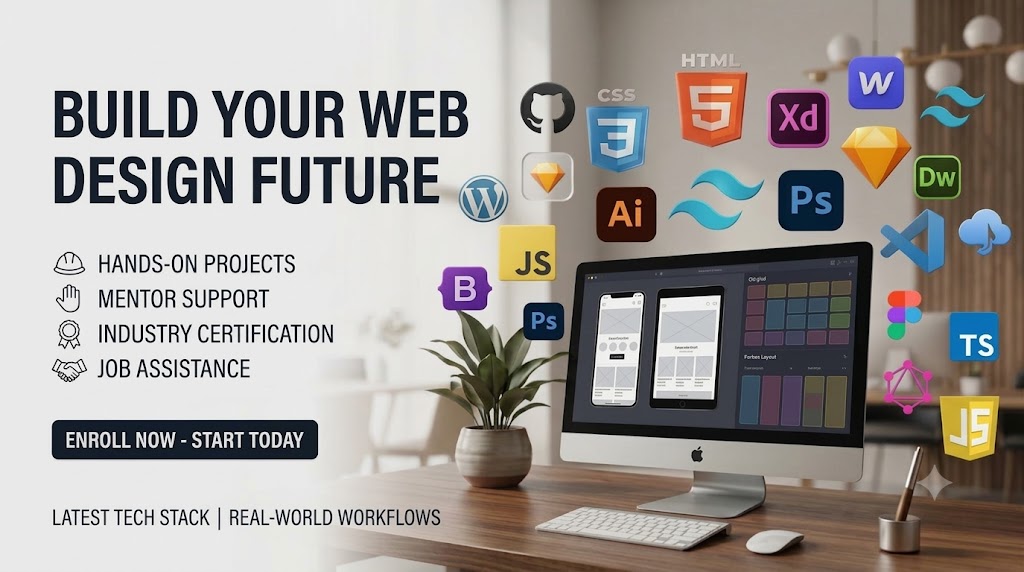
Learn to design and build responsive, interactive, and user-friendly websites using HTML5, CSS3, JavaScript, Bootstrap, Figma, Adobe XD, and WordPress with practical projects and portfolio
Web designing combines visual design, user experience, and front-end website skills to create websites that are functional, responsive, and easy to use. The skillset is useful for agencies, startups, businesses, and freelance projects.
Learn by designing and building websites, not just studying theory.
Learn to design and build responsive, interactive, and user-friendly websites using HTML5, CSS3, JavaScript, Bootstrap, Figma, Adobe XD, and WordPress with practical projects and portfolio development.
What you will learn:
• Understand web design fundamentals
• Structure websites using HTML5
• Style websites using CSS3
• Build responsive layouts for different devices
• Create interactive elements using JavaScript
• Use Bootstrap for faster responsive development
• Apply UI/UX design principles
• Create wireframes and prototypes using Figma and Adobe XD
• Build and customise WordPress websites
• Understand domains, hosting, and website deployment
• Apply basic SEO practices to websites
• Use Git and GitHub for version control
• Build a professional web design portfolio
2–3 Months programme
beginner
offline
Curriculum
A path from first steps to shipped work
Comprehensive practical web designing curriculum covering UI/UX, front-end code, CMS and deployment.
13 learning modules01 / 13
Module 01 · Module 1
Module 1: Web Design Fundamentals
Understand how websites work and learn the foundations of UI and UX.
Topics covered
How websites work
Front-end vs back-end
Web design fundamentals
User interface basics
User experience basics
UI/UX design principles
Module 02 · Module 2
Module 2: HTML5 – Structuring Web Pages
Learn how to structure modern web pages using HTML5.
Topics covered
HTML5 fundamentals
Semantic tags
Forms
Tables
Multimedia embedding
HTML structure
Accessibility basics
Module 03 · Module 3
Module 3: CSS3 – Styling & Layout
Transform structured HTML pages into visually organised website interfaces.
Topics covered
CSS3 fundamentals
Colors
Typography
Spacing
Positioning
Flexbox
CSS Grid
Animations
Transitions
Module 04 · Module 4
Module 4: Responsive Web Design
Create websites that adapt to desktops, tablets, and smartphones.
Topics covered
Responsive design
Media queries
Mobile-first design
Responsive layouts
Desktop layouts
Tablet layouts
Mobile layouts
Module 05 · Module 5
Module 5: JavaScript Basics
Add interaction and dynamic behaviour to websites using JavaScript.
Topics covered
JavaScript fundamentals
Variables
Functions
DOM manipulation
Event handling
Interactive elements
Forms
Sliders
Dynamic content
Module 06 · Module 6
Module 6: Bootstrap Framework
Use Bootstrap's responsive grid and components to build websites efficiently.
Topics covered
Bootstrap fundamentals
Grid system
Responsive components
Pre-built components
Responsive layouts
Bootstrap utilities
Module 07 · Module 7
Module 7: UI/UX Design Principles
Learn the visual and usability principles behind effective website interfaces.
Topics covered
Color theory
Typography
Whitespace
Visual hierarchy
User flow
Usability
Interface design
Module 08 · Module 8
Module 8: Figma & Adobe XD
Design website interfaces and prototypes before writing code.
Topics covered
Wireframes
Mockups
Interactive prototypes
Figma
Adobe XD
Design collaboration
Client presentation
Module 09 · Module 9
Module 9: WordPress – CMS Website Building
Build and customise websites using WordPress and its ecosystem.
Topics covered
WordPress fundamentals
Themes
Plugins
Page builders
Website customisation
CMS-based website building
Module 10 · Module 10
Module 10: Website Hosting & Domain Basics
Understand how websites are taken from local development to the live internet.
Topics covered
Domain basics
Web hosting
Website setup
Deployment basics
Live website publishing
Module 11 · Module 11
Module 11: Basic SEO for Web Designers
Learn foundational SEO practices that should be considered while designing websites.
Topics covered
Page speed
Heading structure
Image optimisation
Mobile-friendliness
Basic SEO principles
Module 12 · Module 12
Module 12: Git & GitHub Basics
Learn basic version-control practices for managing website projects.
Topics covered
Git fundamentals
Repositories
Commits
Push
Version control
GitHub
Project collaboration
Module 13 · Module 13
Module 13: Portfolio Building
Bring your strongest website and design work together into a professional portfolio.
Topics covered
Project selection
Website showcase
Design showcase
Portfolio presentation
Job-ready portfolio
Freelance portfolio
Every module includes practical exercises, live project tasks and portfolio deliverables.
Find your pace
What you can do, phase by phase
The Web Designing syllabus in the order you meet it, and what you are able to do by the end of each stretch of it. Every row is a capability, not a topic you sat through.
Every capability in the Web Designing syllabus, and the phase it is covered in
Capability
Foundation Plan
Professional Plan
Master Track
How websites workModule 1: Web Design Fundamentals
Covered in Foundation Plan
Covered in Professional Plan
Covered in Master Track
Front-end vs back-endModule 1: Web Design Fundamentals
Covered in Foundation Plan
Covered in Professional Plan
Covered in Master Track
Web design fundamentalsModule 1: Web Design Fundamentals
Covered in Foundation Plan
Covered in Professional Plan
Covered in Master Track
User interface basicsModule 1: Web Design Fundamentals
Covered in Foundation Plan
Covered in Professional Plan
Covered in Master Track
User experience basicsModule 1: Web Design Fundamentals
Covered in Foundation Plan
Covered in Professional Plan
Covered in Master Track
UI/UX design principlesModule 1: Web Design Fundamentals
Covered in Foundation Plan
Covered in Professional Plan
Covered in Master Track
HTML5 fundamentalsModule 2: HTML5 – Structuring Web Pages
Covered in Foundation Plan
Covered in Professional Plan
Covered in Master Track
Semantic tagsModule 2: HTML5 – Structuring Web Pages
Covered in Foundation Plan
Covered in Professional Plan
Covered in Master Track
FormsModule 2: HTML5 – Structuring Web Pages
Covered in Foundation Plan
Covered in Professional Plan
Covered in Master Track
TablesModule 2: HTML5 – Structuring Web Pages
Covered in Foundation Plan
Covered in Professional Plan
Covered in Master Track
Multimedia embeddingModule 2: HTML5 – Structuring Web Pages
Covered in Foundation Plan
Covered in Professional Plan
Covered in Master Track
HTML structureModule 2: HTML5 – Structuring Web Pages
Covered in Foundation Plan
Covered in Professional Plan
Covered in Master Track
Accessibility basicsModule 2: HTML5 – Structuring Web Pages
Portfolio presentationModule 13: Portfolio Building
–Not yet covered in Foundation Plan
Covered in Professional Plan
Covered in Master Track
Job-ready portfolioModule 13: Portfolio Building
–Not yet covered in Foundation Plan
Covered in Professional Plan
Covered in Master Track
Freelance portfolioModule 13: Portfolio Building
–Not yet covered in Foundation Plan
Covered in Professional Plan
Covered in Master Track
The full programme runs 2–3 Months. Where you finish is a question of pace rather than of syllabus — everyone covers all of it.
The case for it
Your months should build more than a certificate.
A course is worth the time you give it only if you finish with work you can show and skills you can defend. That is the standard this programme is designed against.
12+Practical learning areasfrom fundamentals to delivery
Start with web design fundamentals, HTML5, CSS3, and the basics of UI/UX.
Build responsive layouts, add JavaScript interaction, and work with Bootstrap.
Create wireframes, mockups, and prototypes using Figma and Adobe XD.
Build WordPress websites, learn hosting and SEO basics, use Git/GitHub, and develop your portfolio.
Why this course
Why should you choose this course?
Six things we hold ourselves to for every Web Designing batch that starts in Ludhiana.
01
Structured web designing learning path
Structured web designing learning path
02
HTML5 and CSS3 fundamentals
HTML5 and CSS3 fundamentals
03
Responsive website development
Responsive website development
04
JavaScript interaction basics
JavaScript interaction basics
05
Bootstrap experience
Bootstrap experience
06
UI/UX design knowledge
UI/UX design knowledge
07
Figma and Adobe XD practice
Figma and Adobe XD practice
08
WordPress website building
WordPress website building
09
Hosting and deployment basics
Hosting and deployment basics
10
Basic SEO knowledge
Basic SEO knowledge
11
Git and GitHub fundamentals
Git and GitHub fundamentals
12
Portfolio development
Portfolio development
13
Placement and interview support
Placement and interview support
Why TechCadd
Why students choose us for this
Web designing combines visual design, user experience, and front-end website skills to create websites that are functional, responsive, and easy to use. The skillset is useful for agencies, startups, businesses, and freelance projects.
Visual Design & Frontend Integration
Web designing combines visual design, user experience, and front-end website skills to create websites that are functional, responsive, and easy to use. The skillset is useful for agencies, startups, businesses, and freelance projects.
Project-First Learning
Learn by designing and building websites, not just studying theory.
Structured web designing learning path
Structured web designing learning path
HTML5 and CSS3 fundamentals
HTML5 and CSS3 fundamentals
Responsive website development
Responsive website development
JavaScript interaction basics
JavaScript interaction basics
Who can join
Who this Web Designing course is for
No prior coding or web designing knowledge is required.
12th-pass students
No prior coding or web designing knowledge is required.
Graduates from any stream
No prior coding or web designing knowledge is required.
Job seekers
No prior coding or web designing knowledge is required.
Working professionals
No prior coding or web designing knowledge is required.
Aspiring freelancers
No prior coding or web designing knowledge is required.
Small business owners and entrepreneurs
No prior coding or web designing knowledge is required.
Students from non-IT backgrounds
No prior coding or web designing knowledge is required.
What you actually need before day one
2–3 Months · offline
A laptop or desktop — we help you set it up in the first session
A stable internet connection for the online batches
No prior coding or technical background
Basic English reading — the tools and their documentation are in English
About 6-8 hours a week outside class for practice
Willingness to finish the lab task before the next class
Not sure which of these you are, or whether the timing works around what you already do? That is exactly what the call is for. Ask about Web Designing
Technology ecosystem
One discipline. A mesh of real tools.
Web Designing is the centre. These are the tools you use around it in a working team.
Web Designingcore skill
Markup Language
Styling Language
Programming Language
CSS Framework
UI/UX Design Tool
UI/UX Prototyping
CMS Platform
Graphic Design
Browser Developer Tool
Version Control
Code Platform
HTML5Markup Language
CSS3Styling Language
JavaScriptProgramming Language
BootstrapCSS Framework
FigmaUI/UX Design Tool
Adobe XDUI/UX Prototyping
WordPressCMS Platform
CanvaGraphic Design
Chrome DevToolsBrowser Developer Tool
GitVersion Control
GitHubCode Platform
Hands-on projects
Projects you actually ship, not just follow along with.
Each one lands in your portfolio with the working files, the process and something a reviewer can open.
Certification
Get certified in Web Designing
Finish the Web Designing programme at techcadd Ludhiana and you leave with more than a line on a CV — a verifiable certificate, and the project work that makes it mean something in an interview.
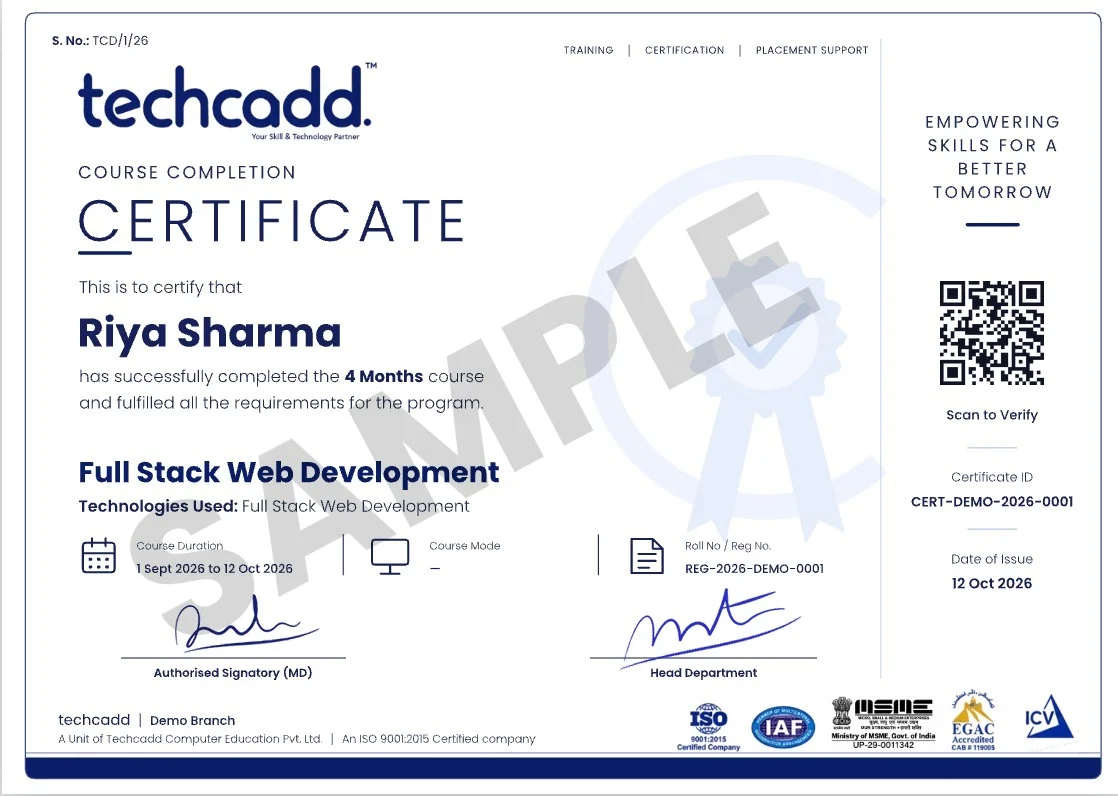
Course completion certificate
Issued in your name on completion of the Web Designing syllabus, with a reference number an employer can verify with us.
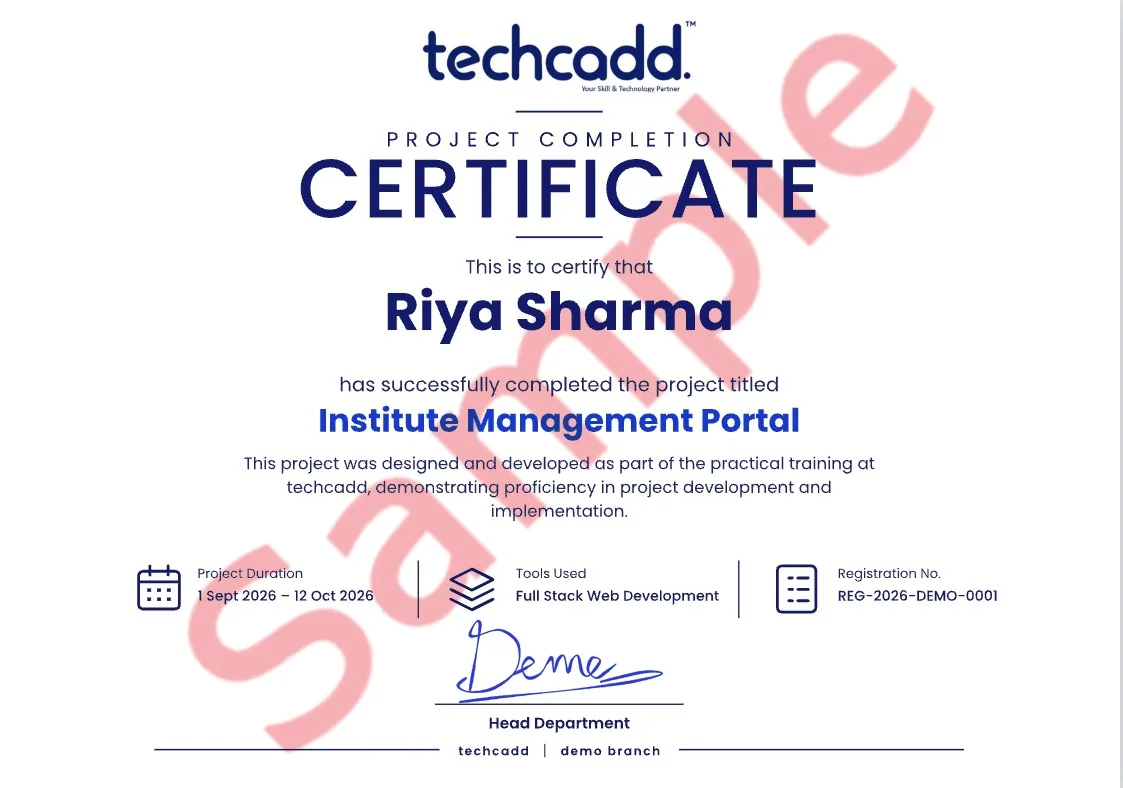
Project certificate
A separate certificate for the capstone you submit, naming the project so the work is attached to the credential.
Internship letter
Students who complete the live-project phase receive an internship letter covering the duration and the work delivered.
Portfolio you own
Every file, repository and deployed link stays yours — the part of the credential a reviewer can actually open.
techcadd has been training in Ludhiana since 2007. The certificate carries that record; the Web Designing work you did carries the rest.
Course completionProject & internship
Where it takes you
Where this course takes you
The route from your first module to the roles Web Designing opens — and the work that has to exist at each step.
01Learning
02Projects
03Portfolio
04Industry readiness
05Career opportunities
Web Designer
Design and build responsive websites using HTML, CSS, JavaScript basics, Bootstrap and UI/UX principles.
Junior Front-End Designer
Work on website interfaces using HTML5, CSS3, responsive design and basic JavaScript.
WordPress Designer
Create and customise CMS websites using WordPress themes, plugins and page builders.
UI/UX Designer
Create wireframes, mockups and prototypes while applying typography, colour, whitespace and visual hierarchy.
Freelance Web Designer
Use website, WordPress, UI/UX and portfolio skills to work on freelance website projects.
Salary outlook
What Web Designing pays, and where
Indicative ranges for the roles this course opens — what a fresher out of Ludhiana is offered, what the metro and remote markets pay for the same skills, and how that moves with two or three years of work behind you.
Indicative annual packages by role and market
Role
Ludhiana & Punjab
Delhi NCR & Bengaluru
Remote & freelance
Web Designer
—
—
Ludhiana & Punjab
Junior Front-End Designer
—
—
Ludhiana & Punjab
WordPress Designer
—
—
Ludhiana & Punjab
UI/UX Designer
—
—
Ludhiana & Punjab
Freelance Web Designer
—
—
Ludhiana & Punjab
Ranges are indicative, drawn from what our own students report and from openings we see through the placement cell. Actual offers depend on your portfolio, the interview and the company — nobody can promise you a number, and we do not.
Web Designer, Junior Front-End Designer, WordPress Designer, UI/UX Designer and related positions, depending on which part of the syllabus you go deepest on.
The first jump usually comes at 18–24 months, once you have shipped work you can point to. Depth in one area moves it faster than breadth across many.
Yes, and a good number of our students do. Remote and contract work is the reason Ludhiana candidates now compete for the same briefs as metro ones — the portfolio travels, the address does not matter.
IT services, manufacturing and export units running automation, e-commerce and D2C brands, healthcare, education, and the agencies serving all of them. Punjab hiring is broader than it looks from a job board.
It helps with the practical half. The projects and tooling carry into an M.Tech, MCA or a specialisation abroad, and the portfolio is often what separates two applicants with the same marks.
Future scope
The road ahead for Web Designing
A course ends; the field does not. Here is the honest version of what the next few years look like for Web Designing — where the roles go, and what is shifting underneath them while you learn.
Year 0–1
Get in on proof of work
Entry roles such as Web Designer open as soon as you have projects that run. At this stage nobody is asking about your marks — they are asking you to walk through something you built.
Year 2–4
Specialise and get paid for it
The generalists plateau; the specialists do not. Depth in one part of Web Designing — the part your first job leans on hardest — is what moves you towards junior front-end designer work.
Year 5+
Own the decisions
Architecture, standards, hiring and mentoring. The technical skill is assumed by now; what you are paid for is judgement, and judgement only comes from having shipped things that mattered.
AI is now part of the job
Teams expect Web Designing work to be done alongside AI tooling. It raises the floor on output and raises the bar on what counts as a junior — which is exactly why the fundamentals in this course are taught the hard way.
The scope keeps widening
What used to be one narrow role now touches data, deployment and the product decision behind it. Every extra layer of Web Designing you understand is another kind of room you get invited into.
Demand outside the metros
Remote and hybrid hiring means Ludhiana, Jalandhar and Chandigarh candidates now compete for the same roles as Bengaluru ones. Location has stopped being the ceiling it used to be.
Proof beats paper
Hiring has moved to portfolios, take-home tasks and live problem solving. A certificate opens a shortlist; work that runs is what gets you through the round after it.
Sectors hiring for this skill set
IT services
Product startups
Banking & fintech
Healthcare
E-commerce
Manufacturing
EdTech
Government & PSUs
The comparison
Why students pick techcadd for Web Designing
Comparison of TechCADD practical curriculum against standard institutes.
techcadd compared with a other institutes, feature by feature
What to ask about
techcadd
Other Institutes
Practical Projects
6+ real-world websites & design prototypes
Primarily theory and basic templates
UI/UX Tools
Figma & Adobe XD with interactive prototyping
Basic image editors or excluded
CMS Mastery
Complete WordPress theme & page builder training
Often restricted to static HTML
Responsive Design
Mobile-first Flexbox, Grid and Bootstrap
Basic CSS styling only
Deployment & Hosting
Live hosting, domains, SEO and GitHub workflow
Local file preview only
Portfolio Support
Dedicated job-ready portfolio compilation
No portfolio guidance
Every comparison here is about curriculum substance and practical workflows.
Student Voices
WhatWebDesigninglearnerssay
Feedback from students who completed the Web Designing programme at techcadd Ludhiana.
I joined with no background in this. By the third month I was building Web Designing work on my own, and the project reviews are where I actually learnt to do it properly.
HS
Harman Sethi
Web Designing / Now working as an intern in the field
The classes are practical. Every session ends with a task that has to work, so you cannot fake understanding. That habit helped me most in interviews.
AV
Ankit Verma
Web Designing / BCA final year
Doubt support was the difference for me. My trainer sat with my work, found the mistake and made me fix it myself instead of handing over the answer.
SK
Simranjeet Kaur
Web Designing / B.Sc. IT graduate
I joined with no background in this. By the third month I was building Web Designing work on my own, and the project reviews are where I actually learnt to do it properly.
HS
Harman Sethi
Web Designing / Now working as an intern in the field
The classes are practical. Every session ends with a task that has to work, so you cannot fake understanding. That habit helped me most in interviews.
AV
Ankit Verma
Web Designing / BCA final year
Doubt support was the difference for me. My trainer sat with my work, found the mistake and made me fix it myself instead of handing over the answer.
NS
Navjot Singh
Web Designing / Career switch from operations
I came for the skill and left with a portfolio — projects I could actually demo on a call, not a certificate I had to explain.
SK
Simranjeet Kaur
Web Designing / B.Sc. IT graduate
I joined with no background in this. By the third month I was building Web Designing work on my own, and the project reviews are where I actually learnt to do it properly.
HS
Harman Sethi
Web Designing / Now working as an intern in the field
The classes are practical. Every session ends with a task that has to work, so you cannot fake understanding. That habit helped me most in interviews.
NS
Navjot Singh
Web Designing / Career switch from operations
I came for the skill and left with a portfolio — projects I could actually demo on a call, not a certificate I had to explain.
SK
Simranjeet Kaur
Web Designing / B.Sc. IT graduate
I joined with no background in this. By the third month I was building Web Designing work on my own, and the project reviews are where I actually learnt to do it properly.
HS
Harman Sethi
Web Designing / Now working as an intern in the field
The classes are practical. Every session ends with a task that has to work, so you cannot fake understanding. That habit helped me most in interviews.
AV
Ankit Verma
Web Designing / BCA final year
Doubt support was the difference for me. My trainer sat with my work, found the mistake and made me fix it myself instead of handing over the answer.
NS
Navjot Singh
Web Designing / Career switch from operations
I came for the skill and left with a portfolio — projects I could actually demo on a call, not a certificate I had to explain.
SK
Simranjeet Kaur
Web Designing / B.Sc. IT graduate
I joined with no background in this. By the third month I was building Web Designing work on my own, and the project reviews are where I actually learnt to do it properly.
AV
Ankit Verma
Web Designing / BCA final year
Doubt support was the difference for me. My trainer sat with my work, found the mistake and made me fix it myself instead of handing over the answer.
NS
Navjot Singh
Web Designing / Career switch from operations
I came for the skill and left with a portfolio — projects I could actually demo on a call, not a certificate I had to explain.
SK
Simranjeet Kaur
Web Designing / B.Sc. IT graduate
I joined with no background in this. By the third month I was building Web Designing work on my own, and the project reviews are where I actually learnt to do it properly.
HS
Harman Sethi
Web Designing / Now working as an intern in the field
The classes are practical. Every session ends with a task that has to work, so you cannot fake understanding. That habit helped me most in interviews.
AV
Ankit Verma
Web Designing / BCA final year
Doubt support was the difference for me. My trainer sat with my work, found the mistake and made me fix it myself instead of handing over the answer.
NS
Navjot Singh
Web Designing / Career switch from operations
I came for the skill and left with a portfolio — projects I could actually demo on a call, not a certificate I had to explain.
HS
Harman Sethi
Web Designing / Now working as an intern in the field
The classes are practical. Every session ends with a task that has to work, so you cannot fake understanding. That habit helped me most in interviews.
AV
Ankit Verma
Web Designing / BCA final year
Doubt support was the difference for me. My trainer sat with my work, found the mistake and made me fix it myself instead of handing over the answer.
NS
Navjot Singh
Web Designing / Career switch from operations
I came for the skill and left with a portfolio — projects I could actually demo on a call, not a certificate I had to explain.
Real, unedited feedback from techcadd learners on Google.
Frequently asked questions
Questions before you enrol
The 7 things people ask most often about the Web Designing course at techcadd Ludhiana.
The complete Web Designing programme runs for 2–3 Months depending on the batch you choose. Weekday, weekend and fast-track options are available, along with shorter modules for students who only need the fundamentals.
School students after 12th, college students from any stream, graduates and working professionals changing track. The first module assumes no prior experience.
No. The course starts from the basics. If you already have some background, your trainer will move you faster through the first module so you reach the project work sooner.
HTML5, CSS3, JavaScript, Bootstrap, Figma, Adobe XD, WordPress, Canva, Chrome DevTools, Git and GitHub — plus the day-to-day tooling and workflow that surrounds them in a real team.
Yes. Each module closes with a lab project, and the course ends with a capstone you can put on your portfolio and defend in an interview.
Placement support includes resume and portfolio review, aptitude and role-specific practice, mock interviews and interview referrals through our hiring network.
Yes. You receive a techcadd Web Designing completion certificate, and a separate project certificate for the capstone you submit.
Next batch
Enquire about Web Designing
Send this form and a counsellor calls you back about this course
specifically — batch dates, fees and whether it fits what you already
know.