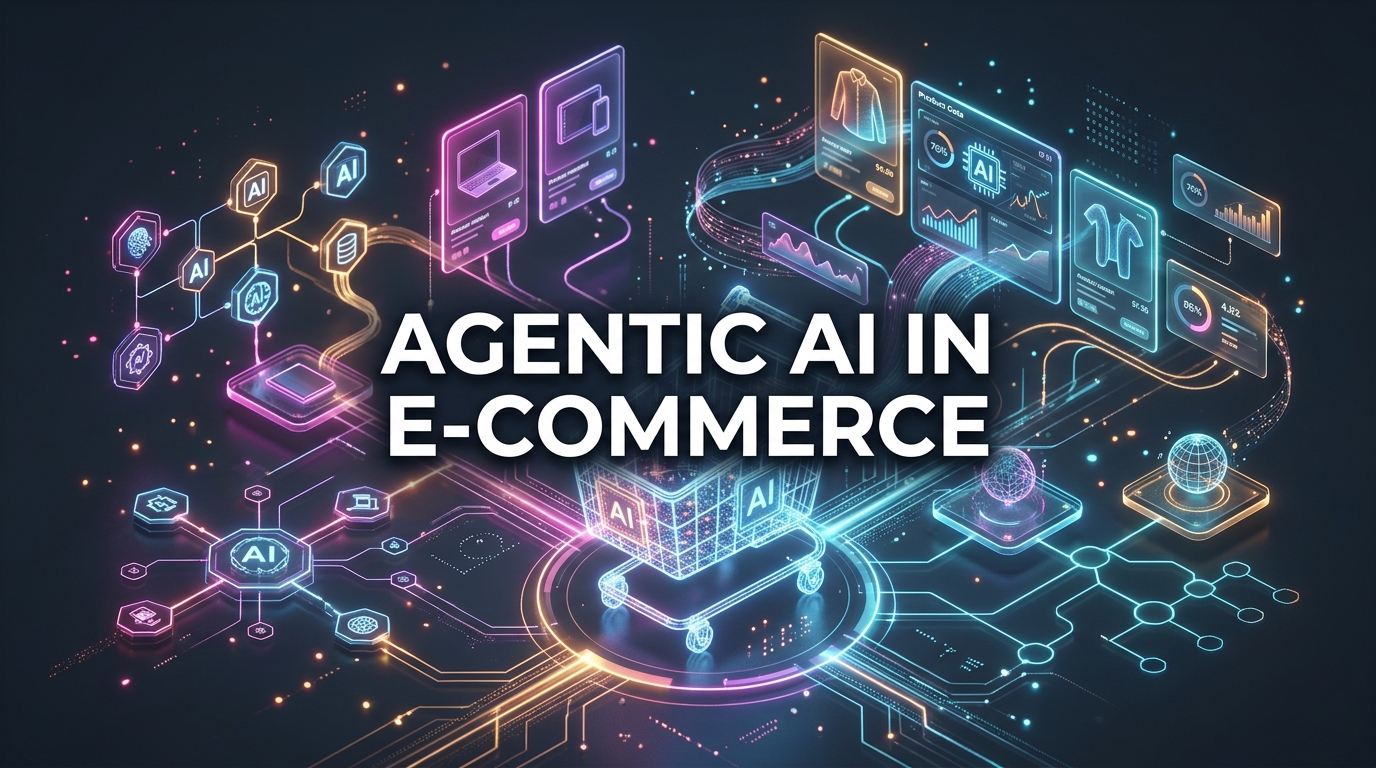
Agentic AI in E-commerce
Agentic AI in e-commerce refers to the use of AI systems that can understand goals, make decisions, use tools, and perform multi-step tasks with limited human intervention. Unlike traditional AI systems that may respond to a specific prompt or prediction request, AI agents can be designed to plan actions and work toward a defined objective.
In e-commerce, Agentic AI can be used across customer shopping experiences and business operations. Potential applications include personalized shopping assistants, product discovery, customer support, marketing automation, inventory operations, order management, fraud detection, and business analytics.
What Is Agentic AI?
Agentic AI describes AI systems designed to act toward goals by combining reasoning, planning, tool use, memory or context, and interaction with external systems.
For example, a traditional chatbot may answer a question such as whether a product is available. An agentic system could potentially check inventory, compare suitable products, apply an eligible promotion, create an order workflow, and provide the customer with an update, subject to the permissions and controls provided to the system.
How Does Agentic AI Work in E-commerce?
An agentic e-commerce system can connect an AI model with business data and software tools. The exact architecture varies by application, but a typical workflow can include:
- Understand the user's goal.
- Collect relevant information.
- Break the goal into smaller tasks.
- Choose appropriate tools or actions.
- Execute approved actions.
- Evaluate the results.
- Continue, modify, or stop the workflow based on the results.
- Provide the user or business team with an outcome.
Agentic AI vs Traditional E-commerce AI
| Traditional AI | Agentic AI |
|---|---|
| Often performs a specific prediction or response | Can work toward a broader goal |
| Usually responds to a defined input | Can plan multiple steps |
| Limited to predefined workflows in many implementations | Can dynamically select actions within permitted boundaries |
| May provide recommendations | Can potentially execute approved tasks using connected tools |
| Typically task-specific | Can coordinate multiple related tasks |
Agentic AI Applications in E-commerce
1. AI Shopping Assistants
Agentic AI can support customers during product discovery by understanding preferences, budgets, requirements, and constraints.
Instead of simply displaying a list of products, an AI shopping assistant could help narrow options, compare products, answer questions, and potentially assist with actions such as creating a shopping list or preparing an order for user confirmation.
2. Personalized Product Discovery
AI agents can use available customer context and product information to help identify relevant products. This can make product discovery more conversational and goal-oriented.
3. Customer Support
Agentic AI can assist customer service by retrieving order information, checking policies, identifying the appropriate workflow, and helping resolve common requests.
For sensitive actions such as refunds, account changes, or cancellations, organizations can require human approval or apply predefined authorization rules.
4. Order Management
AI agents can potentially coordinate multiple steps involved in order-related workflows, such as checking order status, retrieving delivery information, identifying exceptions, and routing issues to the appropriate team.
5. Inventory Management
Agentic systems can help analyze inventory information and identify situations that may require attention. For example, an agent could monitor stock levels and prepare replenishment recommendations based on configured business rules.
6. Marketing Automation
Agentic AI can support marketing workflows by analyzing campaign information, identifying opportunities, generating content variations, and helping teams coordinate repetitive campaign tasks.
Human review can remain important for brand messaging, budgets, targeting, and high-impact campaign decisions.
7. Fraud Detection and Risk Analysis
AI systems can help identify unusual transaction patterns and potential fraud indicators. Agentic workflows can potentially combine information from multiple systems and route suspicious cases for further investigation.
8. Dynamic Pricing Support
AI can analyze factors such as demand, inventory, competition, and historical information to support pricing decisions. Fully automated pricing requires strong business rules and safeguards because pricing decisions can have significant commercial consequences.
9. Product Content Management
Agentic AI can help generate and organize product descriptions, attributes, categorization, metadata, and content variations. Human review can be used to maintain accuracy, consistency, and brand standards.
10. Returns Management
AI agents can help customers understand return policies, collect relevant information, check order details, and route eligible requests through the appropriate workflow.
Benefits of Agentic AI in E-commerce
- More conversational shopping experiences
- Potentially faster customer support
- Automation of repetitive multi-step tasks
- Personalized product discovery
- Improved operational efficiency
- Faster access to business information
- Support for employees handling complex workflows
- Potentially more consistent execution of routine processes
Challenges of Agentic AI in E-commerce
Agentic AI introduces additional considerations because AI systems may interact with business tools and potentially take actions.
Accuracy and Hallucinations
An AI system can produce incorrect information or make an incorrect interpretation. E-commerce systems therefore need validation mechanisms, reliable data sources, and appropriate human oversight.
Security
Agents connected to customer accounts, payment workflows, inventory systems, or business tools create security considerations. Authentication, authorization, access control, logging, monitoring, and tool restrictions are important.
Privacy
E-commerce systems can process customer information, order history, preferences, and behavioral data. Organizations need appropriate data governance and privacy controls.
Unintended Actions
An autonomous workflow can potentially make an undesirable decision if its goals, permissions, or instructions are unclear. High-impact actions should therefore have appropriate guardrails and approval mechanisms.
Integration Complexity
Connecting an AI agent to product catalogs, order management systems, payment services, customer relationship platforms, inventory systems, and other business tools can require significant engineering effort.
Agentic AI Architecture for E-commerce
A typical agentic e-commerce architecture may contain several components:
- Large language model or other AI model
- Agent orchestration layer
- Memory or contextual information
- Product catalog and business data
- APIs and external tools
- Order management system
- Customer relationship management system
- Inventory systems
- Authentication and authorization
- Monitoring and logging
- Human approval workflows
The architecture should be designed according to the specific business process rather than assuming that every e-commerce task should be fully autonomous.
Example: Agentic AI Shopping Journey
Consider a customer looking for a laptop for programming within a specific budget.
- The customer describes their requirements.
- The AI agent identifies important constraints such as budget and intended use.
- The agent searches the available product catalog.
- It compares relevant specifications.
- It explains the most suitable options.
- The customer selects a product.
- The agent can prepare the next step, such as adding the product to a cart.
- The customer confirms before any purchase action that requires authorization.
This illustrates how an agent can coordinate multiple steps instead of simply answering an isolated product question.
Agentic AI and Customer Experience
One of the strongest potential applications of Agentic AI is creating more conversational customer journeys. Customers may be able to describe what they want in natural language instead of navigating through multiple filters and pages.
For example, a customer could explain their requirements and ask the AI system to compare products, identify suitable options, explain differences, and help with the next stage of the shopping process.
Agentic AI and E-commerce Employees
Agentic AI does not necessarily have to replace human teams. It can also act as an assistant for employees.
For example, customer support teams could use AI agents to retrieve order information, summarize customer histories, identify relevant policies, and prepare suggested responses. Employees can then review the information and make the final decision where appropriate.
Agentic AI in E-commerce Marketing
Marketing teams can use agentic workflows to support repetitive tasks across campaign planning, content creation, audience analysis, reporting, and optimization.
However, automated marketing actions should operate within clearly defined budgets, brand guidelines, approval processes, and platform permissions.
How Businesses Can Implement Agentic AI
- Identify a repetitive business workflow.
- Define the business objective and success criteria.
- Identify the data and systems required.
- Determine which tools the AI agent can access.
- Define permissions and approval requirements.
- Build a small controlled prototype.
- Test the workflow using realistic scenarios.
- Monitor accuracy, failures, costs, and business outcomes.
- Improve the workflow based on observed results.
- Expand automation gradually when appropriate.
Skills Needed to Learn Agentic AI
Students interested in Agentic AI can build a foundation across programming, AI, APIs, data handling, and software development.
- Python programming
- Artificial Intelligence fundamentals
- Machine Learning basics
- Large Language Models
- Prompt engineering
- API integration
- Databases
- REST APIs
- Software development fundamentals
- AI application security
- Agent orchestration concepts
Agentic AI for Students in Ludhiana
Students in Ludhiana who want to explore emerging AI technologies can study Agentic AI after developing fundamentals in Python, Artificial Intelligence, APIs, databases, and software development.
When comparing the best Agentic AI course in Ludhiana, look for practical coverage of AI agents, LLMs, Python, APIs, tool calling, automation workflows, databases, AI application development, evaluation, and responsible AI practices.
A practical Agentic AI course in Ludhiana should include hands-on projects where students build and test AI-powered workflows rather than focusing only on theoretical concepts.
Agentic AI E-commerce Project Ideas
- AI shopping assistant
- Product recommendation agent
- Customer support agent
- Order tracking assistant
- Product comparison agent
- Inventory monitoring assistant
- AI product description generator
- Returns support agent
- E-commerce analytics assistant
Frequently Asked Questions
What is Agentic AI in e-commerce?
Agentic AI in e-commerce refers to AI systems that can understand goals, plan multiple steps, use connected tools, and perform approved actions to support shopping experiences and business operations.
How is Agentic AI different from a chatbot?
A traditional chatbot may primarily respond to user messages. An agentic system can be designed to plan and execute multiple steps using connected tools and systems within defined permissions.
How can Agentic AI be used in e-commerce?
Applications include shopping assistants, product discovery, customer support, order management, inventory workflows, marketing automation, fraud analysis, product content management, and returns support.
Can Agentic AI automate online purchases?
Technically, an agent can be connected to systems that support purchasing workflows, but organizations should use appropriate authentication, authorization, user confirmation, spending limits, and other safeguards for financial transactions.
What are the benefits of Agentic AI in e-commerce?
Potential benefits include personalized customer experiences, faster support, automation of repetitive workflows, improved employee productivity, and more efficient access to business information.
What are the risks of Agentic AI in e-commerce?
Important risks include incorrect outputs, privacy issues, security vulnerabilities, unauthorized actions, poor data quality, integration failures, and insufficient human oversight.
What skills are needed to learn Agentic AI?
Useful foundations include Python, AI fundamentals, Large Language Models, APIs, databases, software development, prompt engineering, tool integration, and AI security.
What is the best Agentic AI course in Ludhiana?
The best course depends on your current skills and career goals. Compare practical projects, Python, LLMs, AI agents, APIs, tool calling, automation, databases, evaluation, and responsible AI coverage.
Conclusion
Agentic AI in e-commerce has the potential to change how customers discover products and how businesses manage repetitive digital workflows. AI agents can combine reasoning, planning, data access, and tool use to support tasks across shopping, customer service, marketing, inventory, and operations.
For students and professionals in Ludhiana, learning Agentic AI alongside Python, AI fundamentals, APIs, databases, and software development can provide a foundation for exploring this rapidly developing area of technology.