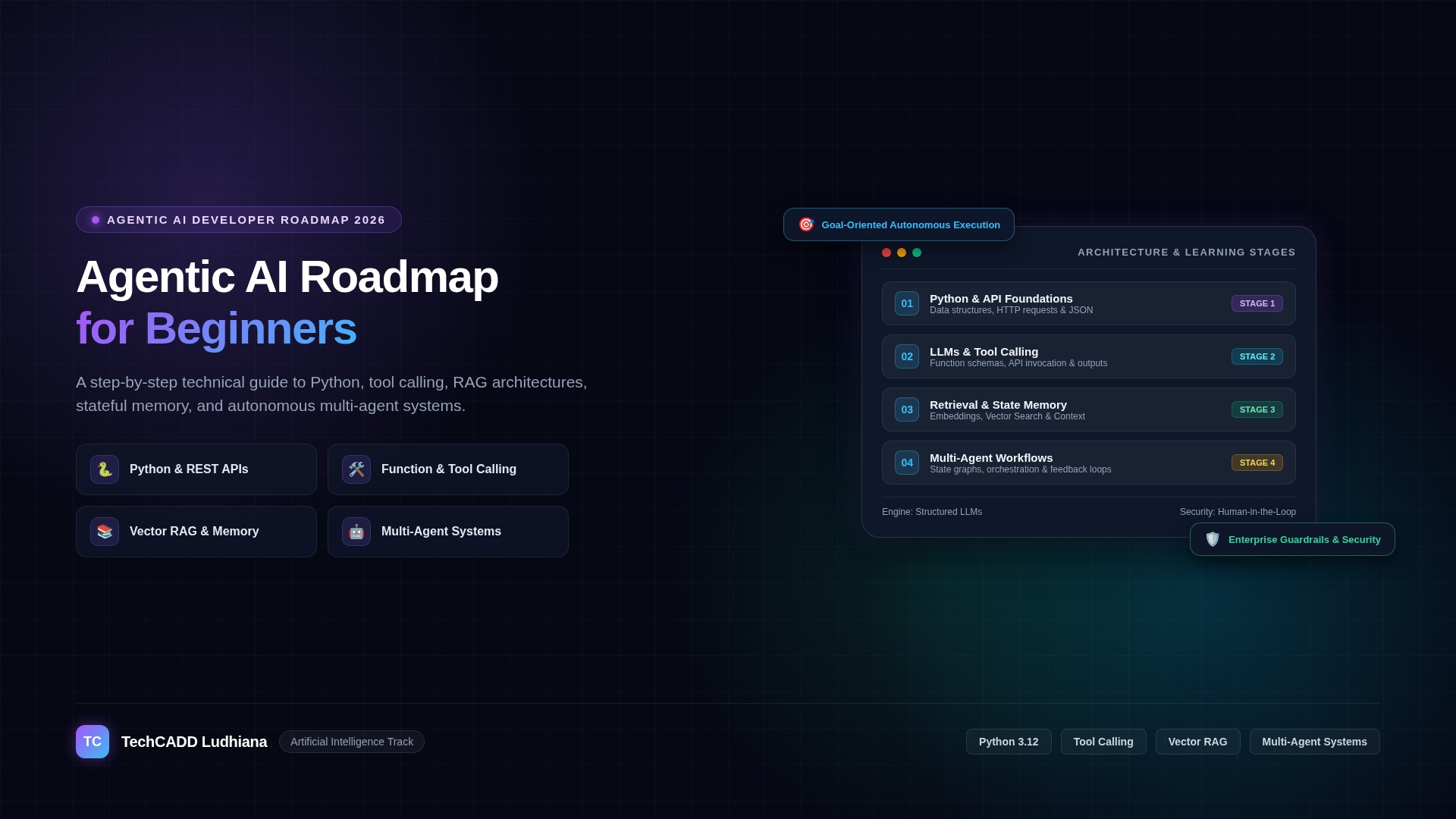
Agentic AI Roadmap for Beginners: A Step-by-Step Guide
Agentic AI is changing how software handles complex tasks. Instead of responding only to individual prompts, an AI agent can work toward a goal, plan steps, use approved tools, observe results, and adjust its approach. For beginners, learning Agentic AI requires a combination of programming fundamentals, language model concepts, workflow design, and responsible system development.
This roadmap explains what to learn first, which technologies to explore, what projects to build, and how to prepare for entry-level opportunities in Agentic AI.
What Is Agentic AI?
Agentic AI refers to AI systems designed to pursue goals through a sequence of decisions and actions, often using tools, memory, and feedback. An AI agent may break a task into smaller steps, call an API, retrieve information from documents, evaluate the result, and continue until it reaches a stopping condition.
For example, a basic chatbot might explain how to plan a trip. An agentic travel assistant could compare information from approved sources, organize potential itineraries, estimate costs using available tools, and ask the user to confirm before making a booking.
Agentic systems vary in autonomy. Many useful agents operate within defined workflows and require human approval for important or irreversible actions.
Why Should Beginners Learn Agentic AI?
- Practical automation: Build systems that complete multi-step tasks rather than only generating text.
- Software integration: Connect language models with APIs, databases, business tools, and internal applications.
- Growing technical field: Develop skills relevant to AI application development, automation engineering, and software engineering roles.
- Portfolio opportunities: Demonstrate practical skills through working projects and measurable evaluations.
- Transferable foundations: Python, APIs, databases, testing, and security are useful across many software development roles.
Agentic AI Roadmap: Learning Stages
Beginners can follow the roadmap below in sequence. The timeline is illustrative; your progress will depend on your existing programming knowledge and the time you can dedicate to practice.
| Stage | What to Learn | Practice Outcome | Suggested Duration |
|---|---|---|---|
| 1. Programming foundations | Python, functions, data structures, exceptions, modules | Build a command-line application | 2–3 weeks |
| 2. APIs and data handling | HTTP, JSON, REST APIs, environment variables | Call an external API safely | 1–2 weeks |
| 3. LLM fundamentals | Tokens, prompts, context windows, structured outputs, limitations | Create a structured-output assistant | 1–2 weeks |
| 4. Tool calling | Function schemas, validation, tool execution, error handling | Build an assistant that uses approved tools | 1–2 weeks |
| 5. Retrieval and memory | Embeddings, vector search, RAG, conversation state | Build a document question-answering assistant | 2–3 weeks |
| 6. Agent workflows | Planning, state transitions, routing, retries, stopping conditions | Develop a multi-step research or support workflow | 2–3 weeks |
| 7. Evaluation and security | Testing, logging, access control, prompt-injection defense, human approval | Test failures and enforce permissions | 1–2 weeks |
| 8. Deployment and portfolio | FastAPI, Docker basics, monitoring, documentation | Deploy a demonstrable project | 2–3 weeks |
A beginner with basic Python knowledge might use approximately 12–20 weeks for a first substantial portfolio project. This is a planning estimate, not a guaranteed completion time or job-readiness threshold.
Step 1: Learn Python Programming
Python is a practical starting point for building many AI applications because it has libraries for API integration, data processing, web services, and machine learning.
Important Python topics
- Variables, data types, operators, and control flow.
- Lists, dictionaries, sets, and tuples.
- Functions, modules, packages, and object-oriented programming basics.
- Exception handling, file handling, and logging.
- Virtual environments, dependency management, and configuration through environment variables.
- Basic testing with assertions or a testing framework.
Beginner project
Create a task manager that accepts a user's goal, breaks it into a checklist, saves tasks to a JSON file, and reports completed and pending items. Start with deterministic Python logic before adding an LLM.
Step 2: Understand APIs and Web Fundamentals
AI agents often use external services to retrieve data or perform actions. Before building tool-using agents, learn how applications communicate over HTTP.
- Understand HTTP methods, status codes, request headers, and response bodies.
- Read and write JSON.
- Send requests to a documented API using Python.
- Handle timeouts, rate limits, invalid responses, and network failures.
- Use environment variables for API credentials and avoid committing secrets to source control.
- Learn basic authentication and authorization concepts.
Practice task: Build a weather or public-information assistant that retrieves data from an API and summarizes the returned fields. Keep API calls explicit and handle errors gracefully.
Step 3: Learn Large Language Model Fundamentals
Large language models (LLMs) provide the language and reasoning capabilities used by many agentic applications. Understanding their strengths and limitations helps you design more reliable workflows.
- Prompt design: Give clear instructions, context, constraints, and examples.
- Structured output: Request and validate JSON or schema-constrained responses.
- Context windows: Understand how input length and conversation history affect processing.
- Hallucinations: Recognize that a model may produce plausible but incorrect information.
- Model selection: Compare quality, latency, cost, context limits, and deployment requirements.
- Tool calling: Understand how a model can request a function call and how the application executes it.
Start with one model provider or a local model setup. Learn the underlying request-response pattern before adding frameworks. Never assume that an LLM response is accurate simply because it sounds confident.
Step 4: Build Your First Tool-Using AI Agent
A tool-using agent combines an LLM with a set of functions that the application is permitted to execute. The model can choose a tool when appropriate, but your application must validate the request and enforce permissions.
Core concepts
- Define each tool's purpose, input schema, and allowed parameters.
- Validate inputs before execution.
- Return clear results and errors to the model.
- Set timeouts and limits on repeated calls.
- Prevent tools from accessing data or performing actions outside their permissions.
- Ask for human confirmation before sending messages, spending money, deleting data, or making other consequential changes.
Example: a task-planning agent
- The user asks the agent to prepare a study plan.
- The agent proposes a sequence of tasks.
- The application validates the plan's structure.
- A permitted tool saves the checklist.
- The agent summarizes the result and asks whether the user wants to revise it.
This project introduces agentic behavior without giving the system unrestricted access to a computer or external accounts.
Step 5: Learn Retrieval-Augmented Generation (RAG)
Retrieval-Augmented Generation (RAG) allows an AI application to retrieve relevant information from a document collection or knowledge base before generating a response. It is useful when an agent needs access to specific organizational or project information that may not be included in the model's built-in knowledge.
Learn these concepts
- Document loading and text extraction.
- Chunking documents into manageable sections.
- Embeddings and semantic similarity.
- Vector databases or vector-search libraries.
- Metadata filtering and source attribution.
- Retrieval evaluation and handling missing evidence.
Beginner project: Build a PDF question-answering assistant that retrieves relevant passages and cites page numbers or document sections. It should say when the available documents do not contain enough information rather than inventing an answer.
Step 6: Understand Memory and State Management
Memory in agentic applications is not one universal feature. It may include short-term conversation history, the current workflow state, saved user-approved preferences, or a searchable store of previous information.
Learn to distinguish conversation context from persistent storage. Store only information needed for the task, apply access controls, and provide appropriate retention and deletion behavior.
- Conversation state: The messages or variables required for the current interaction.
- Workflow state: The current step, completed actions, pending approvals, and failure status.
- Persistent memory: Information saved across sessions when justified and permitted.
- Retrieval memory: Searchable records that can be retrieved when relevant.
Begin with explicit state in Python dictionaries or a database. Add more complex memory mechanisms only when your use case needs them.
Step 7: Learn Agent Frameworks and Workflow Orchestration
Once you can build a simple agent manually, explore frameworks that simplify tool integration, state management, and multi-step execution. Frameworks change quickly, so understand the underlying concepts and check current documentation before choosing a library.
| Technology or concept | What it helps with | When to learn it |
|---|---|---|
| Direct model API integration | Understanding model requests, structured responses, and tool calls | First |
| LangChain | Components and integrations for LLM applications | After basic API usage |
| LangGraph | Stateful, graph-based workflows with controlled transitions | When workflows need branching and persistence |
| LlamaIndex | Data ingestion, retrieval, and knowledge-oriented LLM applications | When building RAG systems |
| Multi-agent orchestration libraries | Coordinating multiple specialized agent roles | After mastering single-agent workflows |
| FastAPI | Exposing Python functionality through web APIs | When turning projects into services |
You do not need to learn every framework. Choose one that suits your project and learn how it represents state, handles errors, limits tool access, and supports testing.
Step 8: Explore Multi-Agent Systems
A multi-agent system uses multiple agent roles or components to work on a shared problem. For example, a research workflow might include a planner, a retrieval component, a fact-checking step, and a report writer.
Multiple agents are not automatically better than a single agent. They can increase latency, token usage, debugging complexity, and the number of possible failure points. Start with a simple workflow and add separate agents only when the separation improves quality or maintainability.
Beginner multi-agent project
Create a research assistant with three constrained roles: a researcher that gathers evidence from approved sources, an analyst that organizes the evidence, and a reviewer that checks whether important claims are supported. Require citations and flag unresolved disagreements instead of treating agent agreement as proof of truth.
Step 9: Make Your Agents Secure and Reliable
Security and reliability should be built into the first version of an agent, not added only before deployment. Because agents can use tools and process untrusted content, mistakes may have consequences beyond an incorrect answer.
- Prompt-injection defense: Treat retrieved pages, emails, and documents as untrusted data rather than authoritative instructions.
- Least privilege: Give each tool only the access required for its task.
- Input validation: Validate tool arguments and reject unsupported operations.
- Human approval: Require confirmation for consequential or irreversible actions.
- Execution limits: Set budgets for time, model calls, tool calls, and retries.
- Observability: Record relevant events, errors, tool decisions, and latency without unnecessarily storing sensitive data.
- Evaluation: Test expected tasks, edge cases, incorrect assumptions, and adversarial inputs.
- Data protection: Protect credentials, personal information, and private documents.
For cybersecurity-oriented learners, agent security is a useful specialization. Practice in isolated labs and use only systems and datasets you are authorized to access.
Step 10: Deploy and Document Your Project
A portfolio project should run consistently, be easy to understand, and demonstrate how the system behaves when something goes wrong. Deployment is not just making a demo available online; it also involves configuration, access control, testing, and maintenance.
- Use Git and write a clear README.
- Separate configuration from source code.
- Use FastAPI or another suitable interface to expose functionality.
- Add tests for tools, validation, and important workflow paths.
- Document model and API dependencies, cost assumptions, and limitations.
- Use Docker if containerization helps make the project reproducible.
- Implement authentication and appropriate rate limits before exposing a service publicly.
- Monitor errors, latency, and usage costs after deployment.
Best Agentic AI Projects for Beginners
1. Personal study planner
Create an assistant that converts a goal into tasks, estimates a schedule, and updates a checklist. Begin with deterministic task storage and add LLM-based planning later.
2. Document research assistant
Build a RAG application that answers questions from selected PDFs, shows supporting passages, and identifies questions the documents cannot answer.
3. Customer support assistant
Create an agent that searches a sample knowledge base, drafts responses, and routes uncertain cases to a human. Use mock customer records rather than real private data.
4. Cybersecurity log analysis assistant
Use a synthetic log dataset to summarize unusual events, group related alerts, and explain possible investigation steps. Keep detection logic explicit and require an analyst to verify findings. Do not let the agent execute containment actions on real systems without authorization and approval.
5. Multi-step research and reporting tool
Build a system that gathers information from approved sources, organizes evidence, checks citations, and generates a report. Record the source and retrieval time for each important claim.
6. Meeting action-item assistant
Process a sample transcript to extract tasks, owners, and due dates. Present the result for review before writing anything to an external calendar or project-management system.
A Practical 12-Week Agentic AI Study Plan
| Weeks | Learning Focus | Deliverable |
|---|---|---|
| 1–2 | Python fundamentals, functions, data structures, exceptions | Python task manager |
| 3 | HTTP, JSON, API calls, configuration, error handling | API-powered utility |
| 4–5 | LLM fundamentals, prompting, structured outputs | Structured-output assistant |
| 6 | Tool calling, validation, permission checks | Tool-using task agent |
| 7–8 | Embeddings, retrieval, RAG, document processing | Document research assistant |
| 9 | State, memory, workflow design, retries | Multi-step workflow |
| 10 | Security, evaluation, logging, failure testing | Test suite and risk checklist |
| 11 | API serving, deployment basics, documentation | Runnable application |
| 12 | Polish, demo, evaluation, portfolio presentation | Published project repository and demo |
Adjust this plan to your starting level. If Python is new to you, spend more time on programming and API basics. If you already build web applications, focus on model integration, stateful workflows, evaluation, and security.
Where Can You Learn Agentic AI?
Use a combination of official documentation, programming practice, and small projects. Start with Python's official tutorial, the documentation for the model provider you choose, and a framework's official getting-started guide. For RAG, study retrieval, embeddings, and evaluation concepts rather than relying only on a framework's abstractions.
Useful learning habits include:
- Build one small working feature before moving to another tool or library.
- Read examples from official documentation and reproduce them in a separate project.
- Track model errors and tool failures instead of judging the application only by successful demonstrations.
- Use free documentation and tutorials first, and check API pricing before using paid services.
- Keep a project log that explains what you built, why you chose the design, and how you tested it.
How to Choose an Agentic AI Course in Ludhiana
If you are searching for an Agentic AI course in Ludhiana, Punjab, compare programs by their practical content rather than by the course title alone. Agentic AI is an evolving field, so a useful course should teach transferable engineering concepts and give learners opportunities to build and evaluate complete applications.
Before enrolling, ask the provider:
- Does the syllabus cover Python, APIs, LLMs, tool calling, and retrieval?
- Will students build at least one complete agentic application?
- Does the program teach testing, prompt-injection risks, data privacy, and tool permissions?
- Are instructors able to explain the code and help debug projects?
- Are project requirements, course duration, fees, and support clearly stated?
- Can learners retain or demonstrate their project work in a portfolio?
Compare local classroom options in Ludhiana with online courses and official technical documentation. Confirm the current syllabus, instructor experience, project scope, and total cost directly with each provider. Do not rely on job-placement or salary guarantees without verifiable evidence.
Career Opportunities After Learning Agentic AI
Agentic AI skills can support several technical career paths, depending on your broader programming knowledge and practical experience.
- AI application developer: Integrates language models, APIs, and application logic.
- AI automation engineer: Designs controlled workflows for repetitive business processes.
- LLM application engineer: Builds retrieval, tool-use, and evaluation features around language models.
- Backend developer for AI products: Creates APIs, databases, authentication, and deployment infrastructure.
- AI quality and evaluation engineer: Develops tests and measures the reliability of model-powered applications.
- AI security engineer: Assesses risks involving tool access, prompt injection, sensitive data, and agent behavior.
Learning Agentic AI alone does not guarantee employment. Employers may also expect software development fundamentals, problem-solving ability, communication skills, practical projects, and experience with testing and deployment.
Common Mistakes Beginners Should Avoid
- Starting with complex multi-agent systems before understanding a single tool-using agent.
- Learning frameworks without understanding Python, APIs, and model requests.
- Assuming model-generated answers are always correct.
- Giving an agent unrestricted access to files, terminals, accounts, or external services.
- Ignoring cost, latency, timeouts, and failure handling.
- Using private or real customer data in practice projects without appropriate authorization and safeguards.
- Building demos without tests, documentation, or clear stopping conditions.
- Adding memory when the application does not actually need persistent user information.
Frequently Asked Questions
Can a complete beginner learn Agentic AI?
Yes. Start with Python and API fundamentals, then learn LLMs, tool calling, retrieval, and workflow orchestration. Beginners should build small projects before attempting complex autonomous systems.
Do I need to learn machine learning before Agentic AI?
Not necessarily for application-level agent development. You can begin with Python, APIs, and hosted or local language models. Machine learning fundamentals become more important if you plan to train models, develop model architectures, or work on deeper research.
Is Python necessary for Agentic AI?
Python is a strong choice because it has a broad ecosystem for AI applications. JavaScript and TypeScript are also useful, particularly when integrating agents into web applications. Choose a language that matches your target project, but learn one well.
How long does it take to learn Agentic AI?
With regular practice, a beginner may spend roughly three to five months learning foundations and building an initial portfolio project. The actual timeline depends on prior programming experience, study time, and project complexity.
Which framework should I learn first?
Start with direct model API usage and tool calling so you understand the basics. Then select a framework that matches your requirements for workflow state, retrieval, integrations, and testing. You do not need to learn every available framework.
What is the difference between generative AI and Agentic AI?
Generative AI focuses on producing content such as text, images, or code. Agentic AI focuses on pursuing a goal through steps, decisions, and actions. An agent may use a generative model, but generation alone does not make an application an agent.
Can I build an Agentic AI project without paying for APIs?
Potentially. You can begin with mock model responses, free learning resources, or compatible local models. Local model performance and hardware requirements vary, and some hosted API services charge for usage, so check current terms before starting.
Are multi-agent systems always better than single-agent systems?
No. Multiple agents can help separate specialized tasks, but they can also add complexity, latency, cost, and new failure modes. Use multiple agents only when they offer a measurable benefit over a simpler workflow.
What should an Agentic AI portfolio include?
Include a working demo, source code, setup instructions, architecture explanation, sample inputs and outputs, tests, known limitations, security considerations, and evidence of how you evaluated the system.
Can I learn Agentic AI in Ludhiana?
You can explore local training providers in Ludhiana as well as online courses and official documentation. Compare the practical syllabus, project support, instructor experience, fees, and security coverage before choosing a program.
Conclusion
The best Agentic AI roadmap for beginners starts with programming and API fundamentals, progresses through LLMs and tool calling, and then introduces retrieval, memory, workflow orchestration, evaluation, security, and deployment. You do not need to master every framework at once.
Choose one useful problem, build a small agent with clear permissions, test its failures, and document the results. A reliable, well-tested project will demonstrate more practical ability than a collection of tutorials or a complex demo with no evaluation.