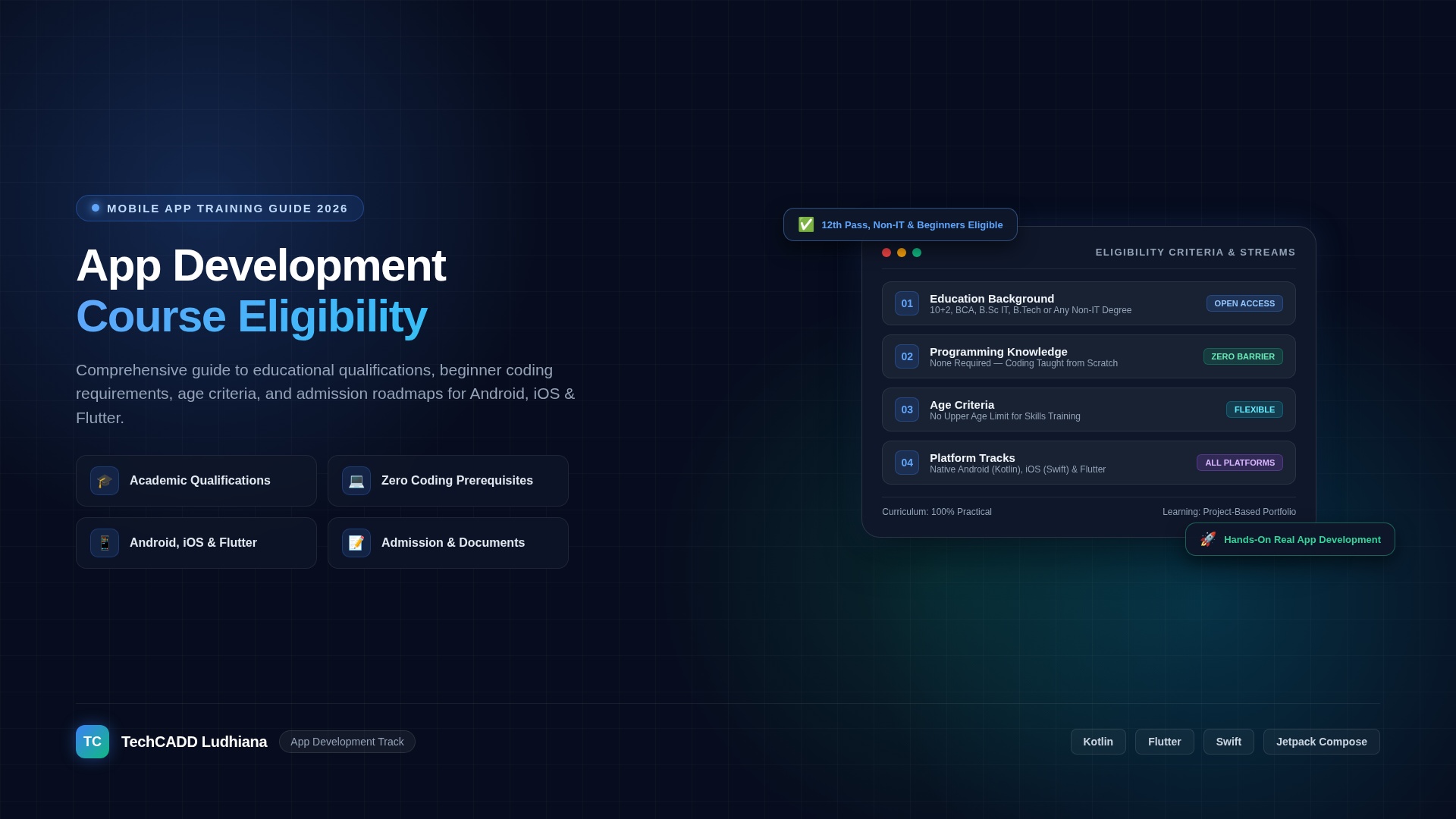
App Development Course Eligibility: Complete Guide for Beginners
App development is a practical technology skill that allows learners to create mobile applications for Android, iOS, and other platforms. Whether you are a school student, college student, graduate, working professional, or complete beginner, you may be able to start learning app development through a suitable training program.
Understanding app development course eligibility helps you choose a course that matches your education, programming experience, career goals, and available study time. This guide explains common admission requirements, essential skills, different learning paths, and what to check before enrolling in an app development course in Ludhiana, Punjab.
What Is an App Development Course?
An app development course teaches learners how to plan, design, build, test, and maintain software applications. Depending on the syllabus, a course may focus on native Android development, native iOS development, cross-platform applications, or general mobile application development.
Common topics include programming fundamentals, user interface design, application navigation, APIs, databases, testing, debugging, security, and deployment. Short-term training courses may concentrate on one platform, while longer programs may cover broader software development concepts.
Who Is Eligible for an App Development Course?
Many beginner-level app development courses accept learners without previous programming experience. Eligibility depends on the training provider, course level, and qualification being offered.
| Learner Background | Typical Eligibility | Recommended Starting Point |
|---|---|---|
| School students | May be eligible for introductory courses, subject to provider rules | Programming fundamentals and simple applications |
| Class 12 students or graduates | Often suitable for beginner training programs | Python or Kotlin fundamentals and app development basics |
| Diploma students | May qualify for beginner or intermediate courses | Programming, UI design, and application logic |
| BCA, B.Sc. IT, B.Tech, or related students | Often suitable, depending on prior knowledge and course requirements | Native or cross-platform development |
| Graduates from non-technical fields | May be eligible for beginner courses that do not require a technical degree | Basic computer skills and introductory programming |
| Working professionals | May enroll in part-time, weekend, or online programs where offered | A course aligned with current skills and career goals |
| Career changers | Often able to begin with foundation-level training | Programming basics followed by small portfolio projects |
These are general examples, not universal admission rules. Always confirm the minimum qualification, prerequisites, and age policy with the specific training provider.
What Educational Qualification Is Required?
There is no single educational qualification required for every app development course. Requirements vary according to whether you are enrolling in a short-term skills course, a diploma, a degree program, or an advanced professional training program.
For short-term app development courses
Some short-term courses accept beginners with basic computer literacy and no prior programming experience. Others may expect familiarity with a programming language or require learners to meet a minimum school-level education requirement.
For diploma or degree programs
Formal diploma and degree programs can have specific educational prerequisites, subject requirements, entrance tests, or minimum marks. These requirements must be checked with the institution offering the qualification.
For advanced app development training
Advanced courses may expect knowledge of programming, object-oriented concepts, APIs, databases, or software development. Learners without these foundations may benefit from a beginner course first.
Is Coding Required to Join an App Development Course?
Not always. Many introductory courses teach programming from the beginning. However, some intermediate and advanced courses assume that students already understand programming concepts.
If you are new to coding, begin with variables, data types, conditions, loops, functions, and basic problem-solving. You can then progress to the programming language and framework used by your chosen course.
For native Android development, Kotlin is a useful starting language. For native iOS development, learners commonly explore Swift. Cross-platform paths may use Dart with Flutter or JavaScript and TypeScript with React Native.
No-code and low-code tools can also introduce app creation, but they may not teach the same programming, debugging, architecture, or platform-integration skills as a code-based course.
Age Limit for App Development Courses
Many skills-based app development courses do not have a universal upper age limit. However, individual institutes can set minimum age requirements, and formal educational programs may have their own admission rules.
School students, college learners, graduates, and working professionals may all find suitable learning options. Before enrolling, check the course provider's age policy, required qualifications, and any conditions for accessing software or development platforms.
Skills Required Before Joining an App Development Course
Beginners do not need to master every skill before starting. The following abilities can make the learning process easier.
- Basic computer skills: Using files, folders, software installations, and a web browser.
- Problem-solving: Breaking a task into smaller steps and thinking logically.
- Basic mathematics: Useful for logic and certain application features, although advanced mathematics is not required for every beginner course.
- Interest in technology: Willingness to experiment, learn, and solve errors.
- Reading technical instructions: Following documentation, tutorials, and error messages.
- Consistent practice: Building small applications and reviewing mistakes regularly.
Previous coding experience can help, but it is not a universal requirement for beginner-level training.
Eligibility for Different Types of App Development Courses
1. Android app development
Beginner Android courses may accept learners without previous mobile development experience. A typical learning path includes Kotlin, Android Studio, layouts, Jetpack Compose or traditional Views, navigation, API integration, local storage, testing, and app security.
Before joining, check whether the course begins with programming fundamentals or expects prior knowledge of Kotlin or Java.
2. iOS app development
iOS development courses commonly teach Swift and Apple's application development tools. Depending on the course, learners may need access to compatible Apple hardware for local development and testing. Check the provider's setup requirements before enrolling.
3. Cross-platform app development
Cross-platform courses use technologies such as Flutter or React Native to develop applications for multiple supported platforms. Some beginner courses teach the required language from the beginning, while advanced programs may expect prior programming knowledge.
4. No-code and low-code app development
These courses may be suitable for learners who want to create prototypes or workflow-based applications with limited traditional coding. Check the platform's capabilities and understand whether the course covers data handling, integrations, testing, security, and deployment.
Which Programming Language Should Beginners Learn?
| Development Path | Common Technology | Suitable Goal |
|---|---|---|
| Native Android | Kotlin | Building Android applications with platform-specific features |
| Native iOS | Swift | Developing applications for Apple's platforms |
| Cross-platform | Dart and Flutter | Sharing much of the application code across supported platforms |
| Cross-platform | JavaScript or TypeScript with React Native | Building mobile apps using React-based development concepts |
| General programming foundation | Python or another beginner-friendly language | Learning programming logic before specializing |
The best choice depends on the course syllabus, your target platform, and the types of applications you want to build. You do not need to learn all these languages before starting an introductory course.
Documents Required for App Development Course Admission
Short-term training providers may require only a basic registration form, while formal academic programs can request additional documentation. Possible requirements include:
- Identity document, where required.
- Recent photograph, if requested by the provider.
- Educational certificates or marksheets, when applicable.
- Contact details and completed admission form.
- Fee payment confirmation or other registration documents.
This is a general checklist, not a universal document requirement. Ask the training provider for its current admission checklist before submitting personal information or making a payment.
How to Prepare Before Enrolling
Use this simple preparation plan if you are new to app development.
- Choose your goal: Decide whether you want to build Android apps, iOS apps, cross-platform apps, or prototypes.
- Review the prerequisites: Read the course syllabus and identify any required programming knowledge or educational qualifications.
- Learn basic programming: Practise variables, conditions, loops, functions, and simple problem-solving.
- Set up your development environment: Check the operating system, hardware, storage, and software requirements.
- Build a small project: Try a calculator, notes app, or task list to understand how application interfaces and logic work together.
- Compare training options: Review the curriculum, practical assignments, instructor support, duration, and total fees.
- Prepare a learning schedule: Reserve regular time for coding, testing, and debugging outside class.
Career Opportunities After an App Development Course
App development training can provide a foundation for several roles, depending on the depth of your skills, the quality of your projects, and employer requirements.
- Android developer: Builds and maintains Android applications.
- iOS developer: Creates applications for Apple's mobile ecosystem.
- Cross-platform developer: Builds applications using frameworks that support multiple platforms.
- Mobile UI developer: Focuses on interface implementation, responsiveness, and accessibility.
- Mobile application tester: Tests app behavior, usability, compatibility, and reliability.
- Junior application developer: Contributes to application features, APIs, testing, and maintenance.
- Freelance app developer: Builds applications for clients, subject to their requirements and your demonstrated ability.
Completing a course does not guarantee employment. Build a portfolio, practise debugging, understand version control, and learn how to explain your technical decisions to strengthen your job applications.
How to Choose an App Development Course in Ludhiana
If you are looking for an app development course in Ludhiana, Punjab, compare courses based on their practical learning opportunities and fit with your goals. The course title alone does not show whether the program teaches the skills you need.
- Confirm the minimum educational qualification and whether beginners are accepted.
- Check whether programming is taught from the basics.
- Review the syllabus for UI development, APIs, databases, testing, and debugging.
- Ask whether you will complete a working application as a final project.
- Check the software and hardware required for the selected platform.
- Review the course duration, total fees, class schedule, and support options.
- Ask how projects are assessed and whether you can demonstrate your completed work.
Compare local classroom training in Ludhiana with online courses and official learning resources. Verify current eligibility criteria and course details directly with each provider, and be cautious of unsupported job-placement or salary guarantees.
Frequently Asked Questions
What is the minimum qualification for an app development course?
There is no single minimum qualification for all app development courses. Some beginner-level training programs accept learners with basic computer skills, while formal diploma, degree, or advanced courses may require specific educational qualifications.
Can I join an app development course after Class 12?
Many beginner-level app development courses may be suitable after Class 12, subject to the provider's eligibility criteria. Check whether the course requires a particular subject background or previous coding experience.
Can a non-IT student learn app development?
Yes. Many introductory courses are designed for beginners from different educational backgrounds. Start with programming fundamentals and choose a course that clearly explains its prerequisites.
Is coding necessary for app development?
Coding is necessary for most traditional native and cross-platform development roles. Some no-code and low-code courses require less programming, but their capabilities and learning outcomes differ from code-based development.
Is there an age limit for app development courses?
There is no universal age limit across all app development courses. Individual providers and formal academic programs may set their own minimum age or admission conditions.
Which language should I learn for app development?
Kotlin is a useful choice for native Android development, Swift for native iOS development, and Dart with Flutter or JavaScript or TypeScript with React Native for cross-platform development. Your choice should match your target platform and course.
How long does an app development course take?
Duration depends on the syllabus, depth, and study format. Introductory workshops may be short, while comprehensive programs can take several months. Review the course schedule and practical project requirements before enrolling.
What documents are needed for admission?
Requirements vary. A provider may request a registration form, identity information, photograph, educational documents, or fee confirmation. Ask for the current checklist before applying.
Can I learn app development in Ludhiana?
You can explore local training providers in Ludhiana, online courses, and official development documentation. Compare eligibility, syllabus, hands-on projects, fees, and instructor support before selecting a course.
Will completing an app development course guarantee a job?
No course can guarantee a job simply by being completed. Practical projects, programming ability, testing knowledge, communication, and interview preparation can help demonstrate your readiness to employers.
Conclusion
App development course eligibility depends on the type of program and the provider's requirements. Many beginner courses welcome learners with basic computer skills and an interest in programming, while advanced and formal academic programs may require specific qualifications or prior experience.
Before enrolling, confirm the admission criteria, choose a suitable development path, review the syllabus, and make sure the course includes practical application building. With consistent practice and a well-documented portfolio, learners from different educational backgrounds can work toward developing useful mobile applications.