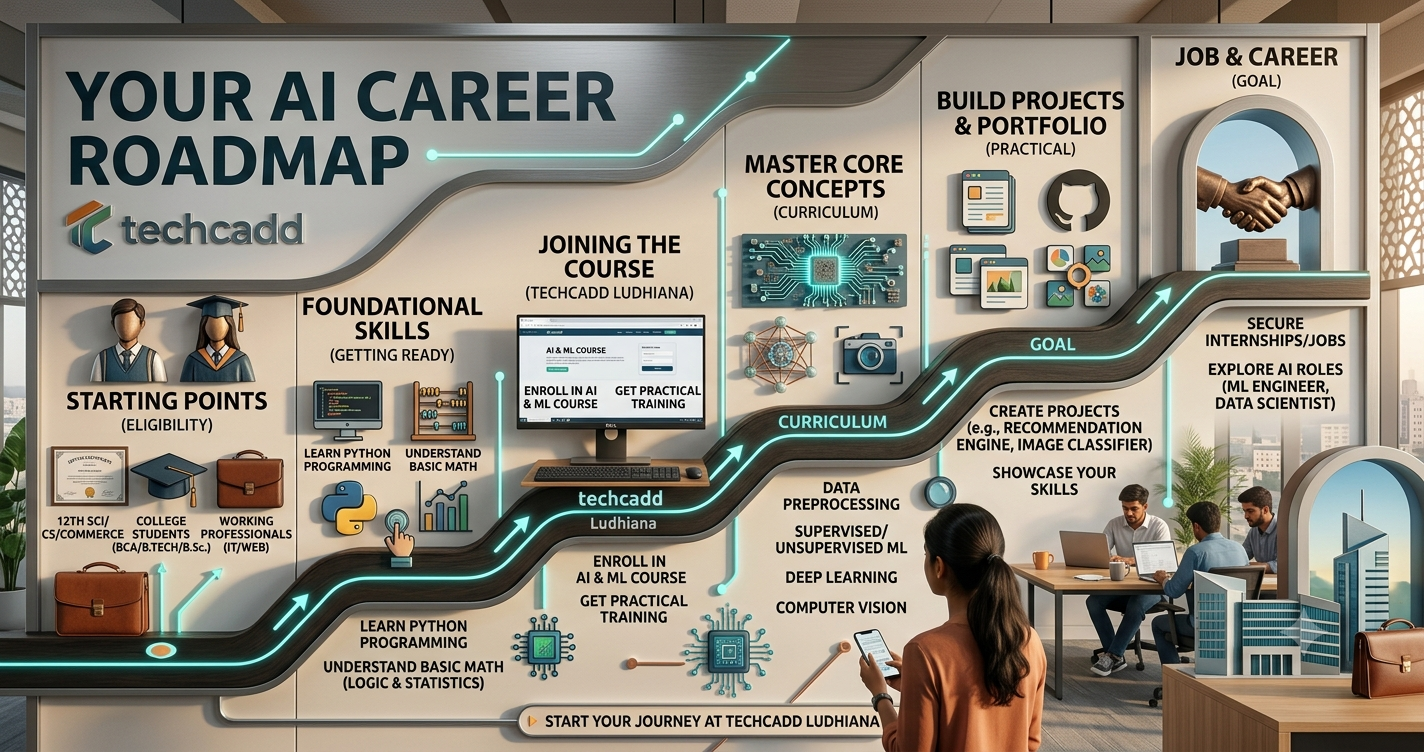
Artificial Intelligence Course Eligibility: What Do You Need to Learn AI?
Artificial Intelligence (AI) is no longer limited to research labs or experienced programmers. Students from different educational backgrounds are now exploring AI because of its growing use in software, business, healthcare, education, finance, marketing and many other fields.
But before enrolling in an artificial intelligence course, one question usually comes up: “Am I actually eligible to learn AI?”
The answer depends on the type of course you choose. Some advanced AI and machine learning programs may expect a strong background in mathematics, programming or computer science. However, beginner-friendly courses can be suitable for students who are still building their technical foundation.
If you are looking for an AI course in Ludhiana, understanding the eligibility requirements beforehand can help you choose a course that matches your current level instead of simply choosing one because it sounds advanced.
Basic Eligibility for an Artificial Intelligence Course
There is no single eligibility rule that applies to every AI course. Institutes and programs can have different requirements depending on their curriculum and difficulty level.
For a beginner-level artificial intelligence course, students generally benefit from having:
Basic computer knowledge
An interest in technology and problem-solving
Basic understanding of mathematics
Willingness to learn programming
Ability to understand logical concepts
You do not necessarily need to be an expert programmer before starting.
For example, a student who has recently completed Class 12 and knows basic computer operations can start building the required skills step by step. Similarly, a college student from a computer-related field may already have some programming knowledge and can move faster through the fundamentals.
Does Your Educational Qualification Matter?
Your educational background can affect which AI program is appropriate for you, but it does not automatically determine whether you can learn artificial intelligence.
Students from Class 12, diploma, undergraduate and postgraduate backgrounds may explore AI courses, depending on the individual institute's admission requirements.
For more technical programs, a background in subjects such as mathematics, computer science, engineering or a related field can be useful. This is because AI involves concepts such as algorithms, statistics, data handling and programming.
That does not mean students from non-computer backgrounds cannot learn AI. They may simply need additional time to understand programming and mathematical concepts.
The more important question is often not “Which stream did I study?”, but “Am I ready to learn the fundamentals required for AI?”
Do You Need to Know Python Before Learning AI?
Python is one of the most commonly used programming languages in artificial intelligence and machine learning. Because of this, many students wonder whether they need to know Python before joining an AI course.
Usually, basic Python knowledge is helpful but not always mandatory for a beginner-level course.
If you already understand variables, conditions, loops, functions and basic data structures, you will have a useful starting point. If you have never programmed before, you may need to learn these concepts before moving into machine learning.
A good learning path is not to rush directly into complicated AI models. Start with programming fundamentals, then learn how data is handled, and gradually move toward machine learning and AI concepts.
How Much Mathematics Do You Need?
Mathematics is another area that worries beginners.
You do not need to be a mathematics genius to start learning AI. However, mathematics becomes increasingly important as you move toward advanced machine learning and AI.
For beginners, a basic understanding of:
Algebra
Percentages
Graphs
Basic statistics
Probability
can be useful.
Later, concepts such as linear algebra, calculus and more advanced statistics may become relevant, particularly if you want to understand how machine learning algorithms work in greater depth.
So if mathematics is not your strongest subject, that does not automatically mean AI is not for you. It simply means you should be prepared to strengthen your mathematical foundation as you progress.
Is AI Suitable for Beginners?
Yes, but expectations matter.
AI is not something most people master in a few weeks. Beginners commonly make the mistake of jumping directly into advanced tools, copying code from tutorials and expecting to understand everything immediately.
A better approach is to build your knowledge in layers.
First understand programming. Then learn how data works. After that, explore machine learning concepts and practical projects. Once your foundation becomes stronger, you can move toward areas such as generative AI, deep learning, computer vision or natural language processing.
For students in Ludhiana, choosing a course that matches their current skill level can make this process much easier.
What Should You Check Before Joining an AI Course?
Eligibility is only one part of the decision. Before enrolling, check what the course actually teaches.
Look at the syllabus and ask:
Does it teach programming fundamentals?
Does it include practical projects?
Does it cover machine learning as well as AI concepts?
Will I get opportunities to work with real datasets?
Is the course suitable for my current level?
These questions can tell you much more than the course title alone.
If you are a beginner, choosing a program with a clear progression from fundamentals to practical AI applications is generally more useful than joining an advanced course simply because it contains impressive terminology.
The goal should not be to prove that you are already eligible for AI. The goal is to find a learning path that helps you become capable of working with AI.
Does Your Class 12 Stream Affect AI Course Eligibility?
One of the first things students ask is whether they need to have studied Computer Science in Class 12 to learn artificial intelligence.
Not necessarily.
Your Class 12 stream can influence how easily you understand certain concepts, but it does not automatically decide whether you can learn AI. Students from science, commerce and other backgrounds can develop AI-related skills if they are willing to learn programming, mathematics and logical problem-solving.
Students with a mathematics background may find topics such as statistics and probability easier initially. Students who have studied computer science may already be familiar with programming concepts. But students without either background can learn these areas from the beginning.
The important thing is to be realistic about the learning curve.
If you have never written a program before, you should expect to spend time learning programming fundamentals before attempting complex machine learning projects. That is not a disadvantage. It is simply the normal progression for a beginner.
Can College Students Learn Artificial Intelligence?
College is actually a useful time to start developing AI skills.
You do not have to wait until graduation to begin. Learning AI alongside your degree can give you additional practical skills that may become useful when applying for internships, projects or entry-level positions.
For example, a student pursuing BCA, B.Tech, B.Sc., MCA or another technology-related degree may already encounter programming and mathematics during their studies. An AI course can provide an opportunity to apply those concepts to practical problems.
Even if your college syllabus does not go deeply into artificial intelligence, you can build your knowledge independently through structured learning and projects.
The key is not to collect certificates without developing practical ability. A student who can explain a concept and build a small working project has generally gained more useful experience than someone who has simply completed several courses.
Can Non-Technical Students Learn AI?
Yes, although they may need to build a stronger foundation first.
Suppose you are interested in AI but have never studied programming. You might initially find words such as algorithms, datasets, models and machine learning confusing.
That is normal.
You can start with basic computer programming, understand how code works and then gradually introduce yourself to data-related concepts.
For a non-technical student, the learning process might look something like this:
Computer fundamentals → Python basics → Data handling → Statistics → Machine learning → Artificial intelligence projects
You do not have to master every stage before moving forward. However, skipping the fundamentals completely can make advanced topics unnecessarily difficult.
This is why beginners should pay attention to the structure of an AI course rather than focusing only on the final technologies mentioned in its syllabus.
Is Mathematics Mandatory for an AI Course?
Mathematics is useful, but the amount you need depends on your goal.
If your goal is simply to understand basic AI applications and work with existing tools, you may not need advanced mathematics at the beginning.
If you want to become a machine learning engineer, AI researcher or work deeply with algorithms, mathematics becomes much more important.
For example, machine learning uses mathematical ideas to understand relationships between data points, measure errors and optimise models.
You may eventually encounter concepts such as:
Mean, median and standard deviation
Probability distributions
Correlation
Matrices and vectors
Functions
Derivatives
Optimisation
Do not let this list scare you.
You can learn these concepts when they become relevant. Trying to memorise advanced mathematics before understanding why you need it can make the learning process frustrating.
A practical approach is to connect mathematics with actual AI problems. When you see how a mathematical concept affects a model, it becomes easier to understand its purpose.
What Skills Should You Have Before Joining?
There are several skills that can make your AI learning journey easier.
1. Basic Computer Skills
You should be comfortable using a computer, installing or opening software, managing files and working with basic applications.
2. Logical Thinking
AI involves breaking problems into smaller steps. You will regularly need to ask, “What information do I have?” and “What should the program do with it?”
3. Basic Mathematics
You should be willing to work with numbers, graphs, statistics and probability.
4. Programming Interest
You do not need to be a professional programmer, but you should be comfortable with the idea of writing and debugging code.
5. Curiosity
AI involves experimentation. Your first model may not perform well. Your code may produce errors. A dataset may not behave as expected.
Being willing to investigate these problems is more valuable than expecting everything to work perfectly the first time.
What If You Are Weak in Coding?
Being weak at coding today does not mean you will remain weak at coding.
Many beginners compare themselves with students who have already been programming for years. That comparison is usually unhelpful.
Instead, focus on whether you are improving.
Start with small programs. Learn how variables work. Write simple conditions and loops. Create small projects. Read error messages instead of immediately copying a solution from somewhere else.
Once basic programming becomes familiar, learning AI concepts becomes much less intimidating.
The same principle applies to mathematics. You do not need to fix every weakness before starting. You can identify the areas that AI requires and improve them alongside your technical learning.
How to Choose the Right AI Course in Ludhiana
If you are searching for an artificial intelligence course in Ludhiana, compare courses based on what you will actually learn and practise.
Start by checking the syllabus.
A useful beginner-oriented curriculum should have a logical progression rather than simply listing dozens of technologies. Look for fundamentals such as programming, data handling and machine learning before advanced AI topics.
You should also check whether the course includes practical assignments or projects.
Ask yourself:
Will I actually write code?
Will I work with datasets?
Will I build projects?
Will someone explain the concepts when I get stuck?
Does the course match my current skill level?
These questions are more useful than judging a course purely by its duration or certificate.
A good learning environment should help you move from understanding a concept to applying it independently.
AI Course Eligibility vs AI Career Eligibility
There is also an important difference between being eligible to join an AI course and being ready for an AI career.
Course eligibility may simply mean that you meet the institute's educational or admission requirements.
Career readiness is much broader.
To work professionally in AI, you may eventually need programming skills, mathematics, machine learning knowledge, data-handling ability, project experience and an understanding of the tools used in the industry.
Therefore, completing an AI course should not be treated as the finish line.
Think of the course as part of your skill-building journey. Your projects, problem-solving ability and continuous practice will determine how much you can actually do with the knowledge you gain.
For a student starting in Ludhiana, the most practical approach is to choose a course that matches your current level and then consistently build your skills beyond the classroom.
What Can You Do After Learning Artificial Intelligence?
Understanding artificial intelligence course eligibility is only the first step. A more important question for students is what they can actually do after developing AI skills.
Artificial intelligence is a broad field, so your career options will depend on the skills you build and the level of expertise you eventually achieve.
Some possible directions include:
AI and machine learning
Data science
Machine learning engineering
Software development with AI
Generative AI applications
Natural language processing
Computer vision
AI automation
Data analysis
You do not have to decide your exact career path on the first day of your course.
Many students start by exploring the basics and discover which area interests them most after working on projects.
For example, you may enjoy building prediction models, while another student may prefer developing AI-powered applications. Someone else may be more interested in working with data.
That is why practical exposure matters.
Can You Get a Job After an AI Course?
Completing an artificial intelligence course does not automatically guarantee a job.
This is an important point that students should understand before enrolling in any technical course.
An AI certificate can show that you completed a program, but employers generally care about what you can actually do. Your programming ability, understanding of machine learning, problem-solving skills and projects can be much more important when demonstrating your capabilities.
For example, imagine two students applying for the same internship.
The first student has completed an AI course but cannot explain their projects or write basic code independently.
The second student has completed a similar course but has built a few working projects, understands the basics and can explain how their models work.
The second student has something practical to demonstrate.
Therefore, while a course can provide structure and guidance, students should use their learning to build an actual portfolio.
Why Projects Matter When Learning AI
Projects help turn theoretical knowledge into practical skills.
Suppose you learn about classification in a lesson. You might understand the definition, but building a simple classification model forces you to deal with real problems such as cleaning data, selecting features, training a model and evaluating its performance.
That experience is difficult to get from theory alone.
Beginners can start with relatively simple projects and increase the difficulty gradually.
Examples include:
House price prediction
Student performance prediction
Spam email classification
Recommendation systems
Customer segmentation
Image classification
Simple AI chat applications
You do not need to build a complicated system immediately.
A small project that you genuinely understand can be more valuable than a large project that you copied from a tutorial without knowing how it works.
What Should Beginners Avoid?
Students starting an AI course often make a few predictable mistakes.
Trying to Learn Everything at Once
AI includes a huge number of concepts and technologies. Trying to learn Python, machine learning, deep learning, generative AI, computer vision and dozens of tools simultaneously can leave you confused.
Start with the fundamentals and expand gradually.
Focusing Only on Certificates
Certificates can be useful, but they are not a replacement for skills.
If you spend all your time completing courses but never write code or build projects, your practical ability may remain limited.
Copying Projects Without Understanding Them
Following a tutorial is perfectly fine when learning. The problem begins when you cannot explain the code after finishing the project.
After completing a tutorial, try changing something yourself. Use a different dataset, modify the features or add a new function.
That is where real learning starts.
Ignoring Programming Fundamentals
AI tools can make complicated tasks look simple. But when something goes wrong, you still need programming and problem-solving skills to identify the issue.
Building a strong foundation may seem slower initially, but it usually saves time later.
How Long Does It Take to Learn AI?
There is no fixed amount of time required to learn artificial intelligence.
It depends on your starting point, the complexity of the topics and how consistently you practise.
A student who already knows Python and basic mathematics may progress faster than someone starting from zero.
Instead of asking, “How many months will it take me to learn AI?”, a better question is:
“What can I realistically learn and build during that time?”
For example, your first stage could focus on programming. The next stage could involve data analysis and machine learning fundamentals. After that, you could start building projects and exploring more advanced AI applications.
Learning consistently for a few hours every week is generally more useful than studying intensively for a short period and then stopping.
Is an Artificial Intelligence Course Worth It for Students in Ludhiana?
It can be, provided you have realistic expectations.
AI is a technical field, and learning it requires effort. You should not choose it simply because artificial intelligence is currently popular.
Ask yourself whether you actually enjoy programming, technology, mathematics, experimentation and solving problems.
If the answer is yes, learning AI can be a useful addition to your technical skill set.
For students in Ludhiana, local classroom training can also provide a structured learning environment if you prefer having instructors, regular practice and other students around you. On the other hand, students who are comfortable learning independently may choose online resources and self-paced practice.
There is no single correct method.
The better option is the one that helps you stay consistent and actually practise what you learn.
Frequently Asked Questions About AI Course Eligibility
Can I learn artificial intelligence after Class 12?
Yes. Students who have completed Class 12 can explore beginner-level AI programs, subject to the specific institute's eligibility requirements. Having mathematics and computer-related knowledge can be helpful, but beginners can build these skills progressively.
Do I need a computer science degree to learn AI?
No. A computer science degree is not universally required to learn artificial intelligence. However, students who want an AI-related career will need to develop relevant technical skills such as programming, mathematics, data handling and machine learning.
Can a BCA student learn artificial intelligence?
Yes. BCA students can learn AI and machine learning. Their programming and computer-related coursework can provide a useful foundation, which they can build upon through additional AI training and practical projects.
Can non-maths students learn AI?
They can learn AI, particularly at the beginner level, but they may need to strengthen their mathematical foundation as they progress. Statistics, probability, algebra and other mathematical concepts become increasingly relevant in machine learning.
Is Python compulsory for artificial intelligence?
Python is not necessarily a prerequisite for every beginner course, but learning Python is highly useful because it is widely used for programming, data analysis and machine learning.
What is the most important eligibility for learning AI?
Apart from the formal requirements of a particular course, your willingness to learn programming, practise regularly and solve problems is extremely important. AI is a skill-based field, so consistent practice matters.
Final Thoughts
Artificial intelligence course eligibility is not as complicated as many students initially think.
You do not necessarily need years of programming experience or an advanced technical degree to start learning AI. What you need depends on the level of course you choose and the career direction you want to pursue.
For beginners in Ludhiana, the practical approach is to start at the right level, strengthen your programming and mathematical foundations, practise regularly and gradually work on real projects.
Do not choose an AI course only because the field is trending. Choose it if you are willing to put in the work required to understand the technology.
The certificate may mark the completion of a course, but your skills, projects and ability to solve real problems are what ultimately make your learning useful.