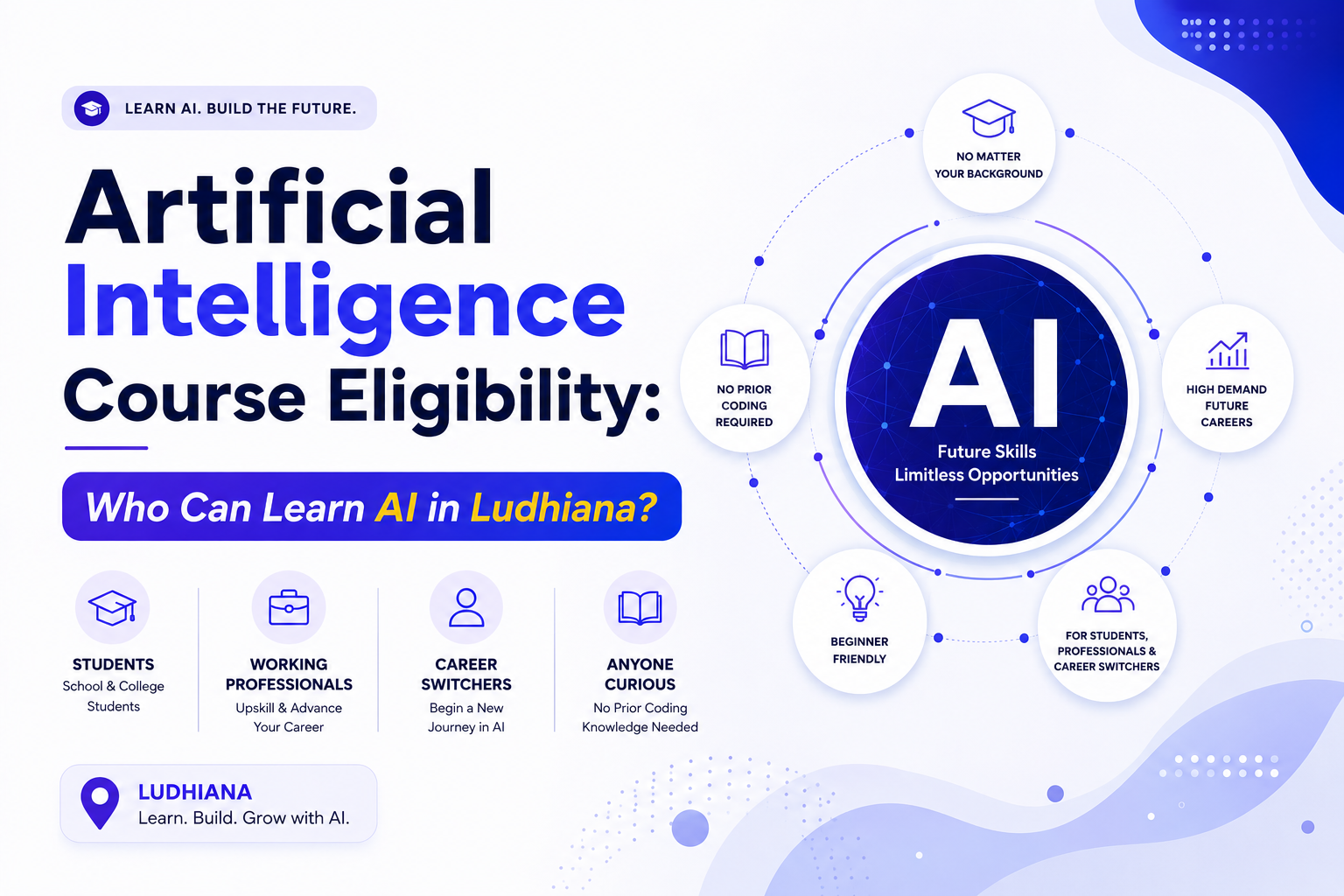
Artificial Intelligence Course Eligibility: Who Can Learn AI in Ludhiana?
Artificial Intelligence sounds like a highly technical field, so one of the first questions students ask is, “Am I actually eligible to learn AI?”
The good news is that there is no single eligibility rule for every Artificial Intelligence course. Requirements depend on the level of the course, the institute offering it and what you want to learn.
For students in Ludhiana, this means you should look beyond the course name and check the actual entry requirements before enrolling. A beginner-level AI course may be open to students with little or no previous experience, while an advanced program may expect knowledge of programming, mathematics or data science.
What Is the Basic Eligibility for an AI Course?
For many beginner-oriented Artificial Intelligence courses, students do not need an advanced technical background.
Depending on the institute, eligibility may include:
Being a school or college student
Having completed or currently pursuing Class 10 or 12
Being a graduate or postgraduate
Having a basic understanding of computers
Meeting the institute's minimum age or educational requirements
The exact requirement can vary, so always check the specific course before applying.
If you are currently in Class 11 or 12 and are curious about AI, you do not necessarily have to wait until college to start learning the basics. An introductory course can help you understand whether you actually enjoy programming and technology before committing to a specialised degree.
Do You Need to Be From the Science Stream?
This is another common concern, particularly among students choosing their subjects in school.
Being from the science stream can be helpful for certain technical AI programs because mathematics and programming become important as you move toward advanced topics. However, your school stream alone does not determine whether you can learn Artificial Intelligence.
Students from different academic backgrounds may be able to learn AI at an appropriate level.
For example, a beginner course can focus on understanding AI concepts, using AI tools and learning basic programming. A more technical machine learning pathway may require stronger mathematical and programming foundations.
So instead of asking only, “Which stream am I from?”, ask:
“What does the course require me to know before I start?”
That question will give you a much clearer answer.
Is Mathematics Required for Artificial Intelligence?
Mathematics does play an important role in Artificial Intelligence, especially when you progress toward machine learning and more advanced concepts.
Topics such as statistics, probability, algebra and other mathematical concepts can become useful when understanding how AI models work.
But that does not mean you need to be a mathematics expert before starting.
A beginner can first develop basic programming and problem-solving skills and gradually strengthen the mathematics needed for more advanced AI topics.
If mathematics is not your strongest subject, do not immediately assume that AI is impossible for you. You may simply need to spend some additional time strengthening the relevant concepts.
Do You Need Coding Experience?
Not necessarily.
Many beginners worry because they have never written a line of code before. If you are in the same situation, look for an AI course that introduces programming fundamentals before moving into complex machine learning concepts.
Python is particularly relevant to many AI and machine learning learning paths. A structured course may introduce basic Python concepts first and then gradually use them for data-related and AI applications.
What matters is that you are willing to practise.
Coding is not something most people master by watching someone else write programs. You need to experiment, make mistakes, understand errors and try again.
Can Beginners Learn Artificial Intelligence?
Yes, provided they choose a course appropriate for their level.
A common mistake is selecting an advanced AI program simply because it sounds impressive. If you are completely new to programming, this can make the learning experience unnecessarily difficult.
A beginner-friendly pathway might look something like:
Computer basics → Python fundamentals → data handling → machine learning basics → AI projects
You do not have to understand neural networks or complex algorithms on your first day.
The goal should be to build your knowledge gradually.
What Skills Are Helpful Before Starting?
Formal eligibility is only one part of the picture. Certain personal and academic skills can make learning AI easier.
Curiosity is one of the biggest advantages. You should be willing to ask “Why does this work?” instead of simply memorising steps.
Basic logical thinking is also useful because programming involves breaking larger problems into smaller ones.
Patience matters too. Your first program may not work correctly, and your first project may involve plenty of errors. That is normal.
If you are a student in Ludhiana considering an AI course, you do not need to arrive with everything figured out. You need a suitable starting point, regular practice and the willingness to keep learning.
Artificial Intelligence Course Eligibility After Class 12
If you are planning to learn Artificial Intelligence after Class 12, your eligibility will depend largely on the type of program you choose. A short-term professional course has very different requirements from a university degree in Artificial Intelligence or a related field.
Can Commerce or Arts Students Learn AI?
Yes, but the starting point matters.
Students from Commerce or Arts backgrounds can explore AI through beginner-friendly courses, particularly if the program teaches programming fundamentals from the beginning. You may need to put extra effort into areas such as mathematics or coding if you have not studied them previously.
For example, someone from a Commerce background might begin with Python and basic data concepts before progressing toward machine learning. The learning curve may be different from that of a student who has already studied computer science, but that does not mean the field is automatically off-limits.
The key is choosing a course whose prerequisites match your current knowledge.
What About Students From a Computer Science Background?
Students who have already studied computer science may have an advantage when starting an AI course because they may already understand programming, databases, algorithms or basic computing concepts.
However, having a computer science background does not automatically mean you are ready for advanced AI.
Machine learning introduces its own concepts, and you still need to understand how models work, prepare data and evaluate results. Practical experience remains important.
If you already know programming, look for a course that does not spend too much time repeating concepts you have mastered. Instead, you can focus on AI-specific skills and projects.
Does Graduation Matter?
Not always.
For many skill-based or professional AI courses, you may not need a college degree. Some programs are designed specifically for students, working professionals or beginners who want to develop practical skills.
However, if you are applying for a degree program such as a B.Tech, B.Sc. or another undergraduate program related to AI, the eligibility rules are set by the university or institution. These may include specific subjects in Class 12 and minimum marks.
This distinction is important:
AI course ≠ AI degree
A professional training course may have relatively flexible entry requirements, while a university degree can have formal admission criteria.
Always check the official eligibility requirements of the specific program you are considering.
Is There an Age Limit for AI Courses?
There is no universal age limit for learning Artificial Intelligence.
Some institutes may have their own minimum-age requirements, particularly for certain classroom programs. Others may allow school students to enrol with appropriate guidance.
If you are still in school, ask the institute whether the course is designed for your age and academic level.
You should also consider whether the teaching pace is suitable. An advanced professional program may technically accept you but still be difficult if you have never studied programming.
What If You Are Weak in Coding?
Being weak at coding at the beginning does not mean you cannot learn AI.
In fact, struggling with programming initially is quite common. Coding improves through practice rather than simply through memorising syntax.
Start with small tasks. Learn variables, conditions, loops, functions and basic data structures. Once these ideas become comfortable, moving toward AI-related programming becomes much easier.
If an institute promises to teach advanced AI without giving beginners enough time to develop programming fundamentals, ask questions before enrolling.
A strong foundation can save you a lot of frustration later.
What If You Are Weak in Mathematics?
You do not need to panic if mathematics is not your strongest subject.
The mathematical requirements become more significant as you move deeper into machine learning and AI. Instead of trying to learn every mathematical topic at once, focus on the concepts directly connected to what you are studying.
An effective course should explain why a particular mathematical concept matters rather than simply asking students to memorise formulas.
For beginners, understanding the basic idea behind a concept is often more useful than immediately trying to master complicated calculations.
Ask These Questions Before Joining an AI Course
Before enrolling at an Artificial Intelligence institute in Ludhiana, ask:
Who is this course designed for?
Do I need previous coding experience?
What educational qualification is required?
Is mathematics required?
What topics will be taught from the basics?
How much practical project work is included?
Can I attend a demo class before enrolling?
Getting clear answers to these questions can help you avoid choosing a course that is either too basic or too advanced for your current level.
The right eligibility is not simply about whether you meet an admission requirement. It is about whether the course gives you a realistic and comfortable starting point for building your AI skills.
How to Know If an AI Course Is Right for You
Meeting the basic Artificial Intelligence course eligibility requirements is only the beginning. Before joining an institute in Ludhiana, you should also think about whether the course matches your interests, current skills and future plans.
You do not need to have your entire career figured out before learning AI. However, having a rough direction can help you choose a course that makes sense for you.
What Should You Know Before Starting?
You do not need to be an AI expert before joining an AI course. For a beginner-level program, some basic computer knowledge, logical thinking and an interest in technology can be enough to get started.
A willingness to practise is even more important.
If you learn programming only during class and never practise afterwards, progress can be slow. On the other hand, even a student starting from zero can gradually become comfortable with coding by spending regular time solving small problems.
Think of AI as a skill you build over time rather than a subject you are expected to master immediately.
What Should You Learn First?
If you are completely new to Artificial Intelligence, avoid trying to learn every AI technology at once.
A sensible learning path could begin with:
Python basics → programming practice → data fundamentals → machine learning → AI applications → practical projects
Once you understand the fundamentals, you can explore areas such as generative AI, natural language processing, computer vision or other specialised fields.
This approach is particularly useful for students because it gives you a strong foundation instead of leaving you dependent on step-by-step tutorials.
Choose the Course According to Your Goal
Your ideal AI course depends on what you want to achieve.
If you simply want to understand AI and explore the field, a beginner course may be sufficient.
If you want to pursue AI as a career, you may need a more comprehensive program covering programming, data, machine learning and project development.
If you already know Python or have studied computer science, you may want a course that moves more quickly into machine learning and advanced applications.
There is no single course that is perfect for everyone.
Look at Practical Work Before Enrolling
Eligibility tells you whether you can enter a course. Practical training tells you what you may actually gain from it.
Ask an Artificial Intelligence institute in Ludhiana how students practise what they learn. Find out whether projects are included and whether you get guidance while building them.
Projects can help you understand how theoretical concepts are used to solve actual problems. They can also become part of a portfolio that demonstrates your skills when you apply for internships or future opportunities.
Do not be impressed only by a long list of technologies. Find out what you will actually build with them.
Don't Let Your Background Stop You
Perhaps you are from Commerce. Maybe you studied Arts. Maybe you have never written code. Or perhaps you are already comfortable with programming but want to move into AI.
Your starting point may be different from someone else's, and that is completely normal.
Instead of comparing your background with other students, focus on finding a course that starts at the right level for you.
If you need Python basics, learn Python first. If your mathematics foundation needs improvement, work on the relevant concepts alongside your AI studies. Progress becomes much easier when you build skills in the right order.
A Quick Eligibility Checklist
Before joining an Artificial Intelligence course in Ludhiana, check these points:
Educational qualification: Does the institute have a minimum qualification?
Programming: Is previous coding experience required?
Mathematics: Does the course expect a particular mathematical background?
Computer knowledge: Are basic computer skills enough to start?
Course level: Is it designed for beginners, intermediate learners or advanced students?
Age requirements: Does the institute have any specific age criteria?
Learning goals: Does the syllabus match what you want to achieve?
Practical training: Will you work on projects and assignments?
Trainer support: Can you get help when you face difficulties?
Start at the Level That Matches You
Artificial Intelligence can look complicated from the outside, but you do not need to know everything before taking your first step.
For students considering an AI course in Ludhiana, the most important thing is to understand the specific eligibility requirements of the course you are choosing and honestly assess your current skills.
A good starting course should teach you progressively, give you opportunities to practise and help you understand where you can go next.
So, if you are wondering, “Am I eligible for an Artificial Intelligence course?”, the answer may be simpler than you think. You may not need an advanced technical background at all. What you need is the right course for your level, curiosity about technology and the commitment to keep practising.
Once those pieces are in place, your AI learning journey can begin with a much clearer direction.