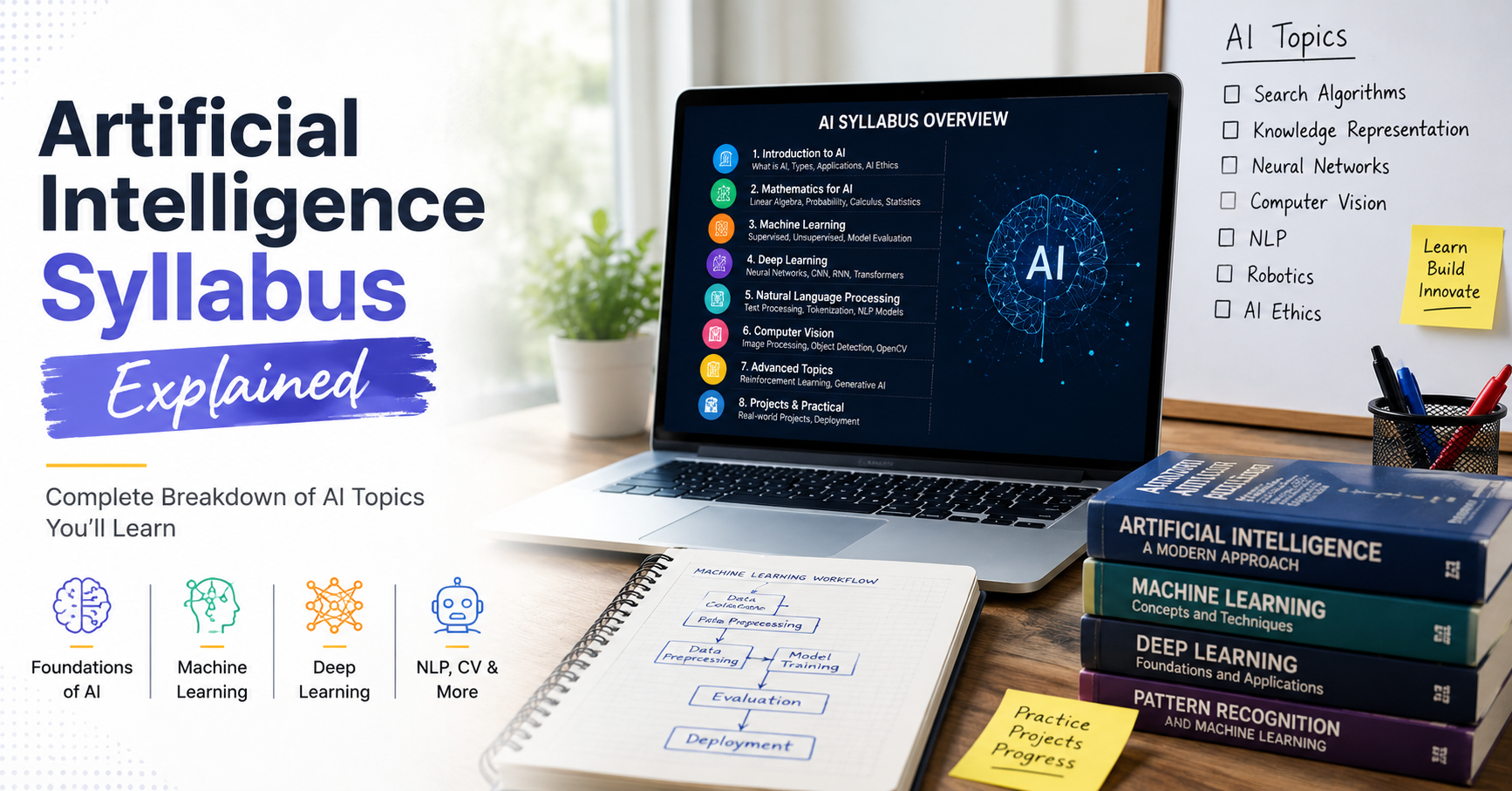
Artificial Intelligence Syllabus Explained
If you're planning to join an Artificial Intelligence course, looking at the syllabus is one of the most important steps before enrolling. A good AI syllabus should not only introduce you to Artificial Intelligence but also gradually build your programming, Machine Learning and practical problem-solving skills.
The exact syllabus can vary depending on the course duration and level. A beginner-focused programme may concentrate on Python and Machine Learning, while an advanced programme can include Deep Learning, Generative AI, AI Agents, RAG, MLOps and cloud deployment.
Here’s what you can expect from a structured Artificial Intelligence syllabus in Ludhiana.
1. Python Programming Fundamentals
Python is one of the first technical skills you'll encounter in an AI programme.
A beginner-friendly syllabus usually starts with programming fundamentals such as:
Variables and data types
Conditions and loops
Functions
Lists and dictionaries
Object-oriented programming
File handling
Basic problem-solving
The objective isn't simply to learn Python syntax. You should become comfortable enough with Python to use it later for data analysis and Machine Learning.
2. NumPy and Pandas
Once the Python fundamentals are clear, the syllabus can move towards working with data.
NumPy helps with numerical computing, while Pandas is widely used for handling and analysing structured datasets.
You may learn how to:
Import datasets
Explore data
Select and filter information
Handle missing values
Organise data
Perform basic data analysis
These skills become particularly important when you start building Machine Learning models.
3. Machine Learning Fundamentals
Machine Learning is a major part of most Artificial Intelligence programmes.
A well-structured syllabus introduces the basic concepts before moving into advanced topics.
You can expect areas such as:
Introduction to Machine Learning
Supervised learning
Unsupervised learning
Classification
Regression
Training and testing data
Model evaluation
Overfitting and underfitting
The goal is to understand how machines can learn patterns from data and use those patterns to make predictions or decisions.
4. Data Visualisation
AI isn't only about building models. You also need to understand the data you're working with.
Data visualisation helps you identify patterns, relationships and unusual values within a dataset.
A syllabus may therefore include:
Charts and graphs
Exploratory data analysis
Understanding data distributions
Identifying patterns
Presenting analytical results
Being able to explain what your data is telling you is an important practical skill.
5. Feature Engineering
As you move further into Machine Learning, you'll encounter feature engineering.
Features are the pieces of information that a model uses to make predictions. Feature engineering involves preparing or transforming data so that it can be used more effectively by a Machine Learning model.
This part of the syllabus helps bridge the gap between simply working with datasets and developing more useful predictive models.
6. Advanced Machine Learning
After understanding the fundamentals, a more comprehensive AI syllabus can move into advanced Machine Learning concepts.
Depending on the programme, this can include:
Advanced supervised learning
Advanced unsupervised learning
Ensemble methods
Dimensionality reduction
Model optimisation
Advanced feature engineering
A shorter programme may introduce these topics at a basic level, while a longer programme can provide more time for practical implementation.
7. Real-World Projects
Projects are an essential part of an industry-focused Artificial Intelligence syllabus.
Instead of learning every topic independently, projects allow you to combine multiple skills.
For example, an end-to-end ML project may involve:
Python → Data Processing → Feature Engineering → Model Building → Evaluation → Deployment
This gives you experience with an actual workflow rather than isolated classroom exercises.
For students in Ludhiana, this practical component can also help when building a portfolio for future internships, jobs or further studies.
Understanding the Syllabus by Course Duration
The syllabus becomes broader as the programme duration increases.
A 3-month AI/ML Practitioner programme focuses on Python, data handling, Machine Learning, visualisation, feature engineering and practical ML projects across 9 modules.
A 6-month Data & ML Professional programme expands into areas such as Deep Learning basics, NLP, Computer Vision, SQL, Time Series Analysis, advanced Python and a capstone project across 16 modules.
A 9-month AI, ML & GenAI Expert programme goes further into Generative AI, advanced NLP, AI application development, AI Agents, RAG, vector databases, cloud deployment, responsible AI and portfolio development across 20 modules.
So when comparing an Artificial Intelligence course syllabus, don't just count the number of topics. Look at how deeply those topics are taught and how much practical work is included.
Advanced Topics in an Artificial Intelligence Syllabus
Once the foundations of Python and Machine Learning are covered, a comprehensive Artificial Intelligence syllabus can move into more advanced technologies. These topics are particularly useful for students and professionals who want to work on modern AI applications rather than limiting themselves to basic ML models.
8. Deep Learning
Deep Learning takes Machine Learning further by using neural networks to identify complex patterns in data.
A broader AI syllabus may introduce:
Neural networks
Deep learning fundamentals
Model training
Basic neural network architectures
Applications of deep learning
This creates a foundation for understanding areas such as Computer Vision, NLP and Generative AI.
9. Natural Language Processing
Natural Language Processing, or NLP, focuses on enabling computers to work with human language.
Depending on the course level, the syllabus may cover:
Text processing
Language data
Text classification
Sentiment analysis
NLP applications
Advanced NLP concepts
NLP is particularly relevant to modern applications such as chatbots, search systems and AI assistants.
10. Computer Vision
Computer Vision focuses on enabling AI systems to interpret visual information.
Students may explore:
Image processing
Image classification
Computer vision fundamentals
Visual recognition
Real-world computer vision applications
Combining Computer Vision with Machine Learning can help learners understand how AI can be applied beyond text and numerical datasets.
11. Generative AI
Generative AI is an important component of a modern AI syllabus.
Instead of only predicting or classifying existing information, generative models can be used to create new content such as text, images or other forms of output.
A comprehensive programme can introduce:
Generative AI fundamentals
Large language models
Prompt Engineering
Generative AI applications
AI-powered application development
For learners interested in current AI technologies, this section can be particularly valuable because it connects traditional AI foundations with newer applications.
12. RAG and Vector Databases
Advanced AI programmes can also introduce Retrieval-Augmented Generation (RAG).
RAG combines information retrieval with generative AI, allowing applications to retrieve relevant information and use it when generating responses.
Students may also learn about:
RAG architecture
Embeddings
Vector databases
Information retrieval
Building knowledge-based AI applications
These concepts become useful when moving from simply using AI tools to developing AI applications.
13. AI Agents and Multi-Agent Systems
Another advanced area is AI agent development.
Instead of simply responding to a single prompt, AI agents can be designed to perform tasks using tools, information and defined workflows.
A comprehensive syllabus may cover:
AI agent fundamentals
Agent workflows
Tool use
Multi-agent AI systems
AI application development
This gives learners exposure to newer approaches to building intelligent applications.
14. MLOps and Deployment
Building a Machine Learning model is only one part of the process. A practical AI syllabus should also introduce learners to what happens when a model needs to be used in a real application.
MLOps-related learning can include concepts around:
Model deployment
ML workflows
Managing models
Application deployment
Production considerations
The goal is to understand the journey from model development to usable application.
15. Cloud Deployment
Advanced programmes may also introduce cloud platforms such as AWS or GCP.
Students can learn the fundamentals of deploying AI applications and models in cloud environments.
This is particularly useful for learners who want to understand how AI solutions can move beyond a local computer and become accessible through real applications.
16. AI Ethics and Responsible AI
Technical skills aren't the only part of an Artificial Intelligence syllabus.
A well-rounded programme should also introduce responsible AI concepts, including:
Ethical AI development
Responsible use of AI
Limitations and risks
Bias and fairness
Appropriate use of AI systems
Understanding these issues helps students think about not just what AI can do, but also how it should be used.
The progression is therefore quite clear: a beginner starts with Python and Machine Learning, develops practical project skills, and can gradually move into Deep Learning, NLP, Computer Vision, Generative AI, RAG, AI Agents, MLOps and deployment.
That progression is what separates a basic introduction to AI from a more comprehensive, industry-focused learning path.