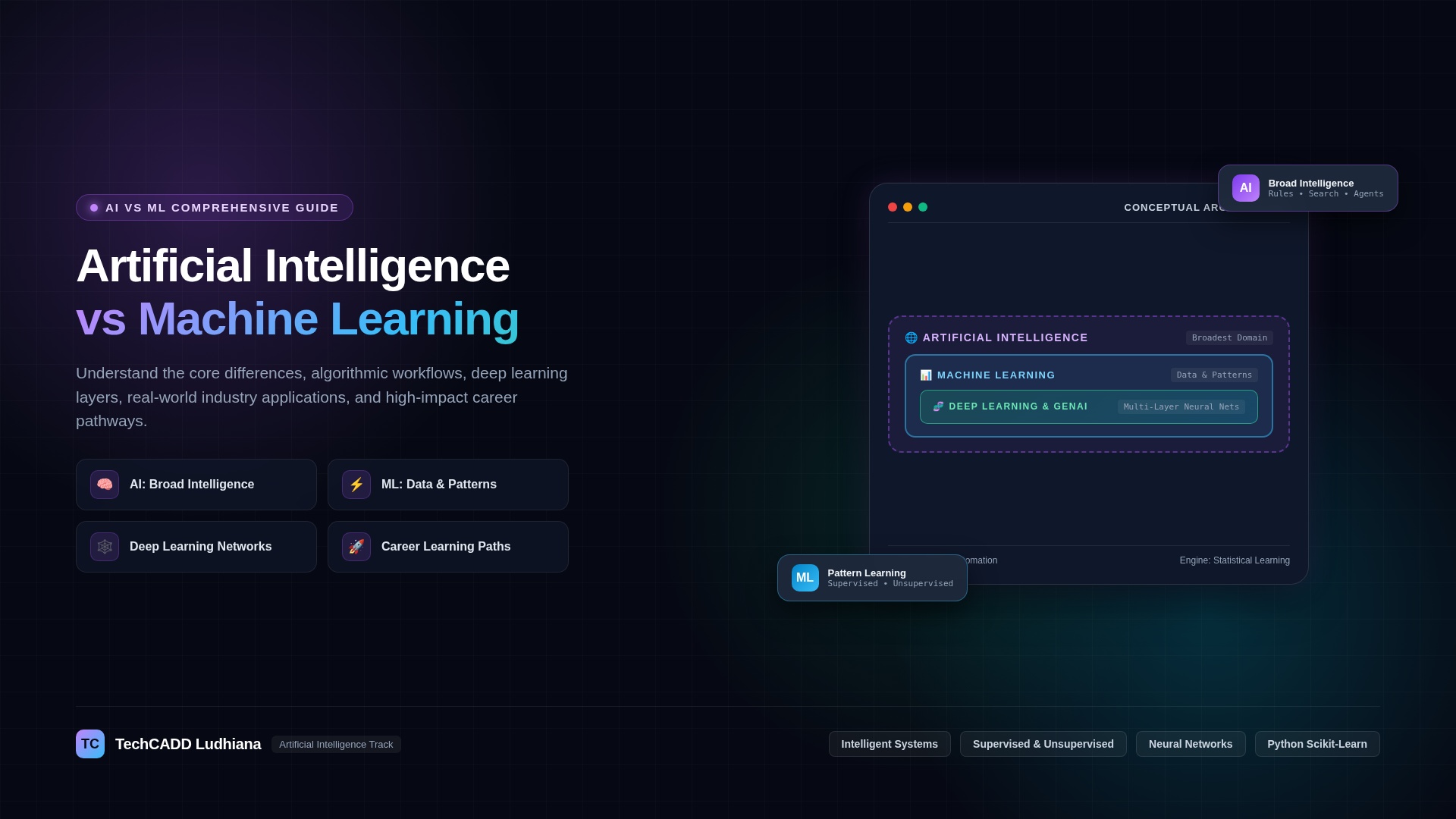
Artificial Intelligence vs Machine Learning: What's the Difference?
Artificial Intelligence (AI) and Machine Learning (ML) are closely related technologies that are transforming industries such as healthcare, finance, education, retail, cybersecurity, and software development. Although people often use these terms interchangeably, they have different meanings.
Artificial Intelligence is the broader field of creating computer systems that perform tasks associated with human intelligence, such as reasoning, planning, understanding language, and making decisions. Machine Learning is a subset of AI that enables systems to learn patterns from data and use those patterns to make predictions or decisions.
In this guide, you will learn the difference between AI and ML, how each technology works, practical examples, their applications, the role of Deep Learning, and how beginners can start learning these technologies.
What Is Artificial Intelligence (AI)?
Artificial Intelligence is a field of computer science focused on developing systems that can perform tasks that typically require aspects of human intelligence. Depending on the application, these tasks may include reasoning, planning, problem-solving, language processing, perception, and decision-making.
AI systems can use different approaches. Some rely on predefined rules and logical reasoning, while others use machine learning models trained on data. Modern AI applications often combine multiple techniques.
Examples of Artificial Intelligence
- Virtual assistants: Systems that interpret requests and help users complete tasks.
- Rule-based expert systems: Programs that apply predefined rules to reach conclusions.
- Route planning: Systems that evaluate routes and recommend paths based on specified conditions.
- Conversational AI: Applications that process and generate natural language.
- Robotics: Systems that combine sensing, planning, and control to perform physical tasks.
- Automated decision support: Applications that help evaluate information and recommend actions.
AI does not always require machine learning. A rule-based system can demonstrate AI techniques without training a model on a dataset.
What Is Machine Learning (ML)?
Machine Learning is a subset of Artificial Intelligence that focuses on algorithms that learn patterns from data. Instead of manually programming every rule for every possible situation, developers train a model using examples or other forms of data.
After training, the model can use the patterns it learned to make predictions, classify new examples, identify groups, or support decisions. Its performance depends on factors such as data quality, model selection, training methods, and how well the data represents the situations where the model will be used.
Examples of Machine Learning
- Email spam detection: Classifying messages as spam or legitimate based on learned patterns.
- Product recommendations: Suggesting items based on user activity, preferences, or similarities.
- Fraud detection: Identifying transactions that appear unusual or suspicious.
- Sales forecasting: Estimating future sales using historical observations and relevant variables.
- Image classification: Assigning labels to images based on learned visual patterns.
- Customer churn prediction: Estimating which customers may stop using a service.
Machine learning is particularly useful when patterns are difficult to express through manually written rules and suitable data is available.
Artificial Intelligence vs Machine Learning: Key Differences
| Comparison factor | Artificial Intelligence | Machine Learning |
|---|---|---|
| Definition | Broad field focused on building systems that perform intelligent tasks | Subset of AI focused on learning patterns from data |
| Scope | Includes rule-based reasoning, planning, search, ML, and other approaches | Focuses on data-driven learning algorithms and models |
| How it works | May use predefined rules, search, logic, learned models, or combinations | Uses data and learning algorithms to fit a model |
| Data requirements | Depends on the approach; some systems do not require training data | Training data or another learning signal is central to most conventional ML approaches |
| Primary objective | Perform tasks associated with intelligence | Learn useful patterns to make predictions, classifications, or other outputs |
| Example | A rule-based system that selects a route using predefined constraints | A model that predicts travel time from historical traffic data |
| Evaluation | Depends on the task, such as planning quality, correctness, or task completion | Often evaluated using suitable predictive or task-specific metrics on unseen data |
| Relationship | The broader field | A major approach within AI |
How Are AI and ML Related?
The relationship is easiest to understand as a hierarchy. Machine Learning is part of Artificial Intelligence, but AI includes methods that do not rely on machine learning.
For example, a rule-based troubleshooting program may use predefined conditions to recommend an action. A machine learning system may instead learn from historical examples to predict which action is likely to be useful. Both can be considered AI applications, but only the second necessarily uses machine learning.
Deep Learning is a further subset of Machine Learning that uses neural networks with multiple layers to learn complex patterns. Generative AI is a category of AI that produces content such as text, images, audio, video, or code. Many modern generative AI systems use deep learning, but not every AI system is generative.
Understanding AI, ML, Deep Learning and Generative AI
Artificial Intelligence (AI)
The broad field of building systems that perform tasks associated with intelligence.
Machine Learning (ML)
A subset of AI that learns patterns from data.
Deep Learning (DL)
A subset of ML that uses multilayer neural networks.
Many modern generative AI models
Use deep learning to generate new content from learned patterns.
This is a simplified conceptual hierarchy. Generative AI describes what a system does, while deep learning describes a family of techniques often used to build it.
How Does Artificial Intelligence Work?
AI systems can be built using different approaches, so their development process varies. A typical AI project may follow these steps:
- Define the problem: Identify the task the system needs to perform.
- Choose an approach: Determine whether rules, search, planning, machine learning, or a combination is appropriate.
- Prepare the system or data: Define rules, organize knowledge, or prepare relevant datasets depending on the chosen approach.
- Develop the solution: Implement the logic, algorithm, or model.
- Evaluate performance: Test whether the system meets the task's requirements.
- Deploy and monitor: Put the solution into use and review its performance and limitations.
How Does Machine Learning Work?
Machine learning follows a more specifically data-driven process. Although details vary by algorithm, a common workflow looks like this:
- Collect data: Gather suitable examples related to the problem.
- Clean and prepare data: Correct data quality problems and create appropriate input features.
- Split the dataset: Separate data for training and evaluation, using a suitable validation approach where needed.
- Select an algorithm: Choose a model based on the task and characteristics of the data.
- Train the model: Fit the model to the training data.
- Evaluate the model: Measure performance on data not used to fit the model.
- Improve the approach: Adjust features, model settings, or data preparation based on valid evaluation results.
- Deploy and monitor: Use the model in an application and monitor performance over time.
It is important to avoid data leakage, where information unavailable at prediction time influences training or evaluation. Reliable testing helps determine whether a model is likely to generalize to new data.
Types of Machine Learning
1. Supervised Learning
Supervised learning uses labelled examples, where the expected output is known during training. It is commonly used for classification and regression.
Example: Training a model on historical house information and prices to estimate prices for new properties.
2. Unsupervised Learning
Unsupervised learning works with data that does not have predefined target labels. It can help discover structure, similarities, or groups in a dataset.
Example: Grouping customers according to purchasing patterns for further analysis.
3. Reinforcement Learning
Reinforcement learning trains an agent to choose actions through interaction with an environment and feedback expressed through rewards or penalties. The objective is to learn a policy that performs well over time.
Example: Training an agent to navigate a simulated environment while optimizing a defined reward.
Real-World Applications of AI and ML
| Industry | AI applications | ML applications |
|---|---|---|
| Healthcare | Clinical decision-support workflows and intelligent information systems | Image analysis, risk prediction, and pattern recognition |
| Banking and finance | Automated workflows and rule-based decision support | Fraud detection, credit risk modelling, and forecasting |
| Retail and e-commerce | Conversational shopping assistants and automated service workflows | Product recommendations, demand forecasting, and customer segmentation |
| Education | Intelligent tutoring and learning support systems | Learning pattern analysis and performance prediction |
| Cybersecurity | Automated security workflows and rule-based detection systems | Anomaly detection, spam classification, and suspicious activity scoring |
| Manufacturing | Automated planning and intelligent process control | Predictive maintenance and defect detection |
| Transportation | Route planning and decision-making systems | Traffic prediction and travel-time estimation |
These examples are illustrative. Real systems often combine machine learning, conventional software, business rules, human review, and other techniques.
Advantages of Artificial Intelligence
- Can automate complex workflows and repetitive tasks.
- Supports planning, reasoning, search, and decision-making applications.
- Can combine rules, knowledge, data, and models in a single system.
- Can help process information at a scale that would be difficult to handle manually.
- Can improve consistency in well-defined tasks when appropriately designed and monitored.
Advantages of Machine Learning
- Can identify patterns in large or complex datasets.
- Supports predictions and classifications based on historical examples.
- Can adapt when models are retrained using relevant new data.
- Can support personalization, forecasting, and anomaly detection.
- Provides measurable evaluation methods for many predictive tasks.
Limitations and Challenges
Neither AI nor ML is automatically accurate, fair, secure, or appropriate for every task.
AI Challenges
- Systems may produce incorrect results or behave unpredictably outside their intended scope.
- Complex systems can be difficult to explain or validate.
- Deployment may require careful monitoring, human oversight, and clear responsibility.
- AI applications can introduce privacy, security, fairness, and reliability concerns.
Machine Learning Challenges
- Model quality depends on data relevance, coverage, and quality.
- Models can overfit training data and perform poorly on new examples.
- Biased or unrepresentative data can produce unfair outcomes.
- Models may degrade when real-world data patterns change.
- Training, evaluation, and deployment may require significant computing and engineering effort.
Which Is Better: AI or Machine Learning?
AI and ML are not competing technologies in a simple either-or choice. Machine Learning is one approach used within the broader field of AI. The appropriate choice depends on the problem you want to solve.
- Use rule-based AI when the requirements can be expressed as clear rules and deterministic behaviour is important.
- Consider machine learning when suitable data is available and patterns or predictions are difficult to encode manually.
- Combine approaches when business rules, predictive models, and human review each add value.
For example, a bank may use predefined rules to block transactions that violate mandatory controls and a machine learning model to identify unusual transaction patterns. The combined system can use both approaches for different purposes.
AI vs ML: Which Should Beginners Learn First?
If you are new to these fields, begin with programming fundamentals and a basic understanding of how AI systems solve problems. Then explore machine learning concepts and simple projects to understand how models learn from data.
A useful learning sequence is:
- Learn Python fundamentals, including variables, functions, lists, dictionaries, and file handling.
- Study basic mathematics, probability, and descriptive statistics.
- Understand core AI concepts such as search, reasoning, and problem-solving.
- Learn data handling with NumPy and Pandas.
- Study supervised and unsupervised machine learning.
- Build basic models using scikit-learn.
- Evaluate models carefully and document limitations.
- Explore deep learning or generative AI after building the foundations.
Projects to Understand AI and Machine Learning
Project 1: Rule-Based Expert System
Build a simple troubleshooting assistant that uses predefined conditions to recommend actions. This demonstrates an AI-style approach without requiring model training.
Project 2: Email Spam Classifier
Use a suitable labelled dataset to train a classification model that distinguishes spam from legitimate messages. Practise data preparation, evaluation, and error analysis.
Project 3: Customer Segmentation
Use an appropriate dataset to explore groups of customers with similar behaviour. Compare clustering results and explain how data preparation and feature selection influence the outcome.
Project 4: Sales Prediction
Use historical sales data to develop a basic regression model. Compare predictions with a simple baseline and explain the limitations of the available data.
Project 5: Intelligent FAQ Assistant
Create a simple FAQ assistant using either keyword-based rules or an appropriate language model. Compare the approaches in terms of development effort, flexibility, reliability, and the need to verify answers.
Use public, synthetic, or properly authorized data for projects. Document your approach, evaluation method, limitations, and any privacy considerations.
Career Opportunities in AI and Machine Learning
AI and ML skills can support several technical roles. The qualifications and experience required depend on the employer and the level of responsibility.
- AI Engineer: develops applications that use AI techniques and models.
- Machine Learning Engineer: builds, evaluates, deploys, and maintains machine learning systems.
- Data Scientist: analyses data and develops statistical or predictive models.
- Data Analyst: prepares data, creates reports, and identifies patterns to support decisions.
- Research Engineer: implements and evaluates methods used in AI research.
- AI Application Developer: integrates AI models and services into software applications.
Learning AI or ML does not guarantee a particular job. Practical projects, programming ability, mathematical understanding, communication, and software engineering skills can all influence career opportunities.
Learning AI and Machine Learning in Ludhiana
Students, graduates, and working professionals in Ludhiana, Punjab, can explore AI and machine learning through self-study, online courses, or classroom training. Before choosing a program, identify whether your goal is to understand AI concepts, build predictive models, develop AI-powered applications, or pursue a research-focused path.
When comparing AI and machine learning courses in Ludhiana, review the syllabus, Python coverage, mathematics requirements, hands-on projects, model evaluation methods, and instructor support. A useful program should explain not only how to build a model but also how to assess its limitations.
Search for artificial intelligence course in Ludhiana, machine learning training in Punjab, and Python machine learning course. Compare the learning outcomes and practical work rather than relying only on promotional claims or job guarantees.
Frequently Asked Questions
What is the main difference between AI and ML?
Artificial Intelligence is the broader field of creating systems that perform intelligent tasks. Machine Learning is a subset of AI that enables systems to learn patterns from data.
Is machine learning a part of artificial intelligence?
Yes. Machine Learning is a subset of Artificial Intelligence. AI also includes approaches such as rule-based reasoning, search, and planning that do not necessarily require machine learning.
What is the difference between AI, ML, and Deep Learning?
AI is the broad field, ML is a subset of AI that learns patterns from data, and Deep Learning is a subset of ML that uses neural networks with multiple layers.
Can AI work without machine learning?
Yes. Rule-based systems, search algorithms, and planning systems can perform AI-related tasks without being trained on data using machine learning.
Is machine learning harder than AI?
The difficulty depends on the approach and task. Basic rule-based AI can be relatively straightforward, while machine learning may require programming, statistics, data preparation, and model evaluation. Advanced AI systems can also be highly complex.
Which language is commonly used for machine learning?
Python is widely used for machine learning because of libraries such as NumPy, Pandas, and scikit-learn, along with frameworks used for deep learning.
Which should I learn first: AI or ML?
Start with programming fundamentals and basic AI concepts, then learn machine learning and data handling. This sequence helps you understand the broader field and the data-driven techniques used within it.
Are AI and ML used together in real applications?
Yes. Many applications combine machine learning models with predefined rules, conventional software, data pipelines, and human review to meet practical requirements.
Conclusion
Artificial Intelligence and Machine Learning are closely connected, but they are not identical. AI is the broader field of creating systems that perform intelligent tasks, while ML is a subset that learns patterns from data to support predictions, classifications, and other outputs.
Understanding this distinction helps you select the right tools, plan practical projects, and build a more effective learning path. Start with programming and foundational concepts, practise with small projects, and gradually explore machine learning, deep learning, and other AI techniques according to your interests.