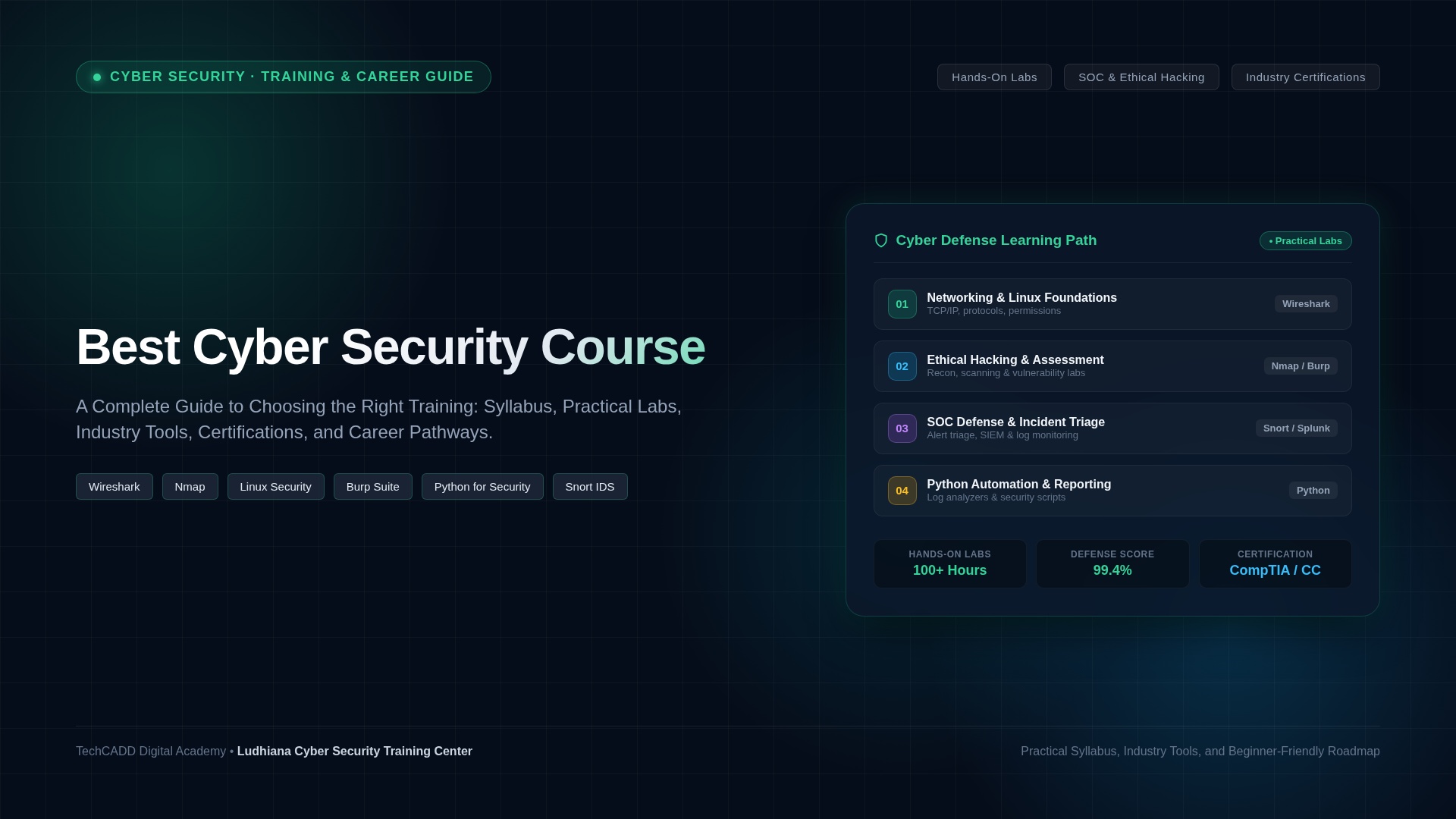
Best Cyber Security Course: A Complete Guide to Choosing the Right Training
Cyber security has become an important part of modern technology as businesses, governments, educational institutions, and individuals depend on digital systems. From protecting personal information to securing business networks and cloud platforms, cyber security professionals help identify vulnerabilities, prevent attacks, and respond to security incidents.
If you want to enter this field, choosing the best cyber security course is an important first step. The right course should match your current knowledge, career goals, budget, and preferred learning style. It should also include practical exercises instead of relying entirely on theory.
This guide explains what to look for in a cyber security course, which topics beginners should learn, what tools are useful, and how to evaluate training options in Ludhiana and elsewhere.
What Is a Cyber Security Course?
A cyber security course teaches learners how to protect computers, networks, applications, accounts, and digital information from unauthorized access, malicious software, data theft, and other security threats. Depending on the course level, it may cover networking, Linux, ethical hacking, vulnerability assessment, security monitoring, incident response, and digital forensics.
Beginner courses generally establish technical foundations, while advanced programs focus on specialized areas such as penetration testing, cloud security, security operations, application security, or incident response.
How to Choose the Best Cyber Security Course
There is no single course that is best for everyone. Compare the curriculum, practical work, instructor experience, learning support, total cost, and relevance to your intended career.
1. Check the Course Curriculum
A good beginner program should explain the fundamentals before moving to advanced security techniques. Look for coverage of:
- Computer networking, TCP/IP, DNS, HTTP and HTTPS, and common ports.
- Linux and Windows fundamentals, command-line usage, and permissions.
- Cyber security principles, threats, vulnerabilities, and risk management.
- Web application security and common vulnerability categories.
- Ethical hacking methodology and authorized security testing.
- Network security, firewalls, and intrusion detection systems.
- Security monitoring, log analysis, and incident response.
- Basic scripting with Python or shell commands.
- Professional ethics, legal boundaries, and responsible vulnerability disclosure.
2. Prioritize Hands-On Practice
Practical experience helps you understand how security concepts work in real environments. Choose training that includes guided labs, safe virtual machines, simulated networks, packet analysis, log investigation, and authorized testing of intentionally vulnerable applications.
Useful beginner projects include creating a network traffic analysis report, writing a Python log analyzer, configuring basic detection rules, and documenting findings from a legal web security lab.
3. Evaluate the Tools You Will Learn
Tools should support your understanding of security concepts rather than replace it. Depending on the course, you may work with:
- Wireshark: inspect and understand network traffic.
- Nmap: discover hosts and services on systems you are authorized to assess.
- Linux: use command-line utilities and understand system permissions.
- Snort: explore network intrusion detection and security alerts.
- Burp Suite: examine web requests and test web applications in authorized environments.
- Python: automate repetitive tasks and analyze logs.
- VirtualBox or similar virtualization software: create isolated learning environments.
Tool availability and depth vary by program. Ask for a module-by-module syllabus before enrolling.
4. Review Trainer Support and Course Structure
Check whether the course offers clear explanations, supervised lab sessions, doubt-clearing support, assignments, feedback, and project reviews. A transparent syllabus and realistic learning outcomes are more useful than broad promises about guaranteed jobs or instant expertise.
5. Check Projects and Career Preparation
Practical assignments can help you demonstrate your skills to employers. Look for programs that require written reports, screenshots or other appropriate evidence, remediation recommendations, and explanations of the methods used. Career support may include resume reviews, interview preparation, or guidance on building a portfolio, but its scope should be confirmed in writing.
Types of Cyber Security Courses
| Course type | Best suited for | Typical focus |
|---|---|---|
| Cyber Security Fundamentals | Complete beginners | Networking, operating systems, security principles, and basic threats |
| Ethical Hacking | Learners interested in authorized security testing | Reconnaissance, vulnerability assessment, controlled testing, and reporting |
| Penetration Testing | Learners with technical foundations | Structured testing of networks, applications, and systems |
| SOC Analyst Training | Learners interested in defensive security | Security alerts, SIEM concepts, log analysis, and incident triage |
| Network Security | Networking students and IT professionals | Network architecture, firewalls, monitoring, and access control |
| Cloud Security | Learners familiar with cloud platforms | Identity, permissions, configuration risks, logging, and cloud protection |
| Digital Forensics and Incident Response | Learners interested in investigations | Evidence handling, timelines, log analysis, and incident investigation |
Which Cyber Security Course Is Best for Beginners?
For most beginners, a structured cyber security fundamentals course is a sensible starting point. It builds the networking, operating system, and security knowledge needed to understand more specialized training.
If you already know basic networking and Linux, you may be ready to explore ethical hacking, penetration testing, or SOC analyst training. Choose according to the work you enjoy: testing systems, monitoring threats, investigating incidents, or securing infrastructure.
Cyber Security Course Syllabus for Beginners
Use this example syllabus to compare training programs. It is a suggested learning sequence, not a fixed industry standard.
- Module 1: IT foundations — computer hardware, operating systems, command-line basics, and virtualization.
- Module 2: Networking — IP addressing, TCP/IP, DNS, HTTP/HTTPS, ports, routing, and common network services.
- Module 3: Linux and Windows security — users, permissions, processes, services, updates, and system logs.
- Module 4: Security fundamentals — confidentiality, integrity, availability, authentication, authorization, encryption, and risk.
- Module 5: Vulnerability assessment — asset discovery, authorized scanning, prioritization, and remediation.
- Module 6: Web security — sessions, access control, input validation, and common web application weaknesses.
- Module 7: Defensive security — firewalls, intrusion detection, event logs, alert triage, and incident handling.
- Module 8: Python for security — file handling, parsing logs, basic automation, and error handling.
- Module 9: Practical projects — complete a lab-based investigation, document findings, and recommend fixes.
- Module 10: Career preparation — portfolio development, resume writing, interview practice, and choosing a specialization.
Cyber Security Certifications to Consider
Certifications can help structure learning and demonstrate knowledge, but their value depends on the role, employer, practical experience, and certification requirements.
- CompTIA Security+: a broad foundational certification to consider after studying core security concepts.
- Certified in Cybersecurity (CC): an entry-level option for learners seeking a structured introduction to security.
- eJPT: a practical entry-level penetration-testing certification option for learners with the required foundations.
- Role-specific certifications: consider advanced security operations, cloud security, or penetration-testing credentials after developing relevant experience.
Before paying for a certification, verify its current syllabus, exam cost, prerequisites, renewal policy, and recognition for your target role. A training course certificate and an independent professional certification are not necessarily the same thing.
How Long Does It Take to Learn Cyber Security?
The time required depends on your existing technical knowledge, study hours, course depth, and practical experience. A short introductory course may provide an overview, while developing job-ready skills generally requires sustained practice.
| Learning stage | Suggested focus |
|---|---|
| Foundation | Networking, Linux, Windows, and security fundamentals |
| Core practice | Packet analysis, authorized scanning, log analysis, and basic scripting |
| Specialization | Choose SOC operations, ethical hacking, cloud security, or another track |
| Portfolio | Complete projects, write reports, and practice explaining your findings |
Rather than relying only on a course duration, assess progress through practical tasks you can complete independently and explain clearly.
Career Opportunities After Cyber Security Training
Depending on your skills and experience, possible career paths include:
- Junior Security Analyst
- SOC Analyst
- Security Operations Intern or Trainee
- Vulnerability Assessment Analyst
- Junior Penetration Tester
- Network Security Support Specialist
- Incident Response Trainee
- IT Support Professional progressing toward security
Job titles and entry requirements vary between employers. Many roles expect solid IT fundamentals, clear documentation, problem-solving ability, and familiarity with real security workflows. Ethical hacking roles may require stronger technical foundations than an introductory course alone provides.
How to Find a Good Cyber Security Course in Ludhiana
If you are searching for the best cyber security course in Ludhiana, Punjab, compare local classroom programs with online and hybrid options. Attend a demo class where possible and ask how much time is devoted to practical work.
Before enrolling, ask the training provider:
- Is the syllabus available before registration?
- Are networking, Linux, Windows, and security fundamentals covered?
- Are practical labs included, and are they conducted in a legal, isolated environment?
- Will you complete projects and receive feedback on your reports?
- Who teaches the course, and what relevant experience do they have?
- What are the total fees, schedule, lab requirements, and refund terms?
- Does the advertised placement support have clearly defined services and conditions?
Search for terms such as cyber security course in Ludhiana, ethical hacking training in Ludhiana, and SOC analyst training in Punjab. Compare course details rather than selecting a provider based only on advertisements or claims of guaranteed employment.
Projects to Build While Learning Cyber Security
Projects help turn theory into evidence of practical understanding. Start with controlled environments and document what you learn.
- Network traffic analysis: capture permitted lab traffic in Wireshark and explain the protocols observed.
- Python log analyzer: parse sample authentication logs and summarize repeated failed login attempts.
- Intrusion detection lab: configure a basic Snort rule and test it using safe, controlled traffic.
- Vulnerability assessment report: assess an intentionally vulnerable lab target and document findings, severity, and remediation.
- Incident response exercise: review sample logs, build a timeline, identify indicators, and write a response report.
For every project, explain the objective, authorized scope, setup, steps, results, limitations, and recommended improvements. Never scan or test systems without explicit permission.
Common Mistakes to Avoid When Choosing a Course
- Choosing a course only because it advertises advanced hacking tools.
- Skipping networking and operating system fundamentals.
- Assuming that a certificate alone guarantees employment.
- Ignoring the quality and availability of practical labs.
- Learning commands without understanding their purpose and results.
- Practicing on real websites, networks, or accounts without authorization.
- Failing to review the total cost, curriculum, and course terms before paying.
Frequently Asked Questions
Which is the best cyber security course for beginners?
A fundamentals-focused course covering networking, Linux, Windows, security principles, and supervised practical labs is a good starting point for most beginners. Choose a specialization after developing these foundations.
Can I learn cyber security without coding?
Yes. You can begin with security fundamentals and defensive tools without being an experienced programmer. However, basic Python, shell scripting, and the ability to read code become increasingly useful for automation, investigations, and technical security testing.
Is ethical hacking the same as cyber security?
No. Ethical hacking is one part of the wider cyber security field. Cyber security also includes defensive monitoring, governance, risk management, incident response, forensics, identity management, and cloud security.
How do I choose a cyber security course in Ludhiana?
Compare the syllabus, instructor experience, practical lab access, project work, support, fees, and career services. A demo class and written course outline can help you assess whether the program suits your goals.
Do I need a computer science degree to learn cyber security?
A computer science degree is not the only route into cyber security. Learners from different educational backgrounds can start by developing IT fundamentals, practicing in legal labs, and building demonstrable skills. Specific employers and roles may have their own education requirements.
Does completing a cyber security course guarantee a job?
No course can responsibly guarantee a job for every learner. Employment depends on practical ability, communication, projects, experience, interview performance, and local hiring requirements.
What tools should I learn first?
Start with Linux command-line basics, Wireshark, and foundational networking tools. Add Nmap, Python, Snort, or web security tools as your knowledge develops, using only systems and environments you are authorized to test.
Conclusion
The best cyber security course is one that builds strong fundamentals, provides supervised practical experience, and helps you develop a clear career direction. Compare the curriculum, lab access, instructor support, project work, and overall cost before enrolling. If you are looking for cyber security training in Ludhiana, evaluate both local and online options and choose the program that best matches your current level and long-term goals.
Most importantly, keep practicing in authorized environments, document your projects, and continue learning as security technologies and threats evolve.