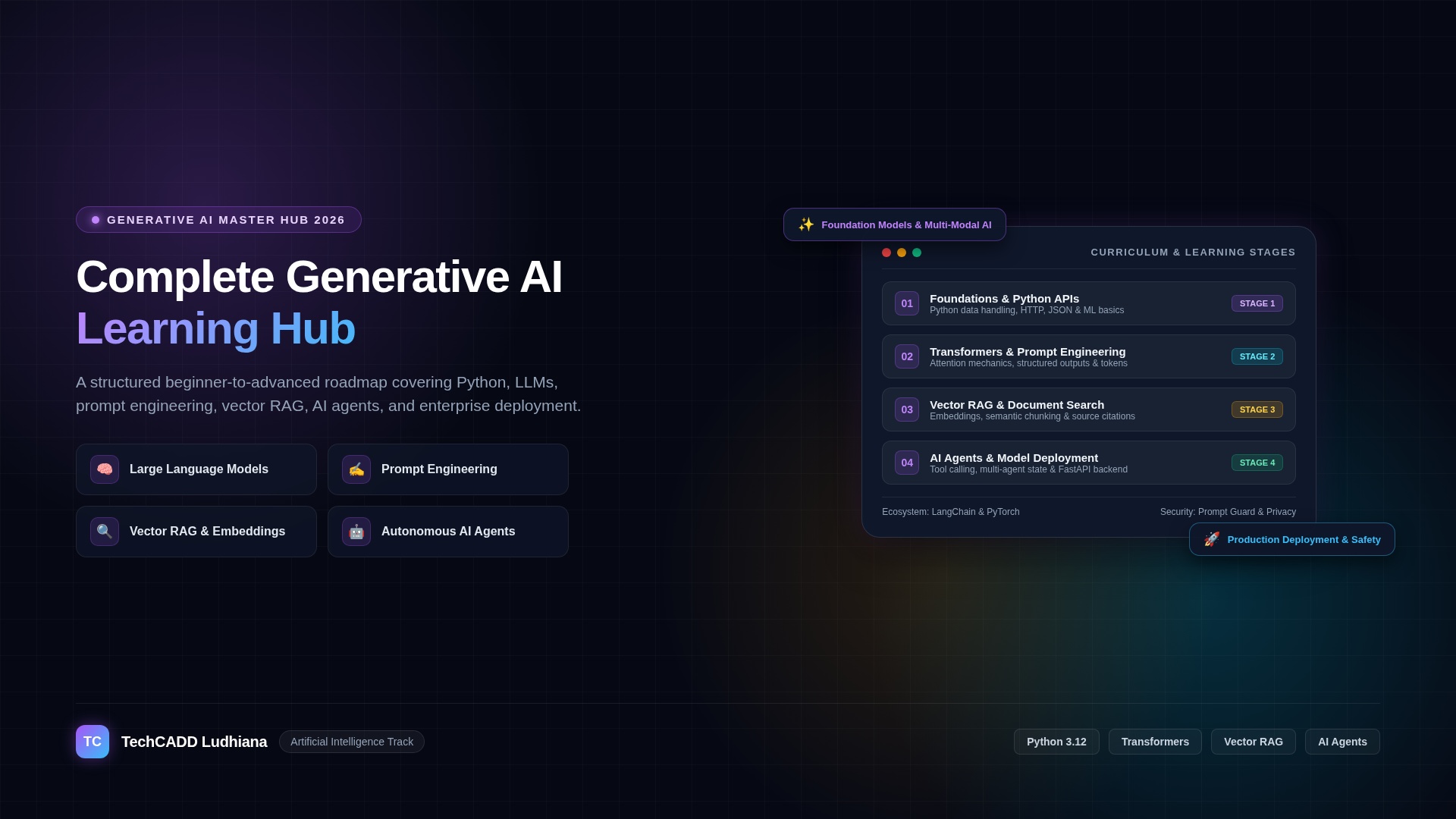
Complete Generative AI Learning Hub: Your Guide from Beginner to Advanced
Generative AI is transforming how people create content, write software, analyze information, and automate complex tasks. From conversational assistants and AI-generated images to document analysis and intelligent agents, generative models are enabling new ways to build digital products.
This complete Generative AI learning hub brings together the essential concepts, technologies, learning stages, projects, and career pathways for anyone interested in developing practical AI skills. Whether you are a student, programmer, working professional, or complete beginner, this guide can help you organize your learning journey.
What Is Generative AI?
Generative Artificial Intelligence (Generative AI) is a branch of AI that creates new content based on patterns learned from training data. Depending on the model, this content can include text, images, audio, video, code, or structured data.
For example, a generative AI application can draft an email from a set of instructions, summarize a long document, generate an illustration from a text prompt, or help a developer understand a codebase. The quality of its output depends on the model, the available context, the instructions, and the task.
Generative AI does not guarantee that its output is accurate, original, safe, or suitable for every purpose. Important outputs should be checked against reliable sources and reviewed before use.
Generative AI vs Traditional AI
Traditional AI applications often focus on tasks such as classification, prediction, ranking, or detecting patterns. Generative AI focuses on producing new content, although many modern applications combine both approaches.
| Feature | Traditional Predictive AI | Generative AI |
|---|---|---|
| Primary purpose | Predict, classify, rank, or detect | Generate content or new outputs |
| Typical input | Structured or unstructured data | Prompts, context, text, images, audio, or other supported inputs |
| Typical output | Labels, scores, predictions, or decisions | Text, images, code, audio, or other generated content |
| Example | Predicting whether a transaction is suspicious | Drafting a natural-language incident summary |
| Evaluation | Often uses task-specific predictive metrics | May require quality, factuality, safety, relevance, and task-specific evaluations |
Why Learn Generative AI?
- Build AI-powered applications: Connect models to websites, mobile apps, and business software.
- Automate repetitive tasks: Create systems for summarization, document extraction, drafting, and information retrieval.
- Improve developer workflows: Use AI tools to assist with code explanation, test generation, and documentation.
- Explore creative applications: Work with text, image, audio, and video generation tools.
- Develop practical projects: Build assistants, search applications, content tools, and workflow automation systems.
- Expand technical skills: Combine programming, APIs, databases, software engineering, and AI evaluation.
Learning Generative AI is most valuable when it helps you solve a specific problem and understand the limitations of the solution.
The Complete Generative AI Learning Roadmap
Use this roadmap to progress from programming foundations to building, evaluating, and deploying generative AI applications. The duration is an estimate and depends on your existing skills and available study time.
| Stage | Topics to Learn | Suggested Duration | Practice Outcome |
|---|---|---|---|
| 1. Programming foundations | Python, functions, data structures, modules, exceptions | 2–4 weeks | Build a Python utility |
| 2. Data and API fundamentals | JSON, HTTP, REST APIs, files, Git | 1–2 weeks | Connect to a public API |
| 3. AI and ML foundations | Basic machine learning, model evaluation, training and inference concepts | 2–4 weeks | Understand a simple prediction workflow |
| 4. Deep learning concepts | Neural networks, embeddings, attention, transformers | 2–4 weeks | Explain how modern language models work at a high level |
| 5. LLMs and prompt engineering | Tokens, context windows, prompting, structured outputs | 1–3 weeks | Build a structured-output assistant |
| 6. Model APIs and application development | Model integration, tool calling, error handling, configuration | 2–3 weeks | Build an AI-powered application |
| 7. Embeddings and RAG | Chunking, vector search, retrieval, source citations | 2–3 weeks | Build a document question-answering system |
| 8. Agents and workflows | Tool use, state, planning, workflow orchestration | 2–4 weeks | Create a controlled multi-step assistant |
| 9. Evaluation and safety | Testing, hallucination checks, prompt injection, privacy | 1–3 weeks | Evaluate failure cases and add safeguards |
| 10. Deployment and portfolio | FastAPI, deployment, monitoring, documentation | 2–4 weeks | Publish a working project demo |
Beginners do not need to master every topic before building an application. Start with a small project, learn the concepts needed to improve it, and expand gradually.
1. Learn Python for Generative AI
Python is a practical starting language for Generative AI because it has a broad ecosystem of libraries for APIs, data processing, model integration, and application development.
Essential Python topics
- Variables, data types, conditions, and loops.
- Functions, modules, packages, and object-oriented programming basics.
- Lists, dictionaries, tuples, sets, and comprehensions.
- File handling, JSON processing, and exception handling.
- Virtual environments and dependency management.
- HTTP requests, environment variables, and logging.
- Git and basic testing.
Beginner project: Create a command-line study assistant that accepts a topic, stores notes in JSON, and generates a revision checklist using deterministic Python logic before integrating a language model.
2. Understand AI, Machine Learning and Deep Learning
You can build useful applications with existing models without becoming a machine learning researcher, but understanding the fundamentals helps you select models, interpret results, and recognize limitations.
Important concepts
- Artificial intelligence: The broader field of systems performing tasks associated with intelligent behavior.
- Machine learning: Techniques that learn patterns from data.
- Deep learning: Machine learning based on multi-layer neural networks.
- Training: The process of adjusting model parameters using data and an optimization procedure.
- Inference: Using a trained model to produce an output for an input.
- Evaluation: Measuring whether a model performs well for its intended task.
Learn these concepts at a high level first. If your goal is to train or fine-tune models, continue into probability, linear algebra, optimization, neural networks, and deeper machine learning practice.
3. Learn Large Language Models (LLMs)
Large language models are trained to process and generate language and may also support code, structured outputs, or multimodal tasks. Many Generative AI applications use LLMs through hosted APIs or locally deployed models.
Key LLM concepts
- Tokens: Units of text processed by a model.
- Context window: The amount of input and conversation context a model can process in a request.
- Transformers: A neural network architecture used by many modern language models.
- Attention: A mechanism that helps models relate information across input sequences.
- Embeddings: Numerical representations used in similarity search and other tasks.
- Inference parameters: Settings that can influence output behavior, depending on the model and API.
- Structured outputs: Responses constrained to a format such as JSON or a defined schema.
When evaluating models, compare task performance, cost, response time, privacy requirements, context limits, and deployment options rather than choosing based on model size alone.
4. Master Prompt Engineering
Prompt engineering is the process of designing instructions and context to help a model produce outputs that meet a specific requirement. Effective prompts define the task, provide relevant information, describe constraints, and specify the expected format.
Elements of a useful prompt
- Goal: Explain what the model must accomplish.
- Context: Supply relevant facts or reference material.
- Constraints: State what the model must avoid or preserve.
- Output format: Define the structure, length, or fields expected.
- Examples: Provide representative input-output pairs when useful.
- Verification: Specify when the model should cite evidence, flag uncertainty, or ask for clarification.
Example prompt
You are a technical learning assistant. Explain the supplied programming concept for a beginner. Use one practical example, list three common mistakes, and finish with a short quiz. If the supplied material does not contain an answer, clearly state that the information is missing.Prompting is only one part of application quality. Reliable systems also need good data, validation, testing, suitable models, and clear evaluation criteria.
5. Explore Generative AI Tools and Technologies
The tools you need depend on whether you want to build applications, create content, train models, or deploy AI systems. Learn the underlying concepts before relying heavily on a framework.
| Technology | Purpose | When to Explore It |
|---|---|---|
| Python | Programming and application logic | At the beginning |
| Jupyter Notebook | Interactive experiments and data exploration | During foundational learning |
| NumPy and pandas | Numerical operations and data handling | When working with datasets |
| PyTorch | Deep learning experimentation and model development | When studying neural networks or model training |
| Hugging Face ecosystem | Model discovery, model usage, datasets, and related tooling | When exploring open models |
| Model provider APIs | Accessing hosted generative models | When building AI applications |
| LangChain or similar frameworks | Components and integrations for LLM applications | After understanding direct API calls |
| Vector search tools | Retrieving semantically relevant information | When building RAG applications |
| FastAPI | Exposing Python application logic through web APIs | When creating backend services |
| Docker | Packaging applications in containers | When reproducible deployment is needed |
Frameworks and provider offerings change frequently. Check official documentation, licensing, compatibility, pricing, and data-handling policies before selecting a technology for a real project.
6. Learn Retrieval-Augmented Generation (RAG)
Retrieval-Augmented Generation combines information retrieval with text generation. Before answering, the application searches a knowledge source and supplies relevant material to the model. This is useful when an assistant needs information from documents, policies, manuals, or project records.
How a basic RAG workflow works
- Load authorized documents from selected sources.
- Extract text and split it into manageable chunks.
- Generate embeddings or use another suitable retrieval representation.
- Store searchable content and useful metadata.
- Retrieve passages relevant to the user's question.
- Supply the retrieved context to the model.
- Generate an answer with references to supporting material.
- Evaluate retrieval quality and verify whether the answer is supported.
Beginner RAG project
Build a PDF learning assistant that answers questions from course notes and identifies the pages or sections supporting each answer. Add a fallback response for questions that cannot be answered from the supplied documents.
RAG can improve access to relevant information, but it does not automatically eliminate hallucinations. Poor retrieval, incomplete documents, and incorrect interpretation can still lead to mistakes.
7. Understand AI Agents and Agentic Workflows
An AI agent uses a model together with tools, state, and an execution process to pursue a goal through multiple steps. Unlike a simple question-answering interaction, an agentic workflow may retrieve data, call approved functions, inspect results, and decide what to do next.
Core building blocks
- Task definition and instructions.
- LLM reasoning or decision-making within defined limits.
- Tool calling and validated function execution.
- Workflow state and stopping conditions.
- Memory or retrieval when needed.
- Logging, evaluation, and failure handling.
- Human review for consequential actions.
Example: A research assistant can retrieve approved sources, organize findings, draft a report, and identify unsupported claims for review. It should not treat generated statements or agreement between multiple agents as proof of accuracy.
Start with a single agent and a small set of safe tools. Add multi-agent orchestration only when separate roles offer a clear improvement over a simpler workflow.
8. Explore Multimodal Generative AI
Multimodal AI systems work with more than one type of input or output, such as text, images, audio, or video. The available capabilities vary by model and service.
- Text generation: Drafting, rewriting, summarization, and question answering.
- Image generation: Creating illustrations, concepts, and visual assets from prompts.
- Speech processing: Transcription, speech synthesis, and voice-based interaction.
- Image understanding: Describing images, extracting information, and answering visual questions.
- Video workflows: Generating or analyzing supported video content.
- Code generation: Producing code suggestions, explanations, and initial test cases.
For multimodal projects, evaluate input limitations, output quality, copyright and consent requirements, privacy, accessibility, and the computational resources needed.
9. Learn Fine-Tuning and Model Customization
Fine-tuning adjusts a model using additional training examples to improve behavior for a particular task or domain. It is different from prompt engineering and RAG, which can often customize an application without changing the model's parameters.
| Approach | What Changes? | Common Use |
|---|---|---|
| Prompt engineering | Instructions and context | Adjusting task behavior without model training |
| RAG | Information retrieved at runtime | Answering questions using a changing knowledge base |
| Fine-tuning | Model parameters or selected trainable components | Adapting style, format, or task behavior with suitable training data |
| Continued pretraining | Further model training on additional data | Specialized language or domain adaptation in appropriate settings |
Before fine-tuning, define a measurable problem and create a suitable evaluation dataset. Consider data quality, privacy, licensing, compute requirements, and whether prompting or retrieval would solve the problem more simply.
10. Generative AI Security, Privacy and Responsible Use
Generative AI applications can expose sensitive information, produce incorrect answers, or be manipulated through untrusted inputs. Security must be part of the design from the beginning.
- Protect secrets: Keep API keys and credentials out of source code and public repositories.
- Validate outputs: Check structured responses before using them in databases, commands, or business workflows.
- Control tool permissions: Allow only the actions needed for the task.
- Defend against prompt injection: Treat retrieved documents and external content as untrusted input.
- Protect personal data: Minimize data collection and understand the provider's retention and processing policies.
- Review generated code: Test code for correctness, security, and unintended behavior before execution.
- Use human approval: Require confirmation for important external actions and irreversible changes.
- Evaluate fairness and reliability: Test outputs across relevant user groups and realistic failure cases.
- Respect intellectual property: Check permissions and applicable terms before using training data or distributing generated content.
Responsible development includes transparency about limitations and a clear process for correcting mistakes.
Best Generative AI Projects for Your Portfolio
1. AI study assistant
Create an assistant that explains technical concepts, generates practice questions, and organizes study notes. Include a review step so learners can verify generated explanations.
2. PDF question-answering application
Build a RAG system that answers questions from selected documents and cites the passages used. Test it with questions that are both answerable and unanswerable from the source material.
3. AI content drafting tool
Create a tool that drafts article outlines, summaries, or social media captions from user-provided information. Include editable output, clear constraints, and fact-checking reminders.
4. AI-powered customer support prototype
Build a support assistant using a sample knowledge base. It should retrieve relevant policies, draft responses, and hand uncertain cases to a human rather than inventing policies.
5. AI code explanation assistant
Create an application that explains selected code, identifies possible issues, and suggests test cases. Treat suggestions as unverified until reviewed and tested.
6. Generative AI image workflow
Build a creative workflow that organizes prompts, stores generated assets, and records the model and settings used. Consider licensing and consent for source materials.
7. Cybersecurity log summarizer
Use synthetic or authorized log data to summarize security events and propose investigation questions. Keep detection rules and analyst verification separate from generated explanations, and do not allow unrestricted response actions.
8. AI research assistant
Develop a workflow that retrieves information from approved sources, organizes evidence, drafts a report, and flags claims that lack adequate support.
9. AI-powered mobile application
Create an Android or web application that connects to a generative model through a protected backend. Include authentication, rate limits, privacy controls, and cost monitoring.
A 12-Week Generative AI Study Plan
| Weeks | Learning Focus | Deliverable |
|---|---|---|
| 1–2 | Python, Git, JSON, API basics | Python utility with API integration |
| 3 | AI, ML, deep learning and transformer concepts | Short technical notes and a simple model experiment |
| 4 | LLMs, tokens, context and prompt engineering | Prompt-based assistant |
| 5 | Structured outputs and model APIs | AI application with validated JSON output |
| 6–7 | Embeddings, retrieval and RAG | Document question-answering application |
| 8 | Tool calling and agent workflows | Controlled tool-using assistant |
| 9 | Multimodal AI or model customization | Small specialization experiment |
| 10 | Testing, evaluation, privacy and security | Evaluation dataset and risk checklist |
| 11 | Backend development and deployment | Runnable application or hosted demo |
| 12 | Documentation, testing and portfolio presentation | Complete project repository and demonstration |
This plan is a starting point, not a promise that every learner will master all topics in 12 weeks. If programming is new to you, extend the foundational stages and reduce the number of advanced topics covered initially.
Career Opportunities in Generative AI
Generative AI knowledge can complement several software and AI career paths. The requirements differ by employer and role, so combine AI knowledge with practical programming and engineering experience.
- Generative AI application developer: Builds applications using model APIs, retrieval, and application logic.
- LLM application engineer: Develops systems involving prompts, structured outputs, evaluation, and integrations.
- AI automation engineer: Designs controlled workflows for multi-step business processes.
- Machine learning engineer: Works on model training, evaluation, deployment, and machine learning infrastructure.
- AI data engineer: Develops data pipelines and prepares information for AI systems.
- AI evaluation engineer: Designs tests and measures model and application performance.
- AI security engineer: Evaluates risks involving prompts, tools, data exposure, and model-powered workflows.
- AI product engineer: Integrates AI capabilities into user-facing software products.
Learning Generative AI alone does not guarantee a job. Employers may also expect programming proficiency, problem-solving, software architecture, testing, communication, and evidence of completed projects.
How to Choose a Generative AI Course in Ludhiana
If you are searching for a Generative AI course in Ludhiana, Punjab, compare the syllabus, practical exercises, instructor support, and project outcomes before enrolling. A strong learning program should explain both how to build AI applications and how to evaluate their limitations.
Consider these questions before choosing a course:
- Does the program teach Python and API fundamentals?
- Does it cover LLMs, prompt engineering, structured outputs, and RAG?
- Will you build projects using real application workflows rather than only follow demonstrations?
- Does the syllabus address evaluation, hallucinations, prompt injection, and data privacy?
- Will you learn how to deploy and document an application?
- Are the duration, prerequisites, fees, and support arrangements clearly stated?
- Can you keep and demonstrate your project work after the course?
Compare local classroom options with online learning resources and official documentation. Verify current course details directly with each provider and avoid relying on unsupported placement or salary guarantees.
Common Mistakes to Avoid When Learning Generative AI
- Skipping programming fundamentals and relying entirely on no-code tools.
- Learning frameworks without understanding how model APIs work.
- Assuming every generated answer is factually correct.
- Building demos without testing difficult or unanswerable questions.
- Sending sensitive information to a service without checking its data-handling terms.
- Fine-tuning models before determining whether prompting or RAG is sufficient.
- Giving AI agents unnecessary permissions to perform external actions.
- Ignoring model usage costs, response latency, and rate limits.
- Publishing projects without clear setup instructions, limitations, and evaluation results.
Frequently Asked Questions
What is the best way to start learning Generative AI?
Start with Python and API fundamentals, then learn how LLMs work, practice prompt engineering, build a simple model-powered application, and progress to RAG, agents, evaluation, and deployment.
Can I learn Generative AI without machine learning experience?
Yes. You can begin by integrating existing models into applications without training your own models. Basic machine learning knowledge becomes more important as you move toward model evaluation, fine-tuning, or research.
Is Python necessary for Generative AI?
Python is a practical choice for AI development, but it is not the only option. JavaScript and TypeScript can also be used to integrate models into web applications. Choose a language suited to your project and learn it well.
How long does it take to learn Generative AI?
A learner with basic programming knowledge might build an initial portfolio project in approximately three months of regular practice. Developing deeper expertise can take much longer, depending on the topics studied and the complexity of the projects.
What is the difference between RAG and fine-tuning?
RAG retrieves relevant information and supplies it to a model at runtime. Fine-tuning changes model parameters or selected trainable components using additional training data. RAG is often suitable for changing knowledge bases, while fine-tuning may help with specific task behavior.
What is the difference between Generative AI and Agentic AI?
Generative AI produces content such as text, images, or code. Agentic AI uses models, tools, state, and workflows to pursue goals across multiple steps. An agent may use Generative AI, but generating content alone does not make an application an agent.
Do I need a powerful computer to learn Generative AI?
Not necessarily. You can learn programming, prompt engineering, RAG, and API integration using a standard development computer and suitable hosted services. Training or running larger models locally may require more memory, storage, and specialized hardware.
Which projects are best for a Generative AI portfolio?
Good choices include a document question-answering system with citations, a customer support prototype, an AI study assistant, a code explanation tool, and a research assistant that evaluates source support.
Can Generative AI be used in cybersecurity?
Yes. Potential applications include summarizing logs, explaining alerts, searching security documentation, and assisting with incident reports. Generated findings should be verified by an analyst, and tools should operate within explicit permissions.
How can I learn Generative AI in Ludhiana?
You can compare local training providers, online courses, and official technical documentation. Prioritize hands-on projects, Python and API fundamentals, RAG, evaluation, security, instructor support, and transparent course fees.
Conclusion
This complete Generative AI learning hub provides a structured path from programming foundations to LLM applications, retrieval, AI agents, multimodal tools, security, evaluation, and deployment. You do not need to learn every technology at once to make progress.
Choose one practical problem, build a small application, measure its performance, and improve it through testing. Projects that demonstrate reliable behavior, responsible data handling, and clear documentation can help you develop stronger technical skills and present your work to potential employers.