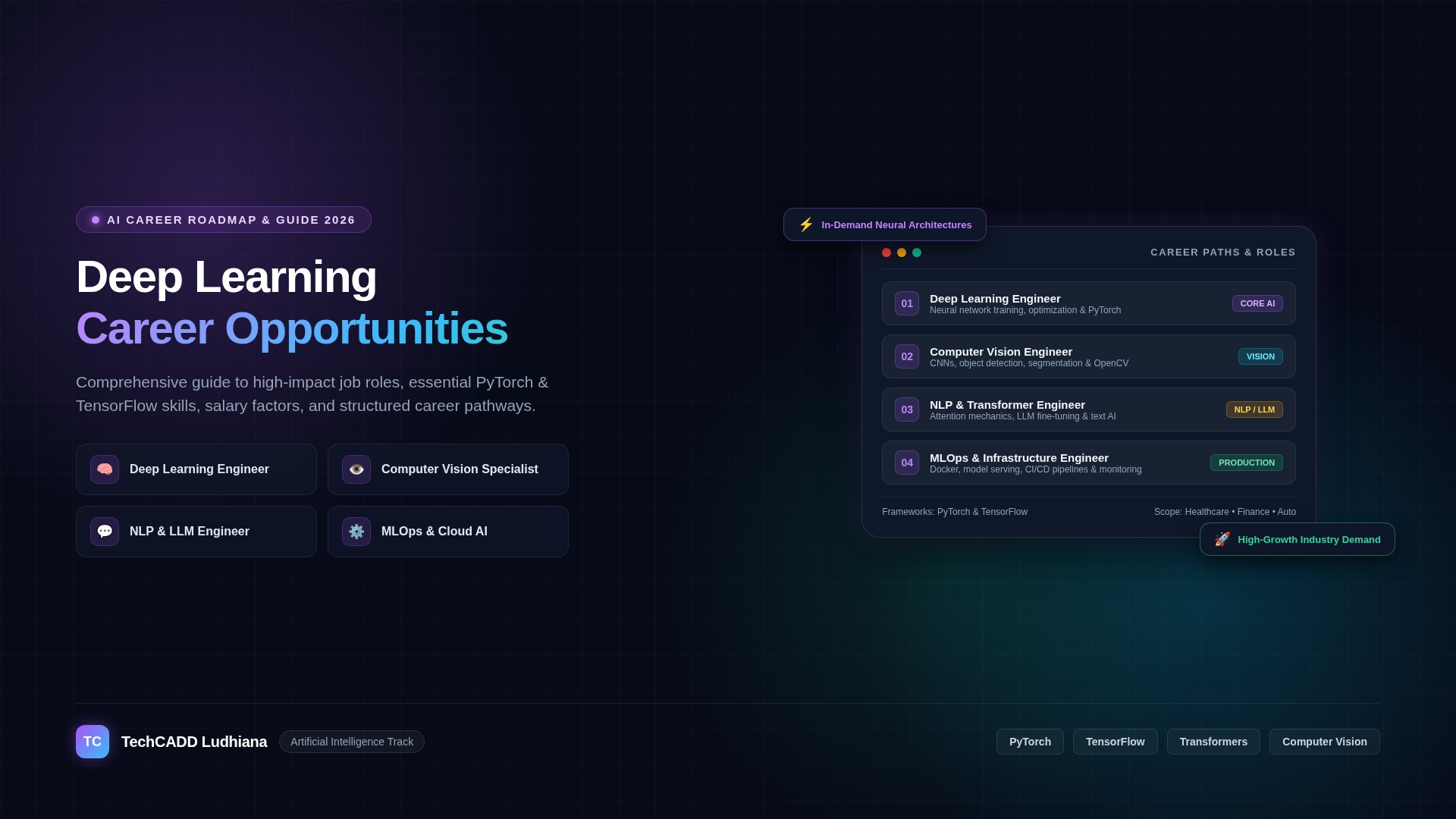
Deep Learning Career Opportunities: A Complete Career Guide
Deep learning is an important area of artificial intelligence (AI) that enables computers to learn complex patterns from large amounts of data. It powers technologies such as image recognition, speech processing, recommendation systems, autonomous systems, and generative AI. As organizations explore AI-driven products and automation, deep learning offers several career paths for people with backgrounds in computer science, mathematics, software development, and data science.
This guide explains the major deep learning career opportunities, the skills employers commonly seek, potential industries, salary considerations, and practical steps for preparing for a career in this field.
What Is Deep Learning?
Deep learning is a branch of machine learning that uses artificial neural networks with multiple layers to learn representations from data. Unlike traditional approaches that may rely heavily on manually designed features, deep learning models can learn useful patterns from examples during training.
For example, a deep learning model can be trained on thousands of labelled images to identify objects, or it can process speech and text to support voice assistants and language applications.
Why Choose a Career in Deep Learning?
- Broad applications: Deep learning is used in healthcare, finance, manufacturing, retail, robotics, cybersecurity, and media.
- Technical problem-solving: Professionals work on data, algorithms, model training, evaluation, and deployment.
- Multiple career routes: Candidates can pursue research, engineering, computer vision, natural language processing, or AI infrastructure roles.
- Continuous learning: The field evolves as new architectures, tools, and deployment methods emerge.
- Transferable skills: Python, statistics, software engineering, and data handling skills can also support careers outside deep learning.
Top Deep Learning Career Opportunities
1. Deep Learning Engineer
Deep learning engineers design, train, evaluate, and optimize neural network models for practical applications. They may work on computer vision, speech recognition, recommendation systems, or generative AI features.
Common skills: Python, PyTorch or TensorFlow, neural networks, model evaluation, data preprocessing, and software engineering.
2. Machine Learning Engineer
Machine learning engineers build systems that use data-driven models to make predictions or automate decisions. Some roles focus on traditional machine learning, while others involve deep learning models and large-scale inference systems.
Common skills: Python, machine learning algorithms, model validation, APIs, data pipelines, deployment, and version control.
3. Computer Vision Engineer
Computer vision engineers develop systems that interpret images and video. Applications include quality inspection, medical image analysis, object detection, facial image processing, and visual navigation.
Common skills: Convolutional neural networks, image processing, object detection, OpenCV, PyTorch or TensorFlow, and dataset annotation.
4. Natural Language Processing Engineer
Natural language processing (NLP) engineers build applications that process human language. Their work can include text classification, information extraction, search, translation, chatbots, and language-model applications.
Common skills: NLP fundamentals, transformers, tokenization, text preprocessing, model evaluation, Python, and relevant language-model libraries.
5. AI Research Engineer or Research Scientist
AI research professionals investigate new model architectures, training methods, evaluation techniques, and approaches to improving model performance. Research scientist positions often require advanced mathematical knowledge and, in many cases, a master's degree or PhD, while research engineering roles may place greater emphasis on implementation.
Common skills: Linear algebra, calculus, probability, optimization, research-paper reading, experimental design, and deep learning frameworks.
6. MLOps Engineer
MLOps engineers help teams reliably deploy, monitor, update, and maintain machine learning systems. Their responsibilities can include automated training pipelines, model versioning, performance monitoring, and reproducible deployments.
Common skills: Python, Git, Docker, CI/CD, cloud platforms, workflow orchestration, model monitoring, and data engineering fundamentals.
7. AI Software Engineer
AI software engineers integrate AI models into usable applications, APIs, websites, mobile apps, and business workflows. This path can suit software developers who want to apply existing models without specializing exclusively in model research.
Common skills: Python or another programming language, APIs, backend development, databases, testing, deployment, and AI integration.
8. Data Scientist with Deep Learning Skills
Data scientists analyze datasets, develop predictive models, communicate findings, and help organizations make evidence-based decisions. Deep learning may be useful when working with unstructured data such as images, audio, and text, although many data science roles rely on statistical methods and traditional machine learning instead.
Common skills: Statistics, SQL, Python, data visualization, experimental analysis, machine learning, and model interpretation.
Deep Learning Careers at a Glance
| Career role | Typical focus | Useful starting foundation |
|---|---|---|
| Deep Learning Engineer | Neural network development and optimization | Python, mathematics, neural networks |
| Machine Learning Engineer | Building and deploying predictive systems | Python, ML fundamentals, software engineering |
| Computer Vision Engineer | Image and video understanding | Image processing, CNNs, model evaluation |
| NLP Engineer | Text and language applications | Python, NLP, transformers |
| AI Research Professional | Research and experimentation | Mathematics, research methods, deep learning |
| MLOps Engineer | Deployment, automation, and monitoring | Python, Docker, cloud, CI/CD |
| AI Software Engineer | Integrating models into applications | Programming, APIs, backend development |
| Data Scientist | Data analysis and predictive modelling | Statistics, SQL, Python, ML |
Industries Hiring Deep Learning Professionals
- Healthcare: Medical-image analysis, clinical decision support, and research tools.
- Automotive and robotics: Object detection, perception, and navigation systems.
- Finance: Document processing, forecasting experiments, fraud analysis, and risk workflows.
- Retail and e-commerce: Product recommendations, visual search, and demand-related analytics.
- Cybersecurity: Research into anomaly detection, malware classification, and suspicious activity analysis.
- Manufacturing: Visual quality inspection and predictive maintenance.
- Media and entertainment: Speech processing, content understanding, image generation, and video tools.
- Software and cloud services: AI-powered products, model-serving infrastructure, and developer tools.
Essential Skills for a Deep Learning Career
Programming
Python is a common starting language because it has a large ecosystem for data analysis and machine learning. Learn functions, classes, modules, debugging, virtual environments, and basic software testing. Familiarity with NumPy, pandas, and visualization libraries is useful.
Mathematics and Statistics
Build a working understanding of linear algebra, derivatives, probability, statistics, loss functions, gradient descent, and optimization. You do not need to master every mathematical topic before building a first project, but stronger foundations become increasingly valuable as models become more complex.
Machine Learning Fundamentals
Learn supervised and unsupervised learning, data splitting, overfitting, regularization, feature engineering, evaluation metrics, and data leakage. These concepts help you understand when a deep learning approach is appropriate and how to measure its performance.
Neural Networks and Frameworks
Study activation functions, forward propagation, backpropagation, optimizers, batch training, and model evaluation. Then practise with a framework such as PyTorch or TensorFlow. Focus on understanding model behaviour rather than simply copying code.
Deployment and Communication
Employers may also value Git, APIs, containers, cloud fundamentals, documentation, teamwork, and the ability to explain model limitations. Production-focused roles require attention to latency, cost, reliability, privacy, and monitoring in addition to model accuracy.
Deep Learning Career Roadmap for Beginners
- Learn Python: Practise programming, data structures, functions, file handling, and debugging.
- Build mathematics foundations: Study the linear algebra, probability, and calculus concepts used in machine learning.
- Learn machine learning: Understand regression, classification, model validation, and common evaluation metrics.
- Study neural networks: Train simple networks and learn how loss functions, gradients, and optimizers work.
- Choose a specialization: Explore computer vision, NLP, speech processing, generative AI, or model infrastructure.
- Complete practical projects: Build projects with clear objectives, documented datasets, baseline comparisons, and evaluation results.
- Deploy a model: Create a simple API or web application that demonstrates a trained model in use.
- Prepare a portfolio: Publish code, project explanations, results, limitations, and setup instructions in a professional repository.
- Apply strategically: Compare your skills with job descriptions and consider internships, junior software roles, data roles, and entry-level ML opportunities.
Portfolio Projects for Deep Learning Jobs
- Image classifier: Train a model to classify a well-defined set of images and report precision, recall, and a confusion matrix where appropriate.
- Object detection demo: Use a suitable dataset to detect objects in images or video and explain limitations across different lighting and backgrounds.
- Sentiment analysis: Build a text classification pipeline and evaluate it on a separate test set.
- Document or FAQ assistant: Create a language-based application and evaluate answer quality, failure cases, and privacy considerations.
- Model deployment API: Serve a trained model through an API and document latency, resource requirements, and input validation.
- Security anomaly detection experiment: Use an appropriate public or synthetic dataset to compare a baseline with a neural network, avoiding claims that the model can detect every real-world attack.
For every project, include the problem statement, dataset source, preprocessing steps, baseline, evaluation method, results, limitations, and instructions for reproducing the work. A well-explained small project can demonstrate more understanding than a complex project copied without explanation.
Deep Learning Salary Expectations
Deep learning salaries vary substantially by country, city, experience, employer, specialization, education, and the scale of systems a person can build. Research-oriented roles may have different requirements and compensation structures from product engineering, data science, and MLOps roles.
Rather than relying on a single salary figure, compare recent job postings for the exact role and location you are targeting. Separate internship, entry-level, mid-level, and senior compensation, and check whether a quoted figure represents base salary, total compensation, or contract pay. Salary reports can be useful for orientation, but they are not a guarantee of an individual offer.
Are Deep Learning Jobs Suitable for Freshers?
Yes, freshers can work toward deep learning-related careers, but dedicated deep learning engineer positions may expect strong programming, mathematics, and project experience. Entry routes can include internships, junior software engineering, data analyst or data science roles, machine learning internships, and AI application development.
Computer science graduates can use their programming background to build a portfolio and demonstrate practical ability. Candidates without a formal AI degree can also learn relevant skills, although employer requirements vary. Research-heavy positions may require postgraduate education, publications, or specialized experience.
How to Explore Deep Learning Training in Ludhiana
Students seeking Deep Learning training in Ludhiana, Punjab, can compare classroom and online learning options by examining the syllabus, instructor experience, practical lab work, project feedback, batch size, and total course fees. Look for coverage of Python, machine learning fundamentals, neural networks, model evaluation, and deployment rather than a course that focuses only on demonstrations.
Before enrolling, ask to see a sample lesson, the complete module list, the tools used in practical sessions, and examples of projects students complete. Confirm what support is included and whether any internship or placement claims are documented. Learners can also combine online coursework with local peer groups, independent projects, and remote internships.
Deep Learning vs Machine Learning Careers
| Aspect | Machine learning | Deep learning |
|---|---|---|
| Methods | Includes statistical models, tree-based methods, and neural networks | Focuses on multi-layer neural networks |
| Data needs | Can perform well on small or structured datasets, depending on the problem | Often benefits from large datasets, although requirements vary |
| Compute | May be feasible with modest hardware for many tasks | Complex training can require GPUs or specialized infrastructure |
| Career roles | ML engineer, data scientist, applied scientist | Deep learning engineer, computer vision engineer, NLP engineer |
| Best starting point | Learn core ML concepts and evaluation | Build ML foundations before specializing in neural networks |
Deep learning is a subset of machine learning, not a separate replacement for all machine learning methods. Employers choose techniques based on data, performance needs, cost, interpretability, and maintenance requirements.
Frequently Asked Questions
What are the best career opportunities in deep learning?
Common options include deep learning engineer, machine learning engineer, computer vision engineer, NLP engineer, AI research professional, MLOps engineer, AI software engineer, and data scientist. The best fit depends on your interests and technical strengths.
Can I get a deep learning job as a fresher?
Yes, it is possible, especially through internships and junior technical roles. Build strong Python and machine learning foundations, complete practical projects, and target openings whose requirements match your skills.
Is Python necessary for deep learning?
Python is the most common starting language for deep learning because major frameworks and data-science tools support it. Other programming languages may be used for deployment and performance-critical components.
Do I need a master's degree for a deep learning career?
Not for every role. Engineering and application-development positions may accept a bachelor's degree plus relevant skills and experience. Research scientist positions often prefer or require a master's degree or PhD.
How long does it take to learn deep learning?
The timeline depends on your starting point, study time, mathematics background, and project complexity. Someone who already knows Python and machine learning may progress faster than a complete beginner. Focus on demonstrable skills instead of relying on a fixed timeline.
Which deep learning framework should beginners learn?
PyTorch and TensorFlow are both widely used. Choose one to start, learn its model-building and training workflow, and later explore the other if it aligns with your target roles.
Are deep learning careers available in India?
Deep learning-related roles exist in India across software companies, product teams, research groups, analytics organizations, and technology-driven industries. Availability varies by city, experience level, and employer requirements, so check current job listings for specific opportunities.
What projects help a deep learning resume?
Useful projects include image classification, object detection, text classification, model-serving APIs, and carefully evaluated AI applications. Document your data, methodology, results, and limitations so recruiters can understand your contribution.
Can deep learning be useful in cybersecurity?
Yes. It is explored for anomaly detection, malware classification, phishing analysis, and security event prioritization. These applications require careful evaluation because false positives, adversarial behaviour, and changing attack patterns can affect reliability.
Where can I learn deep learning in Ludhiana?
Compare local institutes and online programs based on curriculum, instructor experience, practical assignments, projects, feedback, and fees. Choose a program that builds foundations and offers hands-on practice instead of promising guaranteed employment.
Conclusion
Deep learning offers a range of career opportunities, from building neural network models to deploying AI-powered software and researching new techniques. A strong foundation in Python, mathematics, machine learning, and model evaluation will help you choose a specialization and create a credible portfolio. Start with manageable projects, document your results honestly, and align your learning with real job descriptions in your target industry and location.