Digital Marketing Course Eligibility: Who Can Apply?
Digital marketing has become an important skill for businesses that want to reach customers through search engines, social media, websites, email, and online advertising. As companies increasingly use digital channels to promote products and services, students, graduates, business owners, and working professionals are exploring digital marketing as a career or a way to grow their businesses.
One of the first questions learners ask is: What is the eligibility for a digital marketing course? The good news is that many beginner-level digital marketing courses do not require a specific degree or previous marketing experience. However, eligibility requirements can vary depending on the institute, course level, and certification.
This guide explains the usual educational requirements, age considerations, basic skills, admission process, and factors to consider before enrolling in a digital marketing course in Ludhiana, Punjab.
What Is the Eligibility for a Digital Marketing Course?
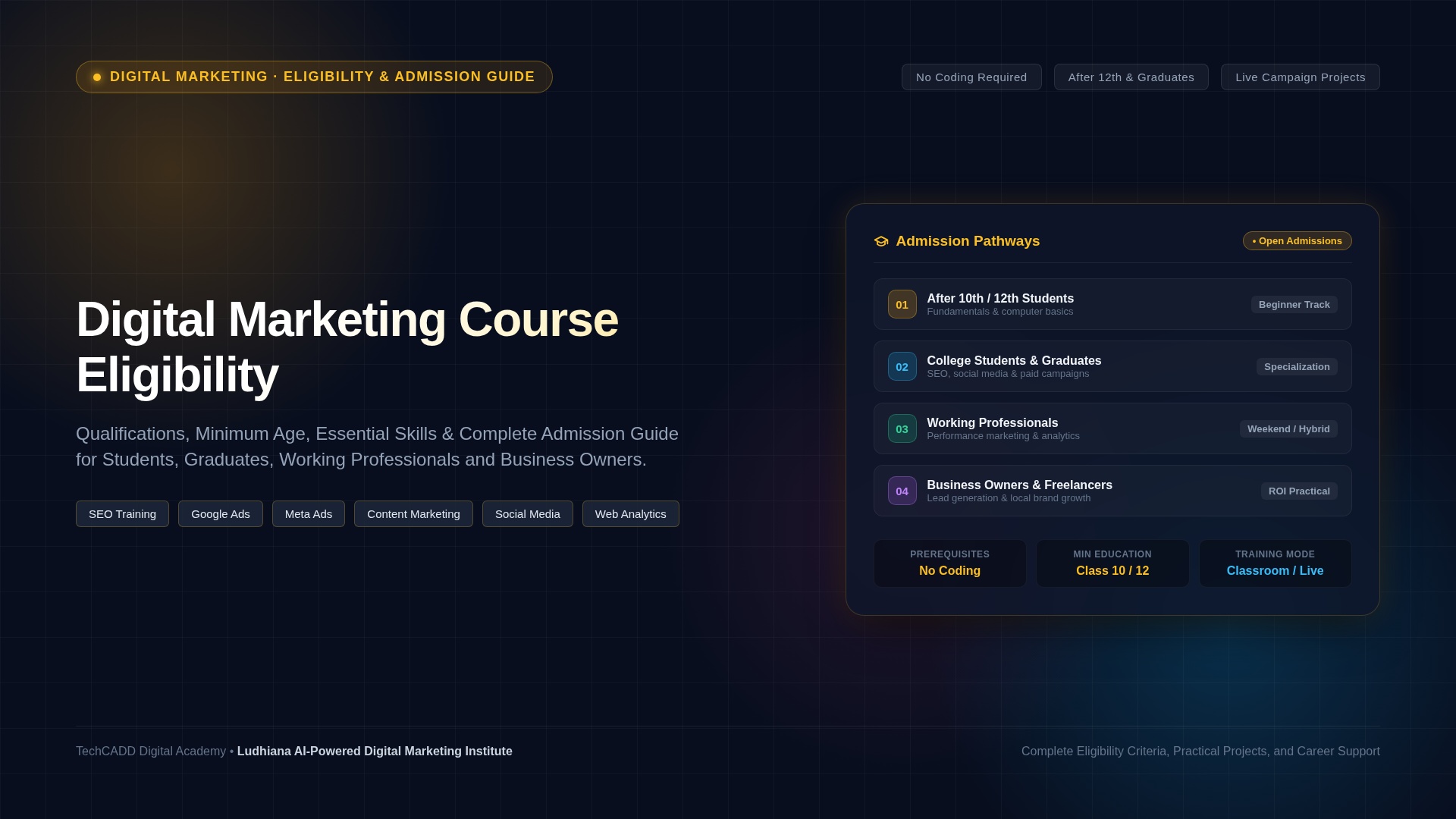
For many beginner-friendly digital marketing courses, students who have completed Class 10 or Class 12, college students, graduates, and working professionals can apply. Some advanced or academic programs may require graduation or prior experience, so always confirm the requirements of the specific course.
Digital marketing is a practical field, and learners can often begin without a technical background. Interest in online platforms, communication, creativity, analytical thinking, and willingness to practice are useful starting points.
Educational Qualification Required for Digital Marketing
| Educational background | Typical eligibility | Suitable learning path |
|---|---|---|
| Class 10 completed | May qualify for beginner courses, depending on the provider | Digital marketing fundamentals and basic computer skills |
| Class 12 completed | Eligible for many introductory training programs | SEO, social media marketing, content creation, and advertising basics |
| College student | Often suitable for short-term or part-time courses | Practical projects, internships, and portfolio development |
| Graduate | Suitable for beginner and advanced training, depending on prior knowledge | Specialization in SEO, performance marketing, analytics, or strategy |
| Working professional | Often suitable for flexible or weekend programs | Career development, digital strategy, or business marketing |
| Business owner or freelancer | Usually suitable for practical courses without strict academic prerequisites | Lead generation, local SEO, social media, and paid advertising |
These are general guidelines, not universal admission rules. An institute may set its own minimum qualification, language, attendance, or assessment requirements.
Is Graduation Necessary for a Digital Marketing Course?
No, graduation is not mandatory for every digital marketing course. Many short-term professional training programs are open to learners who have completed school or are currently studying. A bachelor's degree may be required for certain university programs, formal academic qualifications, or specific job openings.
For practical digital marketing roles, employers may also consider campaign experience, communication, analytical ability, portfolio quality, and knowledge of tools. The importance of a degree depends on the employer and the role.
Is There an Age Limit for a Digital Marketing Course?
There is no single age limit that applies to every digital marketing course. Many training providers accept adult learners at different stages of their careers. Some programs may have minimum-age rules, especially where admission, payment, or internship arrangements require them.
School students should check the provider's minimum age and any parental consent requirements. Adults who are changing careers or starting a business can also explore beginner courses if they meet the provider's admission conditions.
Do You Need Coding or Technical Knowledge?
No advanced coding knowledge is usually required to begin learning digital marketing. Many tasks involve creating content, improving website visibility, planning campaigns, understanding customer behaviour, and measuring performance.
Basic computer literacy and comfort using a web browser, email, spreadsheets, and online tools are helpful. HTML, website development, analytics implementation, and automation can become useful later, particularly for technical SEO and advanced tracking.
Skills That Help You Succeed in Digital Marketing
Although many beginner courses do not require prior experience, certain skills can make learning easier:
- Communication: explain ideas clearly and write content for different audiences.
- Creativity: develop campaign ideas, social media posts, and advertising concepts.
- Analytical thinking: interpret traffic, engagement, leads, and conversion data.
- Problem-solving: identify why a campaign or webpage is not performing as expected.
- Adaptability: learn new platforms, tools, and marketing practices as they change.
- Consistency: practise regularly, review results, and improve campaigns over time.
These skills can be developed during training. You do not need to master all of them before joining a beginner course.
What Do You Learn in a Digital Marketing Course?
Before enrolling, review the syllabus to ensure that it covers the areas relevant to your goals. A comprehensive practical program may include:
- Digital marketing fundamentals: online customer journeys, marketing objectives, and channel selection.
- Search engine optimization (SEO): keyword research, on-page optimization, technical SEO fundamentals, and content planning.
- Social media marketing: content calendars, platform strategy, audience engagement, and performance measurement.
- Google Ads and paid search: campaign structure, keyword targeting, budgeting, and conversion measurement.
- Meta advertising: campaign objectives, audiences, creative testing, and lead generation.
- Content marketing: blog planning, copywriting, and content distribution.
- Email marketing: audience segmentation, campaign planning, and performance analysis.
- Web analytics: traffic reports, events, conversions, and campaign measurement.
- Website and landing-page basics: user experience, calls to action, and lead capture.
- Practical projects: campaign plans, SEO audits, content calendars, and performance reports.
Not every course includes all these modules. Compare the syllabus, tools, practical assignments, and level of detail before making a decision.
Digital Marketing Course Eligibility by Career Goal
| Career goal | Recommended starting point | Helpful preparation |
|---|---|---|
| SEO executive | Beginner digital marketing or SEO course | Writing, research, website basics, and analytical thinking |
| Social media executive | Social media marketing training | Content creation, communication, and platform familiarity |
| Performance marketer | Digital marketing fundamentals followed by paid advertising | Numbers, budgeting, testing, and conversion analysis |
| Content marketer | Content marketing and SEO training | Writing, editing, research, and audience understanding |
| Freelancer | Practical course aligned with a chosen service | Portfolio building, client communication, and project management |
| Business owner | Business-focused digital marketing course | Understanding the product, target customers, and business goals |
Documents and Admission Requirements
Admission requirements differ among training providers. A short-term professional course may have a simple registration process, while a formal academic program may request additional documents.
Depending on the provider, you may be asked for:
- Basic contact and registration details.
- Proof of educational qualification, if required.
- Identity or age documentation, where applicable.
- Photographs or other documents specified by the provider.
- Payment of registration or course fees under the stated terms.
Confirm the exact document list, payment schedule, refund policy, course duration, and certificate conditions before paying any fees.
How to Choose a Digital Marketing Course in Ludhiana
If you are searching for a digital marketing course in Ludhiana, compare classroom, online, and hybrid options according to your schedule and learning needs. Eligibility is only one part of the decision; the course should also provide relevant practical experience and clear learning outcomes.
Before enrolling, ask these questions:
- What is the minimum educational qualification?
- Is there a minimum age requirement?
- Can beginners join without prior marketing or coding experience?
- Does the course include live projects and practical assignments?
- Which tools and platforms are taught?
- Are the trainers available to explain concepts and review work?
- What are the total fees, duration, attendance requirements, and refund conditions?
- What does any advertised placement or internship support actually include?
Search for terms such as digital marketing course eligibility in Ludhiana, digital marketing training in Ludhiana, and beginner digital marketing course in Punjab. Compare written course information rather than relying only on advertisements or unverified placement claims.
How to Prepare Before Joining a Digital Marketing Course
You can take a few simple steps before your course begins:
- Become comfortable using a computer, web browser, email, and online documents.
- Learn basic marketing concepts, such as target audience, customer needs, and value proposition.
- Explore how search engines and social media platforms present content and advertisements.
- Practise writing a short product description or planning a week of social media content.
- Learn basic spreadsheet skills for organizing campaign data.
- Set a goal, such as learning SEO, managing social media, or running measurable advertising campaigns.
You do not need to complete these steps before applying. They can simply help you feel more prepared and make better use of your training.
Frequently Asked Questions
What is the minimum qualification for a digital marketing course?
The minimum qualification depends on the provider. Many beginner professional courses accept learners who have completed Class 10 or Class 12, while other programs may require graduation. Confirm the exact admission criteria before enrolling.
Can I join a digital marketing course after Class 12?
Yes, many beginner-level digital marketing courses accept students after Class 12. Check the course's age, education, and registration requirements before applying.
Can a non-technical student learn digital marketing?
Yes. Digital marketing is open to learners from technical and non-technical backgrounds. Basic computer skills, curiosity, communication, and regular practice are useful starting points.
Is coding required for digital marketing?
Advanced coding is not usually required for a beginner course. Basic website knowledge can help, and technical skills may be useful for advanced SEO, analytics, tracking, and automation.
Is there an age limit for digital marketing training?
There is no universal age limit across all programs. Individual providers may set minimum-age or other admission requirements, so check the policy for your chosen course.
Can working professionals join a digital marketing course?
Yes. Many providers offer flexible schedules or online learning options for working professionals. Check class timings, attendance rules, and the time needed for practical assignments.
What should I check before choosing a digital marketing course in Ludhiana?
Review the eligibility rules, syllabus, practical projects, trainer support, fees, duration, certificate conditions, and any internship or placement services. Request written details before registering.
Will completing a digital marketing course guarantee a job?
No. A course can help you develop knowledge and practical skills, but employment depends on your abilities, portfolio, communication, experience, interview performance, and employer requirements.
Conclusion
The eligibility for a digital marketing course is generally flexible, especially for beginner-level professional training. Students after school, college learners, graduates, working professionals, freelancers, and business owners may all find suitable options, depending on the provider's rules.
You usually do not need advanced coding skills or previous marketing experience to begin. Focus on selecting a course with a clear syllabus, practical projects, appropriate trainer support, and transparent fees. If you are comparing digital marketing courses in Ludhiana, verify the admission criteria directly with each provider and choose the program that fits your background, schedule, and career goals.