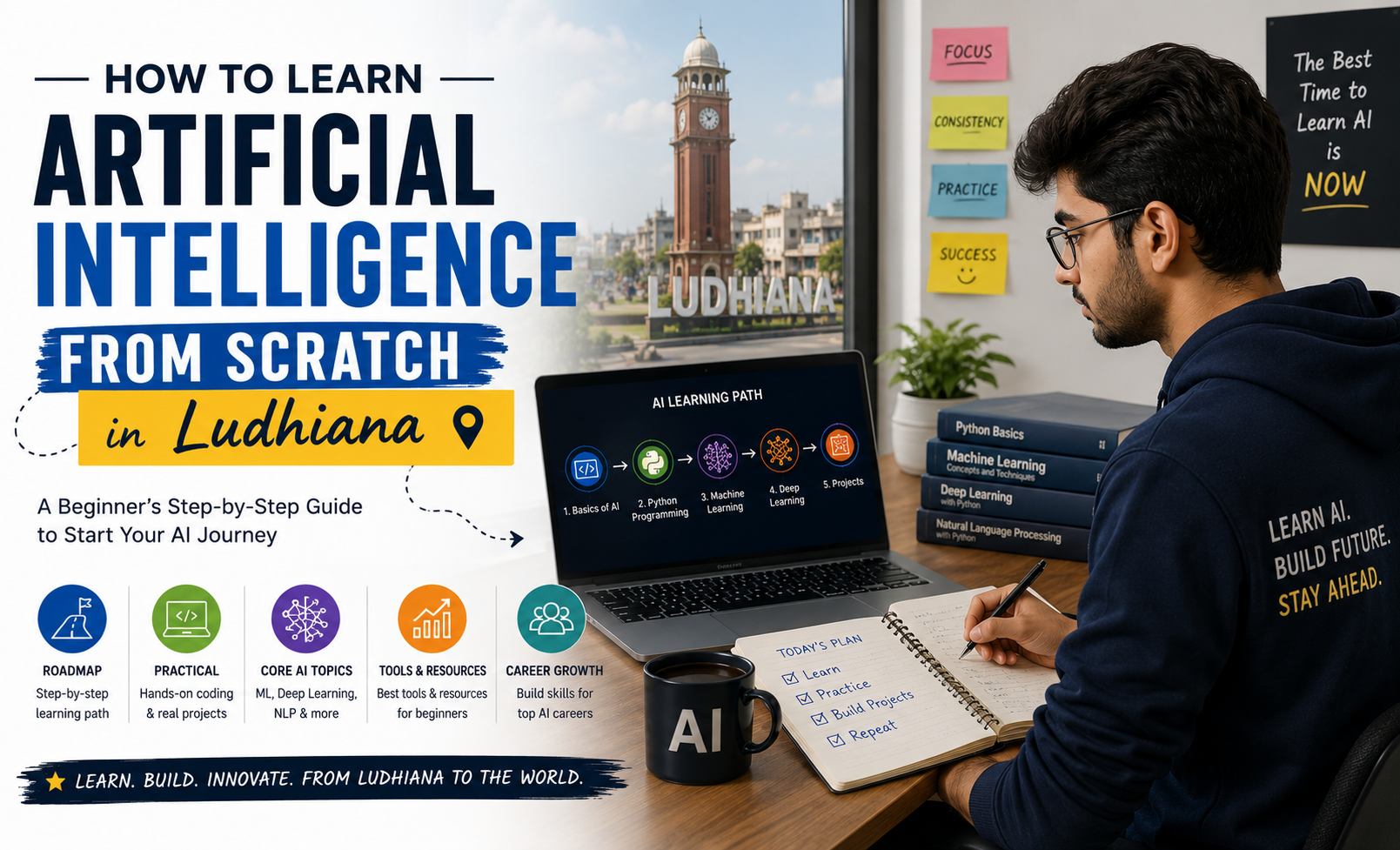
How to Learn Artificial Intelligence from Scratch
If you want to learn Artificial Intelligence from scratch, the first thing to know is that you do not need to understand everything about AI before you begin.
Words like machine learning, neural networks, deep learning and generative AI can make the field seem intimidating. Many beginners make the mistake of jumping straight into advanced tutorials or trying to learn multiple AI tools at once. That usually creates confusion.
A better approach is to build your knowledge step by step.
Start by Understanding What Artificial Intelligence Actually Is
Before learning to build AI applications, understand the basic idea behind Artificial Intelligence.
AI is a broad field focused on creating systems that can perform tasks associated with human intelligence, such as recognizing patterns, analysing information, making predictions or processing language.
Within AI, you may eventually come across areas such as:
Machine learning
Deep learning
Natural language processing
Computer vision
Generative AI
You do not need to master all of them immediately. At the beginning, focus on understanding what each area does and how they connect.
This gives you a clearer picture of what you are learning instead of memorising technical terms without understanding their purpose.
Learn Python First
For students starting from scratch, Python is a practical first step.
You do not need to become an expert programmer before exploring AI. However, you should become comfortable with basic programming concepts.
Start with:
Variables and data types
Conditions
Loops
Functions
Lists and dictionaries
Basic problem-solving
The goal is not to memorise every piece of Python syntax. Try to understand how programming logic works.
For example, instead of copying a program from a tutorial and moving on, change a few values and see what happens. Try creating small programs yourself. When errors appear—and they will—take time to understand why.
That process is where much of the learning happens.
Strengthen the Mathematics You Actually Need
The word mathematics can worry students who already find the subject difficult. But you do not need to stop your AI journey because you are not a mathematics topper.
As you move toward machine learning, topics such as statistics, probability and algebra become increasingly useful. Some advanced areas may also involve concepts from calculus and linear algebra.
The best approach is to learn mathematics alongside your AI journey.
For instance, when you begin studying a machine learning concept, learn the mathematical ideas that help you understand that concept. This can feel much more meaningful than trying to complete an entire mathematics syllabus before writing your first line of AI-related code.
Move Into Data and Machine Learning
Once you understand basic Python, you can begin exploring how computers work with data.
This stage may involve learning how to:
Read and organise data
Identify patterns
Prepare data for analysis
Understand basic visualisations
Work with simple machine learning models
Machine learning can initially feel like magic. You give a model examples, train it and receive a prediction.
But gradually, you should start asking deeper questions.
What information is the model learning from?
Why did it make this prediction?
How do we know whether the result is reliable?
These questions will help you move beyond simply running code.
Practise Instead of Only Watching Tutorials
One of the biggest traps for beginners is spending hours watching videos and feeling productive without actually building anything.
A much better routine is:
Learn a concept → practise it → make mistakes → fix them → build something small
After learning a new Python concept, try using it in a simple program. After learning the basics of machine learning, experiment with a small dataset.
Your first projects do not need to be impressive. The purpose is to turn information into practical understanding.
For students in Ludhiana who are starting their AI journey, the goal should not be to learn everything as quickly as possible. Build a strong base first. Once programming, data and basic machine learning start making sense, moving into more advanced areas of Artificial Intelligence becomes far less overwhelming.
Build Your AI Skills Step by Step
Once you have learned basic Python and started understanding how data works, you can begin moving deeper into Artificial Intelligence. This is where many beginners get excited—and sometimes make the mistake of trying to learn everything at once.
You might see videos about ChatGPT, image generation, self-driving cars, machine learning and neural networks and think, “Which one should I learn first?”
The answer is simple: build your foundation first, then explore the areas that genuinely interest you.
Understand the Basics of Machine Learning
Machine learning is one of the major areas within Artificial Intelligence. Instead of programming every possible rule manually, machine learning models use data to identify patterns and make predictions or decisions.
A simple example could be a model that learns from previous data to make a prediction about new information.
As a beginner, you do not need to start with complicated algorithms.
Begin by understanding:
What machine learning is
How training data is used
The difference between training and testing data
How a model learns patterns
What predictions are
How model performance is evaluated
At this stage, focus on understanding the logic behind the process.
It is easy to run a few lines of code and say that you have built a machine learning model. The more valuable skill is being able to explain what the code is doing and why.
Learn by Working With Real Data
AI becomes much easier to understand when you actually work with data.
At first, datasets may look messy and confusing. You might find missing values, incorrect entries or information that needs to be organised before you can use it.
That is normal.
In fact, learning how to handle data is an important part of the process.
Start practising tasks such as:
Loading datasets
Understanding rows and columns
Identifying useful information
Cleaning basic data
Finding patterns
Creating simple visualisations
Do not worry if your first dataset is small. You are learning the process.
For example, you could explore a dataset related to student performance, house prices or customer behaviour. The topic itself matters less than understanding how to examine data and use it in a project.
Start Building Small Projects
This is the point where your learning starts becoming more interesting.
Instead of waiting until you have “completed AI,” begin building small projects as you learn.
Your first project could be something simple, such as:
A basic prediction model
A recommendation system
A simple chatbot
A text classification project
An image classification experiment
The project does not need to be completely original.
At the beginning, it is perfectly reasonable to follow a guided project. But do not stop there. Once you understand how it works, try changing something.
Change the dataset. Add a feature. Test a different approach. Break the project and then figure out how to fix it.
That is how you move from following tutorials to actually developing problem-solving skills.
Explore Deep Learning at the Right Time
After gaining some confidence with programming and machine learning, you can start exploring deep learning.
Deep learning involves neural networks and is used in many applications, including image recognition, speech-related technologies and language processing.
You may encounter terms such as:
Neural networks
Layers
Training
Classification
Computer vision
Natural language processing
These concepts can sound complicated, so do not rush through them.
Try to understand one idea at a time. If a concept does not make sense immediately, that does not mean you are bad at AI. Some topics simply require more practice and repetition.
Learn About Generative AI
Generative AI has made Artificial Intelligence more accessible to students because people can directly interact with AI systems that generate text, images, code and other content.
However, learning to use an AI tool is different from understanding how AI works.
Both can be useful.
You can explore how generative AI models are applied in real projects while continuing to strengthen your understanding of programming, data and machine learning.
For example, you might eventually learn how AI-powered applications use models through APIs, how prompts affect outputs or how AI features can be integrated into software.
The key is not to become dependent on a single tool. AI technology changes quickly, but fundamental skills such as programming, problem-solving and understanding data remain valuable.
Create a Consistent Learning Routine
You do not need to study Artificial Intelligence for several hours every day to make progress.
Consistency is usually more useful than an intense burst of motivation followed by a long break.
You could create a routine like this:
Learn → practise → revise → build
For example, learn a concept, spend time writing code, review anything you did not understand and then apply the concept in a small project.
If you are balancing school, college or other responsibilities, even a realistic schedule can help you progress over time.
For students learning Artificial Intelligence from scratch in Ludhiana, the goal should be steady progress rather than rushing to reach an “advanced” level. Build one skill, practise it properly and then move to the next.
How to Keep Learning AI and Turn Knowledge Into Real Skills
By this stage, you may be thinking, “I have learned some Python and machine learning basics. What do I do next?”
This is where your learning can start becoming more personal.
Artificial Intelligence is a huge field. You do not need to become equally skilled in every area. Once you understand the basics, you can explore different paths and gradually discover what interests you the most.
Choose an Area of AI to Explore Further
After building a foundation in programming, data and machine learning, you can start looking at specialised areas.
For example:
Natural Language Processing (NLP): Working with human language, text and language-based applications.
Computer Vision: Helping computers analyse and understand images or visual information.
Deep Learning: Working with more complex neural network models.
Generative AI: Exploring systems that can generate text, images, code and other types of content.
AI Applications: Using AI models and tools to build useful software and solve practical problems.
You do not have to choose a specialisation immediately. Spend time exploring different areas through small projects. Your interests will often become clearer once you start building.
Build a Portfolio as You Learn
One of the best ways to track your progress is by keeping your projects organised.
At first, your projects may be simple. That is completely fine.
You could begin with a basic machine learning model and later move toward more complex projects. The important part is understanding what you built.
For every project, try to answer:
What problem was I trying to solve?
What data or information did I use?
How did my AI model or application work?
What difficulties did I face?
What would I improve next time?
These questions help you understand your own work instead of simply collecting projects.
Over time, your portfolio can become useful when applying for internships, courses or other opportunities. A few projects that you genuinely understand are usually more valuable than a long list of projects you copied without learning from them.
Learn to Read, Research and Solve Problems Independently
At some point, every AI learner encounters a problem that is not explained in their course or tutorial.
Maybe your code produces an unexpected result. Perhaps a dataset does not work properly. Or you may discover a concept that feels completely unfamiliar.
This is normal.
Instead of immediately searching for an exact answer to copy, break the problem into smaller questions.
For example:
What is the error?
Which part of the code is causing it?
What does the error message mean?
What have I already tried?
Developing this habit can make a major difference to your growth.
Artificial Intelligence changes quickly, so independent learning is an important skill. A course can provide structure and guidance, but eventually you should feel comfortable exploring documentation, experimenting with tools and learning new concepts on your own.
Avoid Trying to Learn Everything at Once
A common beginner mistake is creating an impossible learning list.
Python. Machine learning. Deep learning. Generative AI. Data science. Computer vision. Prompt engineering.
Everything sounds interesting, so you try to study all of it together.
A few weeks later, you may remember a little about each topic but feel confident about none of them.
Instead, focus on one stage at a time.
A practical roadmap could look like this:
Step 1: Learn Python fundamentals
Understand programming logic and practise writing small programs.
Step 2: Work with data
Learn how data is organised, explored and prepared.
Step 3: Study machine learning basics
Understand how models learn patterns and make predictions.
Step 4: Build beginner projects
Apply what you have learned instead of only watching tutorials.
Step 5: Explore advanced areas
Move toward deep learning, NLP, computer vision or generative AI based on your interests.
Should You Join an AI Course or Learn on Your Own?
Both options can work.
Self-learning gives you flexibility and allows you to explore topics at your own pace. However, beginners sometimes struggle with one major problem: they do not know what to learn next.
A structured Artificial Intelligence course can provide a roadmap, practical assignments and guidance when concepts become difficult.
For students in Ludhiana, the right option depends on your learning style. If you are comfortable finding resources, creating your own study plan and staying consistent, self-learning may work well.
If you prefer a structured path, regular classes and support from a trainer, an AI course may help you build your foundation more systematically.
The Most Important Thing: Keep Building
You do not need to wait until you feel “ready” to start creating projects.
Start small.
Your first project may be messy. Your code may not work on the first attempt. You may need to revisit concepts several times.
That is part of learning.
The goal is not to become an Artificial Intelligence expert in a few weeks. The goal is to make steady progress and gradually become more confident with programming, data and AI concepts.
If you want to learn Artificial Intelligence from scratch in Ludhiana, start with the fundamentals, practise regularly and build projects as you go.
Do not compare your beginning with someone else's advanced work. Focus on the next skill you need to learn.
Step by step, the concepts that once looked complicated will begin to make more sense—and that is when your journey in Artificial Intelligence truly starts.