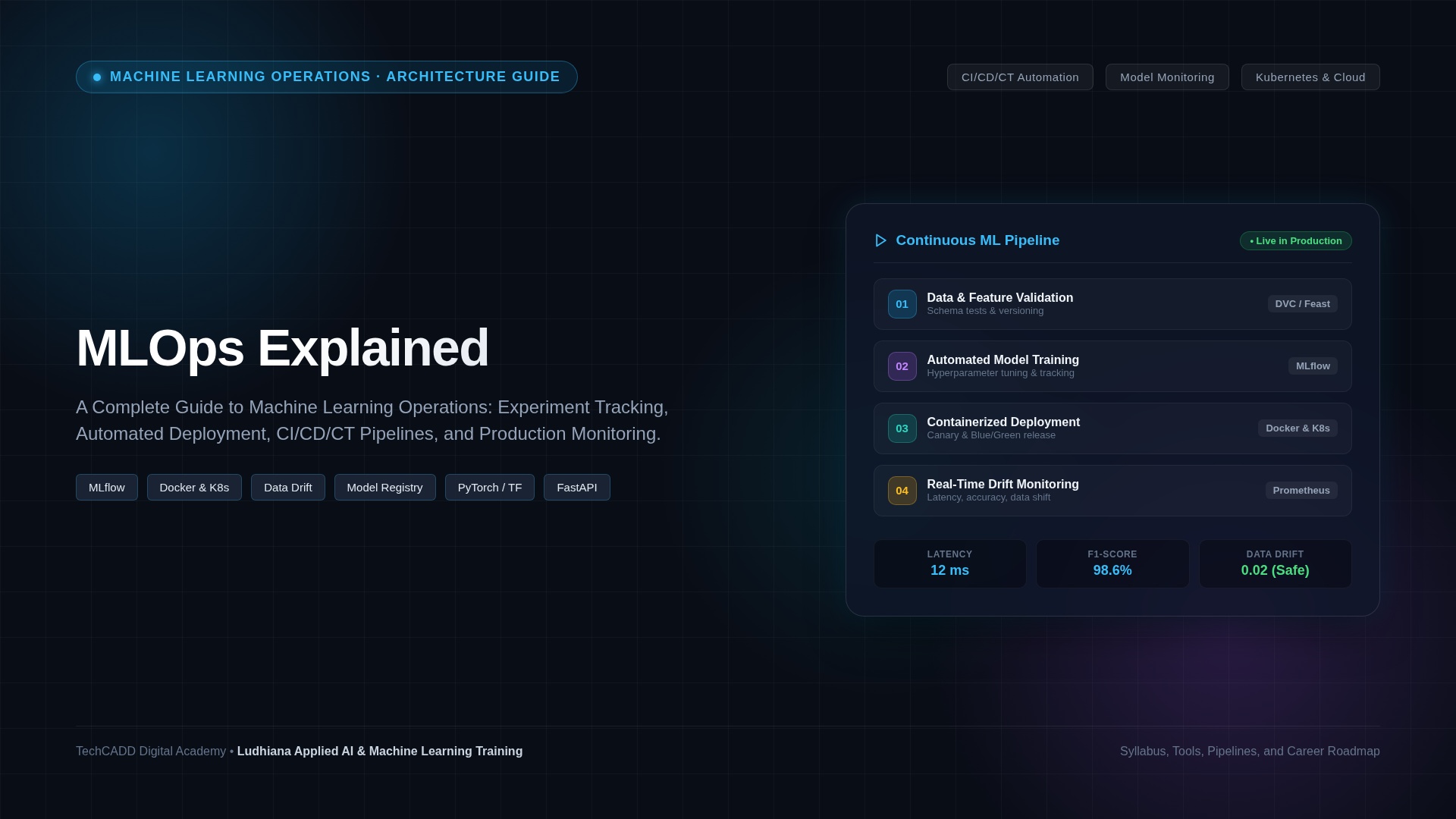
Machine learning models can perform well during experimentation but become difficult to manage when deployed into real-world applications. Models need reliable deployment processes, consistent data pipelines, performance monitoring, version control, and regular updates. This is where MLOps becomes important.
MLOps, short for Machine Learning Operations, combines machine learning, software engineering, automation, and operational practices to help teams develop, deploy, monitor, and maintain machine learning systems reliably. Whether you are learning machine learning, exploring cloud computing, or preparing for an engineering role, understanding MLOps can help you connect model development with production systems.
What Is MLOps?
MLOps is a set of practices, processes, and tools used to manage the lifecycle of machine learning models, from development and experimentation to deployment, monitoring, and retraining. It adapts principles from DevOps to the additional challenges of machine learning, where model performance depends on code, data, features, and trained model artifacts.
Traditional software applications are generally built around code and configuration. Machine learning systems also depend on training data, model parameters, evaluation results, and changes in real-world data. MLOps helps teams manage these dependencies and make model releases more reproducible and maintainable.
Example: A retail business uses a machine learning model to forecast product demand. An MLOps workflow can automate data validation, model training, evaluation, deployment, and monitoring so that the team can identify when the model needs attention or retraining.
Why Is MLOps Important?
Developing a model in a notebook is only one part of building a useful machine learning system. Production systems must continue to operate as data, application requirements, infrastructure, and user behaviour change.
- Reliable deployment: Standardizes how models move from experimentation to production.
- Reproducibility: Tracks the data, code, parameters, and artifacts used in experiments.
- Automation: Reduces repetitive manual work in testing, training, and deployment.
- Monitoring: Helps teams detect performance degradation, data-quality problems, and operational failures.
- Collaboration: Connects data scientists, machine learning engineers, software developers, and operations teams.
- Governance: Supports model approval, access control, audit trails, and controlled releases.
- Scalability: Provides repeatable workflows for managing multiple models and environments.
What Is the MLOps Lifecycle?
The MLOps lifecycle describes the stages involved in developing, releasing, and maintaining machine learning systems. The exact workflow varies by organization and model type, but the following stages are common.
1. Data Collection and Validation
Machine learning models rely on data from databases, files, APIs, sensors, or other sources. Before training, teams need to validate data formats, missing values, ranges, schemas, and potential quality issues.
Data validation helps prevent a model pipeline from continuing with incomplete or unexpected input. Data lineage and versioning also help teams understand which data was used for a particular model release.
2. Model Development and Experimentation
Data scientists experiment with algorithms, features, model architectures, and hyperparameters. Experiment tracking records details such as configuration, metrics, code versions, and generated artifacts.
This makes it easier to compare experiments, reproduce results, and identify which model is suitable for further evaluation.
3. Model Training and Evaluation
Training pipelines transform validated data into trained model artifacts. Evaluation pipelines then measure whether a candidate model meets predefined requirements.
Evaluation may include accuracy, precision, recall, F1-score, latency, resource usage, fairness checks, or domain-specific metrics. The appropriate measures depend on the problem and the consequences of incorrect predictions.
4. Model Packaging and Versioning
Once a model passes evaluation, teams package the model together with its required dependencies and serving configuration. Versioning makes it possible to identify releases and roll back when a deployment causes problems.
Tracking the model artifact, training code, dependencies, configuration, and relevant data lineage helps make releases easier to reproduce.
5. Model Deployment
A model may be deployed through a REST API, batch prediction job, streaming pipeline, or an application running close to the data source. The deployment approach depends on prediction latency, traffic, cost, privacy, and reliability requirements.
Before releasing a model, teams should test compatibility, resource requirements, security, and expected behaviour in the target environment.
6. Model Monitoring
After deployment, teams monitor both software operations and machine learning behaviour. Operational monitoring may track latency, errors, availability, and resource consumption. ML-specific monitoring can examine input data, prediction distributions, and model quality when reliable outcome labels become available.
A model may continue to run without technical errors while its predictions become less useful because real-world data has changed. Monitoring helps identify these situations.
7. Retraining and Continuous Improvement
When monitoring or business requirements indicate that a model needs updating, teams can initiate a new training workflow. Retraining may happen on a schedule, after a data threshold is reached, or when a validated trigger indicates that a new model should be evaluated.
Retraining should not automatically mean deployment. Candidate models should pass suitable quality, safety, and operational checks before replacing an existing production model.
Understanding CI/CD/CT in MLOps
Three important concepts in MLOps are Continuous Integration (CI), Continuous Delivery or Deployment (CD), and Continuous Training (CT). Together, they help teams automate different parts of the machine learning workflow.
| Practice | Meaning | Example |
|---|---|---|
| Continuous Integration (CI) | Automatically tests and validates changes to code, configurations, and pipeline components. | Run unit tests and data-validation checks after a code change. |
| Continuous Delivery or Deployment (CD) | Automates packaging and releasing approved models or application changes. | Deploy an evaluated model to a staging environment before production. |
| Continuous Training (CT) | Automates model retraining and evaluation when defined conditions are met. | Train a new demand-forecasting model when updated data becomes available. |
Continuous training does not mean that every new dataset should result in an immediate production release. Model evaluation, approval policies, and deployment safeguards remain essential.
MLOps vs DevOps vs ModelOps
| Concept | Main focus | Key considerations |
|---|---|---|
| DevOps | Software development and operations. | Code testing, deployment automation, infrastructure, and reliability. |
| MLOps | Operationalizing machine learning systems. | Data and model versioning, training pipelines, model evaluation, monitoring, and retraining. |
| ModelOps | Operational management and governance of models, depending on the organizational definition. | Model inventory, approval, deployment, oversight, and lifecycle governance. |
MLOps builds on many DevOps principles but adds processes for managing data, training workflows, model artifacts, and prediction quality. ModelOps is sometimes used as a broader governance and operationalization term, so its precise meaning can vary across organizations.
Popular MLOps Tools and Technologies
MLOps is not a single software product. Teams combine tools based on their infrastructure, project requirements, and preferred development workflow.
| Tool or technology | Common use |
|---|---|
| Python | Model development, data processing, automation, and pipeline scripting. |
| Git and GitHub | Code version control, collaboration, and workflow automation. |
| MLflow | Experiment tracking, model packaging, and model registry capabilities. |
| Apache Airflow | Scheduling and orchestrating data and ML workflows. |
| Kubeflow | Building and orchestrating machine learning workflows on Kubernetes-based infrastructure. |
| Docker | Packaging applications and dependencies into containers. |
| Kubernetes | Orchestrating containerized workloads where the operational complexity is justified. |
| DVC | Versioning and managing data and machine learning pipeline artifacts in supported workflows. |
| Prometheus and Grafana | Collecting and visualizing operational metrics when integrated into the deployment environment. |
| Cloud ML platforms | Providing managed training, deployment, pipeline, and monitoring capabilities. |
Beginners should avoid installing every tool at once. Start with Python, Git, model evaluation, and experiment tracking. Add orchestration, containers, and cloud infrastructure as your projects become more complex.
How to Build a Simple MLOps Pipeline
A beginner-friendly MLOps project can use a small dataset and a simple machine learning model. The goal is to create a repeatable workflow rather than immediately build a complex production platform.
Step 1: Choose a Machine Learning Problem
Select a manageable task, such as classifying sample data or predicting a numeric value from a dataset. Use public or synthetic data with appropriate permissions.
Step 2: Organize the Project
Create separate files or modules for data preparation, training, evaluation, and prediction. Use Git to track changes and document the dependencies needed to run the project.
Step 3: Create a Training Script
Write a script that loads the dataset, validates expected fields, prepares features, trains a model, and saves the trained artifact. Record important training parameters so that the experiment can be reproduced.
Step 4: Evaluate the Model
Calculate appropriate metrics using a held-out dataset. Define acceptance thresholds that reflect the problem instead of assuming that a single metric is sufficient for every use case.
Step 5: Track Experiments
Use a tool such as MLflow to record parameters, evaluation metrics, and artifacts. Compare model versions and document which candidate satisfies the project's requirements.
Step 6: Automate Testing
Configure a CI workflow to run code checks and tests when changes are pushed. Tests can verify that the training pipeline runs, expected columns exist, and evaluation outputs meet defined conditions.
Step 7: Package and Serve the Model
Expose the approved model through a small API or batch-prediction script. If you use an API, validate input data, handle errors, and avoid exposing unnecessary model or infrastructure details.
Step 8: Monitor and Document
Track prediction errors, request latency, input patterns, and model quality when labels become available. Document how to retrain the model, evaluate a candidate, deploy a release, and roll back to an earlier version.
Example MLOps Project: Customer Churn Prediction
A customer churn prediction project is a useful learning exercise because it can demonstrate the full lifecycle of a model rather than just the training step.
Project objective
Build a model that estimates which customers may stop using a service, using an appropriately licensed sample dataset.
Suggested workflow
- Validate the input dataset and handle missing or inconsistent values.
- Train a baseline classification model.
- Evaluate precision, recall, F1-score, and other relevant metrics.
- Record experiment parameters and results.
- Package the model and expose a test prediction endpoint.
- Create automated tests for the preprocessing and prediction pipeline.
- Monitor input distributions, latency, errors, and quality when outcome labels are available.
- Document retraining conditions and a rollback process.
Important: Churn predictions can influence business decisions about customers. Treat the output as an estimate, evaluate potential bias, protect customer information, and avoid making consequential decisions solely on an unreviewed model prediction.
Common MLOps Challenges
Data Quality and Data Drift
Unexpected data formats, missing fields, changing distributions, and inconsistent data pipelines can reduce model reliability. Validation checks and data monitoring help teams detect these issues.
Model Drift and Performance Degradation
Relationships between inputs and outcomes can change over time. Monitoring input distributions and model quality can reveal when a model may need investigation or retraining.
Reproducibility
It can be difficult to reproduce an experiment if code, dependencies, data, and training configurations are not tracked. Versioning and experiment metadata help address this challenge.
Deployment Complexity
Models may require different libraries, compute resources, and serving environments. Containers, automated tests, and consistent environment configuration can reduce deployment-related problems.
Monitoring Limitations
True prediction quality may be difficult to measure immediately when outcome labels arrive later. Teams may need to monitor proxy signals while recognizing that those signals do not always establish whether a model remains accurate.
Cost and Infrastructure Management
Training, inference, storage, orchestration, and monitoring all have costs. Start with the simplest architecture that meets requirements and scale only when necessary.
Security and Governance
Machine learning systems may handle sensitive data, proprietary models, and privileged infrastructure. Apply access controls, protect credentials, track model lineage, and define approval and rollback procedures.
Skills Required for an MLOps Career
MLOps combines several technical areas. You do not need to master every tool before starting, but a broad foundation makes it easier to understand the full workflow.
- Python programming: Write training scripts, data pipelines, tests, and automation.
- Machine learning fundamentals: Understand model training, evaluation metrics, feature preparation, and overfitting.
- Software engineering: Use modular code, testing, logging, documentation, and version control.
- Linux and command-line skills: Work with development environments, processes, and deployment tools.
- CI/CD: Automate code checks, testing, packaging, and releases.
- Containers: Understand Docker and how dependencies are packaged.
- Cloud fundamentals: Learn identity and access management, compute, storage, networking, and monitoring.
- Workflow orchestration: Understand how pipelines are scheduled, retried, and monitored.
- Observability: Monitor application health, data quality, and model performance.
- Security and governance: Protect datasets, credentials, model artifacts, and production environments.
MLOps Career Opportunities
Knowledge of MLOps can support roles that connect machine learning development with reliable production systems. Job titles and responsibilities vary by organization.
- MLOps Engineer: Builds and maintains machine learning pipelines, deployment workflows, and monitoring systems.
- Machine Learning Engineer: Develops and deploys machine learning models and the software around them.
- ML Platform Engineer: Builds shared infrastructure and tools for machine learning teams.
- Data Engineer: Develops reliable data pipelines and infrastructure used by analytics and machine learning systems.
- DevOps or Cloud Engineer for ML Systems: Supports infrastructure, automation, deployment, reliability, and monitoring for ML workloads.
- ML Reliability Engineer: Focuses on the reliability, observability, and operational performance of machine learning services in organizations that define this specialization.
Employers may expect different levels of machine learning, software engineering, cloud, and infrastructure experience. Practical projects that demonstrate the complete workflow can help show your understanding.
Beginner-Friendly MLOps Learning Roadmap
- Learn Python and Git: Practise writing scripts, organizing code, managing dependencies, and tracking changes.
- Understand machine learning basics: Train simple models and learn data preparation, evaluation metrics, and validation.
- Build reproducible training scripts: Separate training and evaluation code, record configuration, and save model artifacts.
- Learn experiment tracking: Use a tool such as MLflow to compare experiments.
- Automate tests: Add unit tests and a simple CI workflow.
- Learn model serving: Package a model and expose predictions through an API or batch job.
- Explore containers and cloud services: Learn Docker and one cloud platform when you are comfortable with the basics.
- Add monitoring: Track latency, errors, data quality, and model quality where labels are available.
- Complete an end-to-end project: Document the architecture, deployment process, retraining policy, security decisions, and rollback procedure.
Learning MLOps in Ludhiana
Students, graduates, and working professionals in Ludhiana who want to explore MLOps can look for learning programs that combine machine learning fundamentals with Python, Git, automated testing, model deployment, cloud infrastructure, and monitoring.
Before enrolling in an MLOps course in Ludhiana, check whether the curriculum includes an end-to-end practical project, experiment tracking, model versioning, API deployment, and basic CI/CD workflows. A useful program should explain why each operational step matters rather than focus only on tool installation.
If you prefer self-study, start with a simple model and gradually automate training, evaluation, testing, and deployment. Keep the project small enough to understand every component and document the decisions you make.
Frequently Asked Questions
What does MLOps stand for?
MLOps stands for Machine Learning Operations. It describes practices and tools for managing the development, deployment, monitoring, and maintenance of machine learning systems.
What is the main purpose of MLOps?
The main purpose is to make machine learning workflows more repeatable, automated, observable, and maintainable from experimentation through production and ongoing updates.
Is MLOps the same as DevOps?
No. MLOps uses many DevOps principles but also addresses data validation, experiment tracking, model artifacts, training pipelines, model evaluation, and prediction monitoring.
Do I need to learn machine learning before MLOps?
Basic machine learning knowledge is helpful because MLOps involves training and evaluating models. Python, Git, testing, and command-line skills are also important foundations.
Which tools are used in MLOps?
Common tools include Python, Git, MLflow, Docker, workflow orchestration systems, CI/CD platforms, monitoring tools, and cloud machine learning services. The right combination depends on the project.
What is a CI/CD/CT pipeline in MLOps?
CI automates code and pipeline checks, CD automates delivery or deployment of approved changes, and CT automates model training and evaluation under defined conditions.
Can I learn MLOps without Kubernetes?
Yes. Beginners can start with Python, Git, experiment tracking, tests, and a simple model-serving workflow. Kubernetes is useful for certain deployment needs but is not required for every MLOps project.
What is model drift?
Model drift commonly describes changes that cause a deployed model's predictions or performance to become less suitable over time. Monitoring data and outcomes can help teams decide whether investigation or retraining is needed.
How can I learn MLOps in Ludhiana?
You can study through documentation, hands-on projects, or training programs in Ludhiana. Compare learning options based on their coverage of Python, machine learning fundamentals, experiment tracking, deployment, monitoring, and CI/CD.
Conclusion
MLOps helps teams move machine learning beyond experimentation by creating repeatable workflows for data validation, model training, evaluation, deployment, monitoring, and retraining. It combines machine learning knowledge with software engineering, automation, cloud infrastructure, and operational reliability.
For beginners, the best starting point is a small end-to-end project that includes version control, reproducible training, automated tests, model evaluation, and basic monitoring. As your skills grow, you can add experiment tracking, containers, orchestration, and cloud deployment. This practical foundation can help you understand how reliable machine learning systems are built and maintained.