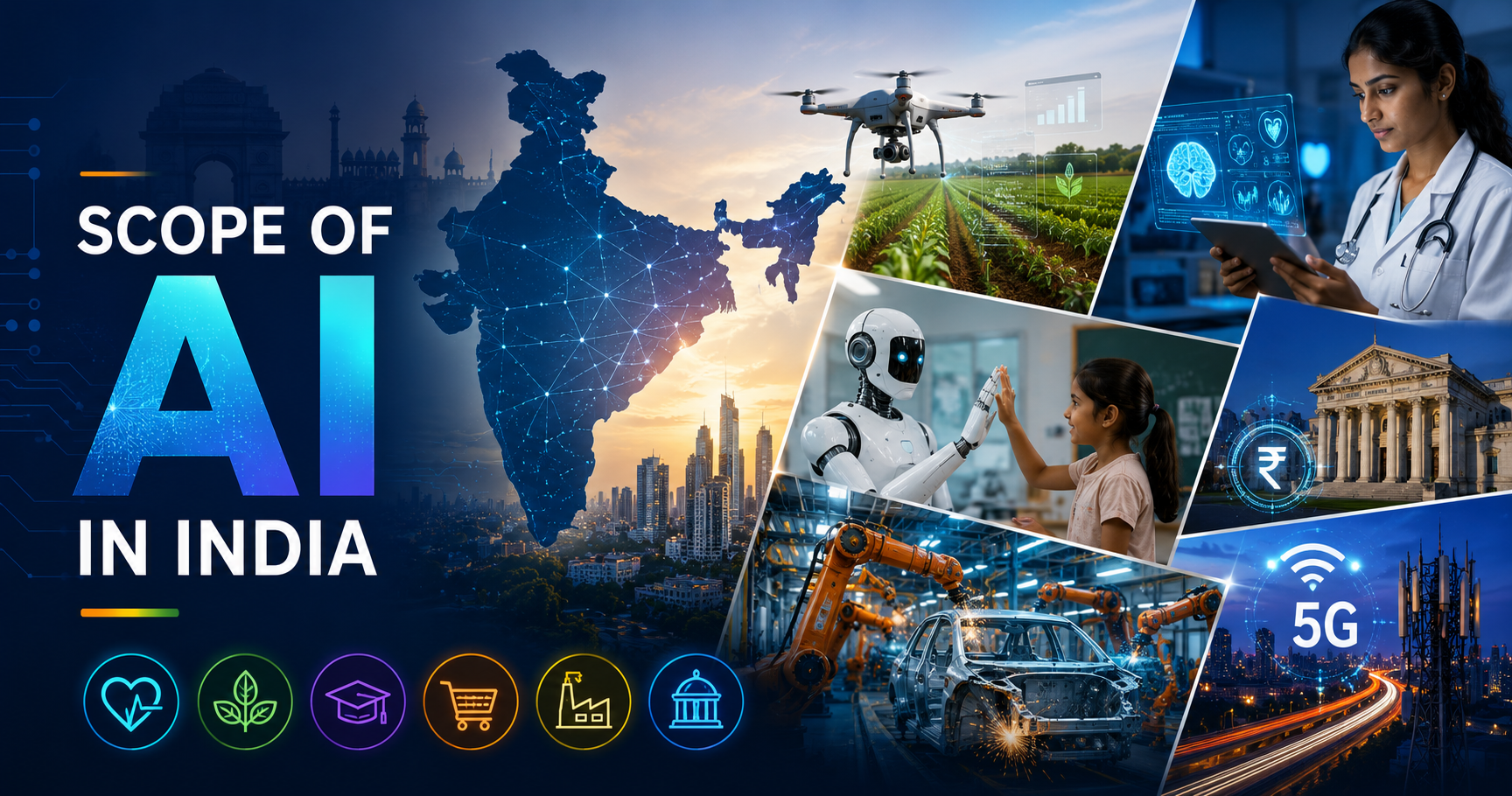
Scope of Artificial Intelligence in India
Artificial Intelligence is becoming an increasingly important field in India, and students are naturally asking an important question: “Does AI actually have a good future as a career?”
The short answer is that AI is already being used across many industries, and the demand for people who understand AI-related technologies is growing. However, the scope of Artificial Intelligence in India is not limited to simply learning how to use popular AI tools. The strongest opportunities are likely to go to people who can understand technology, solve problems and apply AI skills in practical situations.
For a student planning their future, that distinction matters.
AI Is Creating Opportunities Across Different Industries
Artificial Intelligence is not limited to technology companies. AI is being used in a wide range of sectors, which means students can eventually explore different career paths depending on their interests.
Some important areas include:
Healthcare: AI can assist with analysing data, supporting research and improving certain technology-driven processes.
Finance: AI is used for data analysis, automation and identifying patterns.
E-commerce: Recommendation systems, customer support and demand analysis are common AI applications.
Education: AI-powered learning platforms and personalised educational tools are becoming more common.
Manufacturing: AI can support automation, quality analysis and process optimisation.
Marketing: Businesses use AI for content analysis, customer insights and automation.
Software development: AI is increasingly being integrated into applications and development workflows.
This wide range of applications is one reason the scope of Artificial Intelligence in India attracts students from different backgrounds.
What Career Options Can AI Create?
Artificial Intelligence is a broad field, so there is no single job called “AI career.”
As you develop different skills, you may explore roles related to:
AI development
Machine learning
Data analysis
Data science
AI research
Natural language processing
Computer vision
AI product development
Automation
AI integration
The exact skills required will vary from one role to another.
For example, someone interested in building machine learning models may need a stronger understanding of programming, mathematics and data. Someone working on AI-powered applications may focus more on software development and integrating AI models into useful products.
This means students do not necessarily have to follow exactly the same learning path.
Why Skills Will Matter More Than Simply Knowing AI Tools
One of the easiest mistakes to make is assuming that using an AI chatbot automatically means you have learned Artificial Intelligence.
Knowing how to use AI tools can certainly be useful. But using a tool and understanding the technology behind it are two different things.
As AI becomes more accessible, basic tool usage may become common. Skills that can help you stand out include:
Programming
Problem-solving
Data handling
Machine learning fundamentals
Understanding how AI models are applied
Building practical projects
Communicating technical ideas clearly
You do not need to master all of these skills immediately. The important thing is to build a solid foundation.
Is Artificial Intelligence a Good Career Choice for Students?
AI can be a promising field for students who enjoy technology, logical thinking, problem-solving and continuous learning.
However, it is not a shortcut to an instant high-paying career.
A student who spends time understanding Python, working with data, building projects and learning machine learning concepts is developing a stronger foundation than someone who simply collects certificates.
Technology also changes quickly. This means that learning does not stop after completing one course.
A good approach is to develop transferable skills that remain useful even when specific AI tools change.
The Growing Importance of AI Skills in India
India's technology ecosystem, growing digital economy and large pool of students and professionals are creating increasing interest in AI-related education and careers.
Companies are looking at ways to use AI for automation, data analysis, customer experiences and software products. At the same time, startups are exploring AI-based solutions for different industries.
For students, this creates an important opportunity—but also more competition.
Simply writing “Artificial Intelligence” on a resume will not be enough. Employers and organisations will increasingly look for evidence that you can actually apply your knowledge.
That is why practical learning matters.
What Should Students Learn to Prepare?
If you are interested in exploring the scope of Artificial Intelligence in India, start with the fundamentals.
A beginner-friendly path could look like this:
Programming basics → Python → data handling → machine learning fundamentals → practical projects → specialised AI areas
You can later explore fields such as generative AI, natural language processing, computer vision or deep learning based on your interests.
For students in Ludhiana, the best approach is not to rush into advanced AI topics because they are trending. Start by building skills that will help you understand new technologies as they appear.
The scope of Artificial Intelligence in India is expanding, but your individual opportunities will depend heavily on how well you prepare yourself.
Where Is Artificial Intelligence Creating Opportunities in India?
The scope of Artificial Intelligence in India becomes easier to understand when you look beyond job titles and see how different industries are adopting AI. The opportunities are not limited to one type of company or one specific career path.
Technology and Software Development
The technology sector is one of the most obvious areas for AI-related careers. Companies are building AI-powered features into software, using machine learning for data-driven applications and experimenting with generative AI.
For students, this can create opportunities in areas such as:
AI and machine learning development
Software development with AI integration
Data engineering and analysis
AI application development
Testing and improving AI-powered systems
However, learning AI alone may not always be enough. A strong understanding of programming and software fundamentals can make it easier to build useful applications.
For example, knowing how to call an AI model is one skill. Building a complete application around it—handling users, data, security and functionality—requires additional technical knowledge.
Healthcare and Medical Technology
AI is also creating new possibilities in healthcare and medical technology.
AI-based systems can assist researchers and professionals with analysing large amounts of information, identifying patterns and supporting technology-driven decision-making. As healthcare becomes increasingly digital, people with a combination of technical knowledge and domain understanding may find interesting opportunities in this area.
This does not mean that every AI learner needs to become a medical expert. Instead, it shows how AI skills can eventually be combined with other fields.
A person interested in both technology and healthcare, for instance, may explore health-tech projects and AI applications related to that industry.
Finance and Banking
India's financial sector generates large amounts of data, making AI useful for areas such as analysis, automation and pattern recognition.
AI-related technologies can support systems involving customer service, risk analysis, fraud detection and personalised financial experiences.
Students interested in finance do not necessarily have to leave their existing field to explore AI. Understanding both finance and technology could become a valuable combination.
This is particularly relevant for students who wonder whether Artificial Intelligence is useful only for those with a pure science or engineering background. AI is increasingly becoming a tool that can be applied alongside other professional skills.
E-Commerce and Retail
Think about how online platforms recommend products or personalise customer experiences.
AI and data-driven systems can help businesses understand patterns in customer behaviour, predict demand and automate certain processes.
For someone interested in e-commerce, business or marketing, learning the basics of AI can provide a better understanding of how modern digital platforms work.
The opportunities may not always involve becoming a machine learning engineer. Some careers may focus on using AI effectively within business operations, product development or digital strategies.
AI in Marketing and Business
Marketing is another area where AI is changing everyday workflows.
Businesses can use AI to analyse information, support content creation, automate repetitive tasks and understand customer behaviour.
But there is an important difference between using AI casually and using it strategically.
Students who combine marketing knowledge with AI skills may be better prepared to understand how technology can support real business goals. The same idea applies to entrepreneurship. Knowing how AI can be integrated into a product or service may help future founders identify practical problems that technology can solve.
Manufacturing and Automation
Artificial Intelligence also has applications in manufacturing and industrial environments.
AI-based systems can support areas such as quality analysis, predictive maintenance, automation and process improvement.
This is particularly relevant because India's manufacturing sector continues to adopt new technologies. Students interested in engineering, automation or industrial technology can explore how AI connects with their existing field.
Again, this shows why the scope of AI is broader than a single career title.
Generative AI Is Creating New Ways to Build
Generative AI has made Artificial Intelligence more visible to students and professionals.
Today, AI can be used to generate text, assist with programming, create images, analyse information and support many other tasks. This has also encouraged businesses to explore AI-powered products and services.
For learners, this creates an interesting opportunity: you can experiment with AI applications much earlier than before.
A student with programming skills might build an AI-powered website. A business-focused learner might explore AI automation. Someone interested in design could study how AI tools fit into creative workflows.
The important thing is to avoid becoming dependent on one specific tool.
Tools will change. New models will appear. Features will disappear or improve.
But skills such as problem-solving, programming, understanding data and identifying useful applications can remain valuable across different technologies.
Start Thinking About AI as a Skill, Not Just a Job
One of the most useful ways to think about the future scope of Artificial Intelligence in India is to see AI as both a specialised career field and a skill that can complement other careers.
You might become an AI specialist and work directly with machine learning models.
Or you might combine AI with another field you already enjoy, such as finance, healthcare, marketing, software development or business.
For students in Ludhiana, this means you do not necessarily have to decide your entire future immediately. You can begin by learning the fundamentals and gradually discover where your interests and skills fit best.
The next step is understanding what skills, career preparation and realistic expectations can help you make the most of the growing opportunities in Artificial Intelligence.
Building a Future in Artificial Intelligence in India
The scope of Artificial Intelligence in India may be growing, but students should also understand one important reality: learning AI is a long-term skill-building process.
You do not need to become an expert immediately. What matters is developing useful knowledge and gradually learning how to apply it.
Which AI Skills Should Students Focus On?
The skills you need will depend on the career path you eventually choose. However, a strong foundation can make it easier to explore different areas later.
Students interested in technical AI careers can gradually work on:
Python and programming fundamentals
Data analysis and data handling
Statistics and probability
Machine learning concepts
Deep learning basics
Problem-solving
AI model evaluation
Practical project development
As you gain confidence, you can explore specialised areas such as natural language processing, computer vision or generative AI.
The key is to avoid chasing every new trend.
A new AI tool may become popular overnight, but understanding the basics of programming, data and problem-solving can help you adapt even when technology changes.
Projects Can Make Your Learning More Meaningful
Imagine two students who have both completed an AI course.
One can list several topics on a résumé but struggles to explain how an AI model works in practice. The other has built a few projects and can clearly explain the problem, the data used and the approach taken.
The second student has something concrete to show.
This is why projects should become part of your learning journey. They do not have to be huge or revolutionary.
You can begin with small ideas and improve them over time.
For example, a beginner might start with a simple prediction or classification project. Later, they could experiment with a chatbot, recommendation system or another AI-powered application.
With every project, ask yourself:
What problem am I solving?
Why am I using AI here?
What could be improved?
These questions can help you move beyond simply following tutorials.
AI Will Also Change Existing Careers
One reason the scope of Artificial Intelligence in India is so interesting is that AI is not only creating completely new roles. It is also changing the way existing professionals work.
A marketer may use AI to analyse customer behaviour.
A software developer may integrate AI features into an application.
A finance professional may work with increasingly data-driven systems.
A business owner may use AI to automate repetitive processes.
This means students can think about AI in two different ways.
The first is to build a career directly in Artificial Intelligence.
The second is to combine AI knowledge with another field.
For many students, the second option may become especially valuable. If you already have an interest in business, design, finance, healthcare or another industry, learning how AI can be applied within that field can open up interesting possibilities.
What About Competition?
As more students start learning AI, competition will naturally increase.
That should not discourage you, but it does mean that simply completing a course may not be enough to stand out.
Try to build proof of your skills.
Maintain your projects, document what you learn and continue improving your understanding. Focus on solving problems instead of only collecting certificates.
You do not need to have ten complicated projects. Even a smaller number of projects can be valuable if you genuinely understand the work behind them.
How Should Students in Ludhiana Prepare?
If you are a student in Ludhiana and want to explore Artificial Intelligence, start by identifying your current level.
If you are completely new to programming, begin with the basics.
If you already know Python, you may be ready to explore data analysis and machine learning.
If you have experience with machine learning, you can gradually move towards more specialised areas.
A practical learning path could look like this:
Step 1: Build programming fundamentals
Learn how to think logically and write basic programs.
Step 2: Understand data
Practise working with datasets and identifying useful patterns.
Step 3: Learn machine learning fundamentals
Understand how models are trained, tested and evaluated.
Step 4: Build practical projects
Apply your knowledge instead of only consuming tutorials.
Step 5: Explore specialised AI fields
Choose areas that genuinely interest you, such as generative AI, NLP, computer vision or deep learning.
So, Is Artificial Intelligence a Good Career in India?
Artificial Intelligence offers significant possibilities, but it should not be viewed as a guaranteed shortcut to career success.
The strongest opportunities are likely to go to learners who build genuine skills, understand how to solve real problems and continue adapting as technology develops.
For students exploring the scope of Artificial Intelligence in India, this is actually encouraging. You do not need to know everything today.
Start with the fundamentals. Build one skill at a time. Work on projects. Stay curious.
Whether you eventually become an AI specialist or combine AI with another career path, understanding this technology can become a valuable part of your professional skill set.
For students in Ludhiana, the best time to start preparing is not when you feel like you know everything. It is when you are ready to take the first step and keep learning from there.