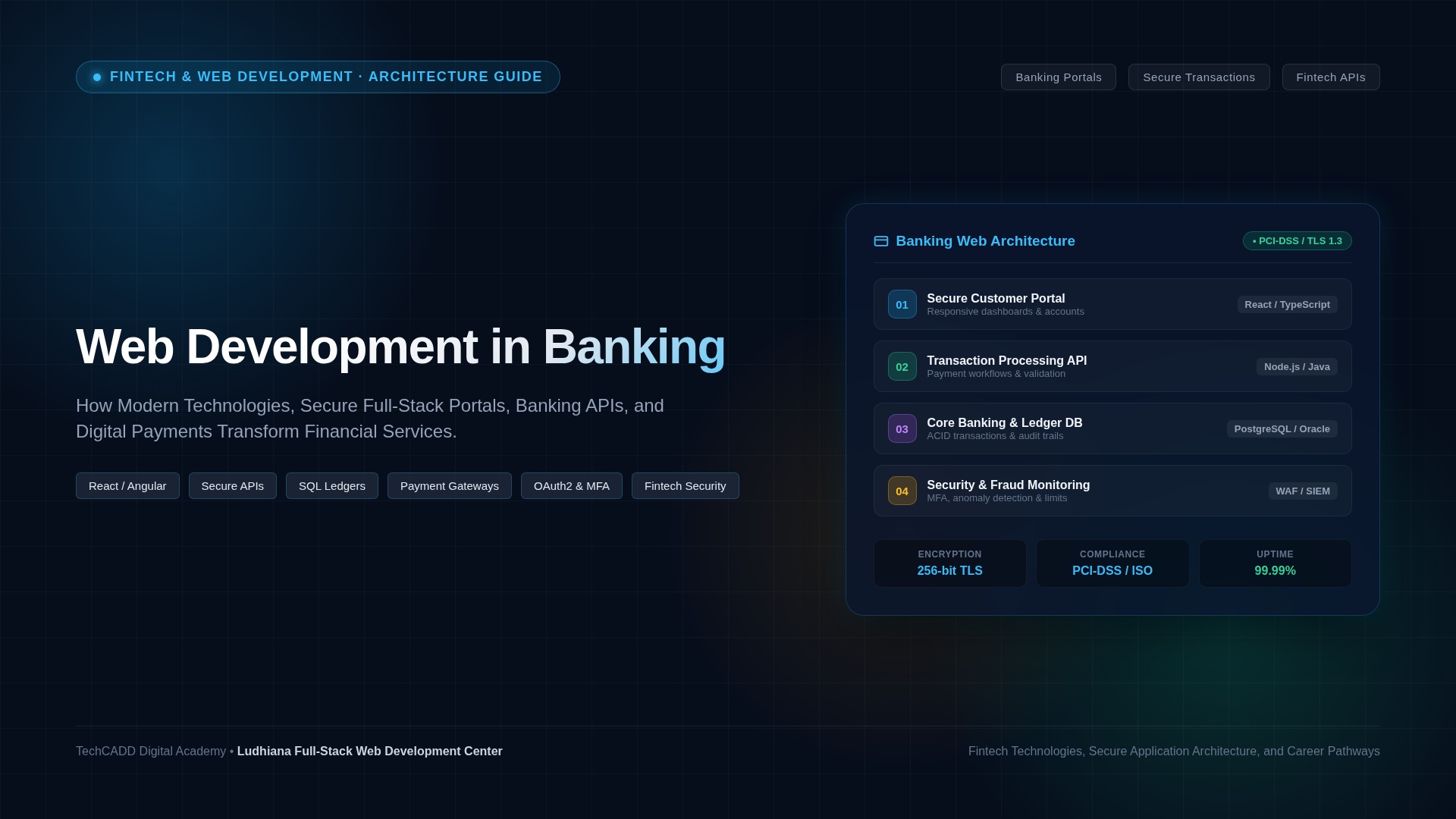
Web Development in Banking: How Technology Is Transforming Financial Services
Web development in banking plays an important role in making financial services accessible, convenient, and efficient. Banks use websites and web applications to help customers check account balances, transfer money, pay bills, apply for financial products, manage cards, and access support without visiting a physical branch.
Modern banking websites are more than online brochures. They connect customer interfaces with secure authentication systems, banking APIs, transaction processing services, databases, fraud detection systems, and regulatory controls. Web developers help bring these components together to create reliable and user-friendly digital banking experiences.
In this guide, we explore how web development is used in banking, the technologies behind banking applications, essential security practices, benefits for financial institutions, and the skills developers need to work on financial technology projects.
What Is Web Development in Banking?
Web development in banking refers to designing, building, testing, and maintaining websites and web applications that support banking services. These systems may serve individual customers, business customers, bank employees, or financial service partners.
Depending on the application, banking web development can include customer-facing interfaces, account management dashboards, loan application portals, payment interfaces, internal administration tools, and integrations with banking systems.
A banking web application typically includes three main layers:
- Frontend: The interface customers use to navigate accounts, review information, and initiate permitted actions.
- Backend: The application logic that processes requests, validates operations, manages workflows, and communicates with authorized services.
- Database and integrations: The systems that store or retrieve permitted information and connect the application to banking platforms, identity services, payment providers, and other systems.
These layers must work together while protecting confidential financial information and preserving the integrity of transactions.
How Web Development Is Used in the Banking Industry
1. Online Banking Portals
Online banking portals allow customers to access banking services through a browser. Depending on the bank and account type, customers may be able to view balances, inspect transaction histories, download statements, manage beneficiaries, or submit service requests.
Developers focus on clear navigation, responsive layouts, secure sessions, accessible interfaces, and accurate presentation of account information.
2. Digital Payments and Fund Transfers
Banking applications can provide interfaces for initiating payments, transferring funds, scheduling payments, and reviewing transaction status. The frontend communicates with backend services that validate requests, check permissions, apply transaction rules, and coordinate processing.
Because payment operations involve financial risk, developers must handle duplicate requests, failed operations, timeouts, and uncertain transaction states carefully. A user interface should not claim that a payment succeeded until the backend confirms the relevant status.
3. Loan and Credit Application Portals
Web applications help customers submit loan applications, upload supporting documents, track application progress, and receive updates. Backend workflows can route applications to appropriate systems for eligibility checks and review.
Developers must consider data validation, document security, consent, access controls, and clear communication about application status.
4. Customer Service and Support Systems
Banking websites can include help centres, secure messaging, service request forms, appointment booking, and searchable support content. These features reduce friction for customers and help support teams organize enquiries.
Private account information should only be displayed after suitable authentication and authorization checks.
5. Business Banking Dashboards
Business banking applications may provide account summaries, payment approvals, transaction exports, cash management tools, and role-based access for employees. Some applications support multiple approval stages for high-value or sensitive operations.
Web developers must implement permission checks on the server, not just hide unauthorized actions in the interface.
6. Financial Product and Service Websites
Banks also use public websites to explain savings accounts, loans, credit cards, insurance partnerships, and other financial products. These websites require clear content, accessible navigation, responsive design, search engine optimization, and secure enquiry forms.
Public product pages should distinguish general information from personalized financial advice and present applicable terms clearly.
Essential Technologies Used in Banking Web Development
The technology stack depends on the bank's architecture, existing systems, regulatory environment, and application requirements. Common technologies include the following.
| Technology | Role in banking web development | Example use |
|---|---|---|
| HTML, CSS and JavaScript | Build the structure, appearance, and interactions of web pages | Account dashboards and service forms |
| React, Angular or Vue | Create interactive frontend interfaces | Transaction history and customer portals |
| Python, Java, C# or Node.js | Implement backend logic and APIs | Application workflows and service integrations |
| SQL databases | Store and retrieve structured application data | Customer preferences and workflow records |
| REST APIs and related integration patterns | Connect web applications with authorized backend services | Fetching account summaries or submitting requests |
| Cloud and infrastructure platforms | Support hosting, deployment, monitoring, and scaling | Web application infrastructure |
| Identity and access management | Authenticate users and control permitted actions | Secure login and employee access |
| Automated testing tools | Verify expected behaviour and reduce regressions | Testing forms, workflows, and API responses |
| Monitoring and logging systems | Support troubleshooting, auditability, and operational visibility | Investigating failed requests and application errors |
Learning the fundamentals of web development is a useful starting point. Developers who want to work in banking should then study security, data handling, testing, reliability, and the integration of existing financial systems.
Security Requirements for Banking Websites
Security is one of the most important considerations in banking web development. Banking applications handle sensitive personal and financial information, so weaknesses can expose customers to fraud, privacy violations, and service disruption.
Authentication and Multi-Factor Authentication
Authentication verifies a user's identity. Depending on risk and regulatory requirements, banking applications may use passwords, one-time codes, authenticator methods, device checks, or other authentication mechanisms. Sensitive actions may require additional verification.
Authorization and Least Privilege
Authorization determines which accounts, records, and operations a user may access. Every sensitive backend request should verify the user's permissions. Access should be limited to what is necessary for the user's role and task.
Encryption and Secure Communication
HTTPS helps protect data in transit between browsers and servers. Sensitive information also requires appropriate protection in storage, careful key management, and restricted access. Encryption alone does not replace sound application security.
Input Validation and Application Security
Developers should validate input on the server, use parameterized database queries, apply contextual output encoding, and implement suitable protections against common web vulnerabilities. Security testing should cover access control, session handling, API behaviour, and business logic.
Fraud Detection and Transaction Monitoring
Banking systems may use transaction monitoring and fraud detection services to identify suspicious activity. Web developers help ensure that applications integrate correctly with these systems and communicate appropriate outcomes without exposing sensitive detection details.
Audit Logs and Monitoring
Reliable logs can help security and operations teams investigate errors, trace permitted administrative actions, and understand system behaviour. Logging should avoid unnecessary exposure of passwords, authentication secrets, full payment details, or other sensitive information.
Secure Development Lifecycle
Security should be considered from design through deployment and maintenance. Code reviews, dependency scanning, automated testing, threat modelling, controlled releases, vulnerability management, and incident response planning help reduce risk over time.
Common Web Security Risks in Banking Applications
Banking applications need protection against multiple categories of risk. Developers should understand common weaknesses and how to reduce them.
| Security risk | Potential impact | Defensive approach |
|---|---|---|
| Broken access control | Users may access records or actions they are not permitted to use | Enforce server-side authorization and test access boundaries |
| Injection vulnerabilities | Untrusted input may affect database queries or other interpreters | Use parameterized queries, safe APIs, and validation |
| Cross-site scripting | Malicious scripts may execute in a user's browser | Apply contextual output encoding and suitable browser security controls |
| Session weaknesses | Unauthorized parties may misuse an authenticated session | Use secure session handling, appropriate cookie flags, and expiration controls |
| Credential attacks | Accounts may be compromised through stolen or reused credentials | Use risk-appropriate authentication, rate limiting, and anomaly detection |
| API security flaws | Unprotected endpoints may expose information or permit unauthorized actions | Authenticate requests, enforce authorization, and validate data |
| Misconfiguration | Publicly exposed resources or excessive permissions may increase risk | Review configuration, access rules, secrets, and deployment settings |
Security controls must be tested in authorized development and staging environments. Any real banking system should only be assessed under explicit permission and an agreed scope.
Benefits of Web Development in Banking
- Convenience: Customers can access supported services without always visiting a branch.
- Service availability: Well-designed online services can provide access beyond branch opening hours, subject to maintenance and service availability.
- Improved workflows: Digital forms and automated processing can reduce repetitive manual work.
- Better customer experience: Clear dashboards and accessible interfaces make common tasks easier to complete.
- Operational visibility: Monitoring and reporting help teams identify performance problems and workflow bottlenecks.
- Scalability: Appropriate infrastructure can support changes in customer demand.
- Integration: Secure APIs can connect customer interfaces with authorized banking and support services.
- Product accessibility: Public websites help customers discover products and understand service requirements.
These benefits depend on sound architecture, reliable operations, appropriate security controls, and ongoing maintenance.
Challenges in Banking Web Development
Building a banking website can be more complex than developing a basic informational website because the application may connect to sensitive systems and must operate reliably.
- Legacy integration: Existing core banking systems may have older interfaces or complex integration requirements.
- Regulatory obligations: The application must meet applicable privacy, security, accessibility, and financial-sector requirements.
- High reliability expectations: Outages or incorrect transaction information can have serious consequences.
- Fraud and cyber threats: Applications must adapt to changing attack methods.
- Data privacy: Customer information must be collected, used, retained, and shared appropriately.
- Performance and scalability: Systems must handle traffic spikes without compromising accuracy or security.
- Complex transaction states: Failed, delayed, duplicated, or pending operations need careful handling.
- Accessibility: Customers with different abilities and devices need usable interfaces.
Successful banking web development requires collaboration among developers, designers, security teams, product owners, compliance specialists, and banking operations teams.
Steps to Build a Banking Web Application
A banking application should be planned carefully before development begins. A safe educational prototype can demonstrate the concepts without connecting to real bank accounts or processing actual money.
- Define the scope: Decide whether the project is a public banking website, a dashboard prototype, a financial education portal, or a simulated transaction application.
- Gather requirements: Identify user roles, workflows, accessibility needs, data requirements, and security expectations.
- Design the interface: Create responsive layouts for login, dashboard, transaction history, and support pages as appropriate.
- Plan the architecture: Separate frontend, backend, data storage, and external integrations.
- Implement authentication: Use established, secure authentication patterns and avoid storing plaintext passwords.
- Enforce authorization: Check permissions for every protected operation on the server.
- Validate data: Validate inputs and define safe handling for errors and unusual requests.
- Test workflows: Test successful, invalid, delayed, repeated, and failed operations.
- Review security: Check access control, session security, secrets management, logging, dependencies, and configuration.
- Deploy carefully: Use a controlled environment, monitoring, backups, and a documented rollback plan.
- Maintain the application: Monitor performance, patch dependencies, review access, and investigate reported issues.
Banking Web Development Project Ideas for Students
Students can explore banking-related web development through simulated projects. These projects should use fictional data and should not connect to real bank accounts or store real payment credentials.
1. Online Banking Dashboard Prototype
Build a dashboard that displays a fictional account balance, sample transactions, and basic navigation. Use mock data to practise frontend development, reusable components, and responsive layouts.
2. Simulated Fund Transfer Application
Create a demonstration workflow in which users select fictional accounts and submit a simulated transfer. Show pending, successful, and failed states, and explain how a production system would require authorization, transaction controls, auditability, and integration with approved banking services.
3. Loan Application Portal
Develop a form that collects fictional applicant information, validates fields, and displays a sample application status. Practise accessible form design, backend validation, and safe handling of test data.
4. Banking Support Portal
Create a searchable FAQ page and a mock service request form. Focus on usability, accessibility, form validation, and clear feedback.
5. Transaction History and Analytics Dashboard
Use a fictional dataset to display transaction categories, monthly totals, and charts. Practise data filtering, pagination, and clear presentation of financial information.
For each project, document the architecture, technologies, test cases, security considerations, and limitations. Make it clear that the project is educational and does not provide real banking services.
Skills Required for a Career in Banking Web Development
Developers working on banking applications benefit from a combination of software development, security, testing, and communication skills.
- HTML, CSS, JavaScript, and responsive design.
- A frontend framework such as React, Angular, or Vue.
- Backend development using a suitable language and framework.
- Database design and SQL fundamentals.
- REST APIs and integration patterns.
- Authentication, authorization, and secure session management.
- Web application security and vulnerability prevention.
- Automated testing, debugging, and code review.
- Git, version control, and deployment workflows.
- Logging, monitoring, documentation, and incident awareness.
- Understanding of financial workflows, data privacy, and regulatory requirements relevant to the project.
Career Opportunities in Banking and Fintech Web Development
Web development skills can support several roles in banks, fintech companies, software development firms, and technology service providers.
- Frontend Developer: builds customer-facing interfaces and dashboards.
- Backend Developer: implements application logic, APIs, and integrations.
- Full-Stack Developer: works across frontend and backend components.
- Application Security Engineer: helps identify and prevent application vulnerabilities.
- QA Automation Engineer: tests workflows, APIs, and application behaviour.
- DevOps or Cloud Engineer: supports deployment, monitoring, infrastructure, and reliability.
- Fintech Software Engineer: develops software for digital payments, financial platforms, and related services.
Job requirements vary by organization. A strong portfolio, knowledge of secure coding, practical experience, and the ability to explain design decisions can help candidates demonstrate their skills.
How to Learn Web Development for Banking Applications
If you are starting from scratch, follow a structured learning path rather than beginning with complex financial integrations.
- Learn HTML, CSS, and JavaScript fundamentals.
- Build responsive web pages and forms.
- Learn a frontend framework and component-based development.
- Study backend programming, HTTP, REST APIs, and databases.
- Learn authentication, authorization, input validation, and secure session management.
- Build a fictional banking dashboard using mock data.
- Add automated tests and document expected application behaviour.
- Study web security risks and practise prevention in a controlled development environment.
- Learn version control, deployment, logging, and monitoring.
- Expand your knowledge of financial workflows and the security and compliance needs of real financial systems.
Web Development in Banking in Ludhiana
Students and aspiring developers in Ludhiana, Punjab, can prepare for banking and fintech development roles by learning core web technologies, backend programming, databases, API integration, and application security. A useful training program should combine fundamentals with practical projects rather than focus only on copying website templates.
When comparing web development training in Ludhiana, review the syllabus, project depth, instructor support, testing practices, and whether secure coding is included. A banking dashboard built with fictional data can be a useful portfolio project for demonstrating frontend, backend, and data-handling skills.
Search for web development course in Ludhiana, full-stack development training in Punjab, and fintech development projects to explore learning options. Evaluate each course according to its curriculum and your career goals rather than relying on unsupported placement claims.
Frequently Asked Questions
What is web development in banking?
Web development in banking involves building and maintaining websites and web applications for services such as online account access, payments, transaction history, loan applications, customer support, and business banking.
Which technologies are used in banking web development?
Common technologies include HTML, CSS, JavaScript, frontend frameworks, backend languages, SQL databases, APIs, identity management, automated testing tools, and monitoring systems. The exact stack depends on the bank's architecture and requirements.
Why is security important in banking websites?
Banking websites handle sensitive personal and financial information and may initiate important transactions. Authentication, authorization, encryption, secure coding, monitoring, and testing help protect data and reduce the risk of unauthorized activity.
Can beginners build a banking website project?
Yes. Beginners can build an educational banking dashboard or simulated transaction application using fictional data. A learning project should not connect to real bank accounts or claim to process actual financial transactions.
Is React useful for banking web development?
React can be used to build interactive banking interfaces such as account dashboards, transaction histories, and service forms. It is one of several possible frontend technologies, and the right choice depends on project requirements and the organization's technology stack.
What security practices should banking web developers know?
Developers should understand server-side authorization, secure authentication and sessions, input validation, parameterized queries, protection against common web vulnerabilities, safe secrets management, monitoring, and secure deployment practices.
What career opportunities are available in banking web development?
Relevant roles include frontend developer, backend developer, full-stack developer, QA automation engineer, application security engineer, cloud engineer, and fintech software engineer. Requirements vary by employer and level of experience.
How can I learn banking web development in Ludhiana?
Start with web development fundamentals, backend programming, APIs, databases, and secure coding. Compare local or online training options based on their practical projects, testing, security coverage, and instructor support.
Conclusion
Web development in banking combines software engineering, user experience, security, and financial workflows to deliver digital banking services. From online banking portals and loan applications to transaction dashboards and support systems, web applications help financial institutions make services more accessible and efficient.
For aspiring developers, the best starting point is to learn frontend and backend fundamentals, understand APIs and databases, and practise secure coding through simulated projects. With a strong technical foundation and an awareness of security and reliability, developers can prepare to contribute to banking technology and the wider fintech industry.