Core Java & Web Foundations
The programming language and web fundamentals every Java developer needs.
You finish with
A console-based Java application and a static web page.
Full Stack DevelopmentIndustry-Ready
The 6-month training that builds enterprise-grade Java skills, not tutorial familiarity.
This is a 6-month, project-led training programme that takes you from programming fundamentals to building and deploying production-ready, enterprise-grade web applications. You build with Core Java, Spring Boot, React, and SQL — in small batches, with mentor-reviewed deliverables, live projects, and placement support in Ludhiana.
Admissions open
Free demo class & counselling
Batch slots
Course overview
This 6 Months Java Full Stack Training in Ludhiana is a project-led programme covering Core Java, Spring Boot, React, SQL, and cloud deployment across 5 stages and 24 weeks. The learning arc runs in three stages: foundations (Core Java, frontend basics), applied backend work (Spring Boot, REST APIs, Hibernate), and a closing enterprise stage (security, microservices, cloud). Students finish with a deployed capstone application, a portfolio of stage deliverables, and interview readiness built on code they have actually written and shipped. The final stage is a professional capstone and career-preparation block — portfolio building, interview practice, and placement support — so the programme ends with something an employer can review, not just a certificate.
Curriculum
The syllabus is a 5-stage ladder, not a parallel list: each stage has topics, tools, a real-world use, and a deliverable, and later stages build directly on earlier ones. Progression runs from Core Java and frontend basics through Spring Boot and database integration to cloud deployment, closing with a capstone.
The programming language and web fundamentals every Java developer needs.
You finish with
A console-based Java application and a static web page.
Connecting Java to databases and building dynamic user interfaces.
You finish with
A database-driven app and a basic React frontend.
Building enterprise-grade backend services and managing data with ORM.
You finish with
A secure, fully functional REST API.
Securing backend systems and connecting frontend to backend.
You finish with
A secure, full-stack integrated application.
Deploying enterprise applications to the cloud and preparing for interviews.
You finish with
A deployed Enterprise Java + React capstone.
What you learn
The 6 Months Java Full Stack Training in Ludhiana at techcadd is designed to help students move from basic programming concepts to building and deploying secure, enterprise-grade web applications.
Master Object-Oriented Programming with Core Java while learning HTML, CSS, and JavaScript to build a solid foundation.
Connect Java applications to relational databases using JDBC and SQL, and build dynamic frontends with React.
Build enterprise-grade backend services, create robust REST APIs, and manage data efficiently using Hibernate/JPA.
Secure your applications with Spring Security, learn microservices basics, and integrate the frontend with backend services.
Deploy your enterprise application to the cloud using Docker and CI/CD, and prepare a portfolio for job interviews.
Tools you’ll work with
The case for it
A course is worth the time you give it only if you finish with work you can show and skills you can defend.
You learn Java Full Stack development the way it is used in production, with the workflow, tools (Spring Boot, React, Git), and standards a working team expects.
Every stage produces a real artifact, from a console app to a fully tested API-driven enterprise app, rather than just tutorial notes.
You learn to build secure, scalable systems using Spring Boot, Hibernate, and industry-standard security practices.
You don't just run code locally. You deploy your full-stack applications live to cloud platforms, managing the entire deployment process.
Why this course
Six things we hold ourselves to for every 6 Months Java Full Stack batch that starts in Ludhiana.
every stage produces a deliverable you can show, not just notes.
a full Java Full Stack enterprise application running live on cloud infrastructure.
deliverables are reviewed by trainers who still do client work.
hands-on use of Spring Boot and Hibernate to build secure systems.
Why TechCadd
techcadd runs this training as a ladder of deliverables, not a lecture series — every stage ends with something built, reviewed, and deployed.
trainers bring current project experience into the batch, not just slides.
every stage produces a real artifact, not a simulation.
review and feedback are possible because batches stay small.
you learn to build secure, scalable systems using industry-standard frameworks.
Who can join
This training fits a specific starting point: you want to build and ship enterprise Java applications, and you are ready to work through 5 stages with real deliverables rather than watch a course passively.
start with Core Java and finish with a deployed capstone you can show at your first interview.
upskill into enterprise backend development without leaving your job, using weekday or weekend batches.
move from a non-coding role into full-stack development through a structured ladder that assumes no prior backend experience.
learn to build and deploy secure, scalable web applications end-to-end, from frontend to a live database.
Not sure which of these you are, or whether the timing works around what you already do? That is exactly what the call is for. Ask about 6 Months Java Full Stack
Technology ecosystem
6 Months Java Full Stack is the centre. These are the tools you use around it in a working team.
Hands-on projects
Each one lands in your portfolio with the working files, the process and something a reviewer can open.
Certification
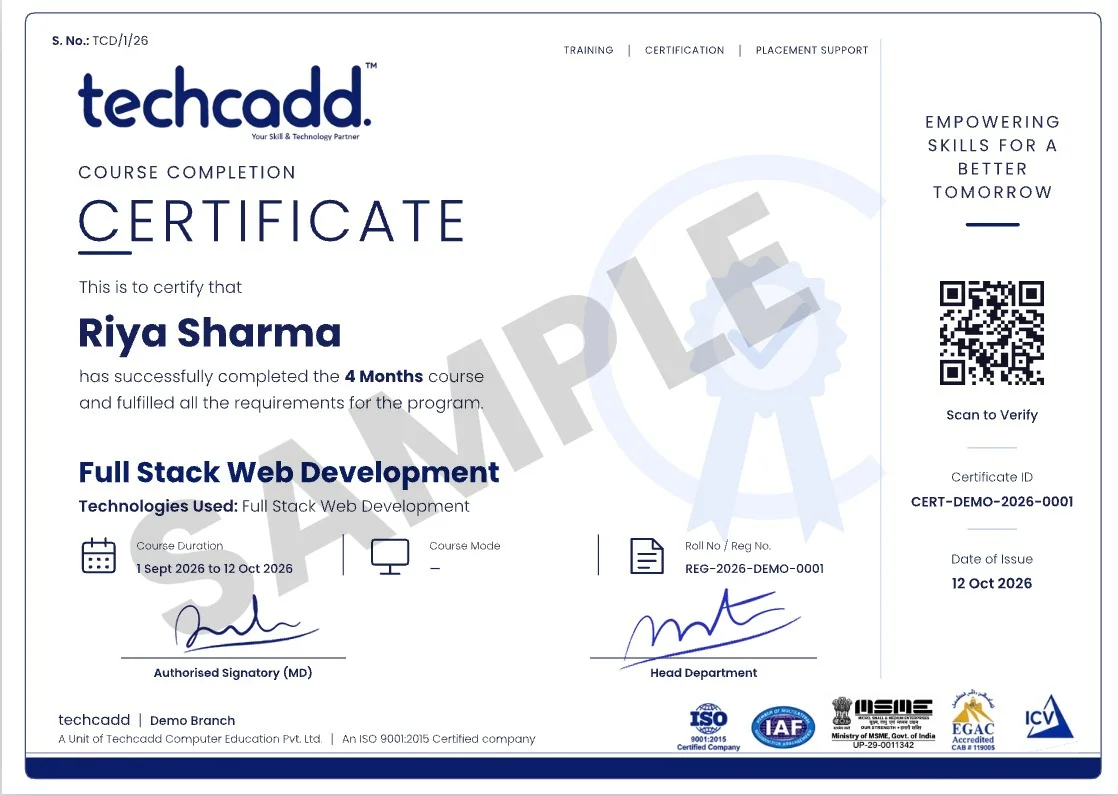
Finish the 6 Months Java Full Stack programme at techcadd Ludhiana and you leave with more than a line on a CV — a verifiable certificate, and the project work that makes it mean something in an interview.
Issued in your name on completion of the 6 Months Java Full Stack syllabus, with a reference number an employer can verify with us.
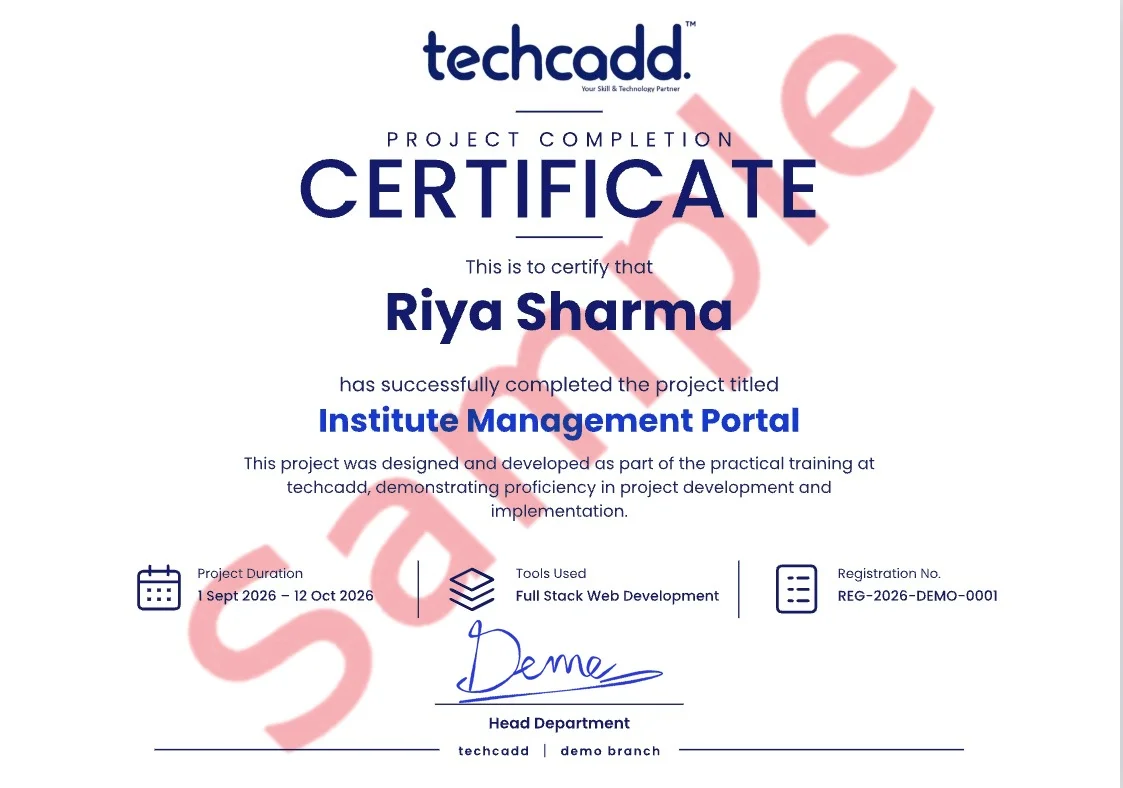
A separate certificate for the capstone you submit, naming the project so the work is attached to the credential.
Students who complete the live-project phase receive an internship letter covering the duration and the work delivered.
Every file, repository and deployed link stays yours — the part of the credential a reviewer can actually open.
techcadd has been training in Ludhiana since 2007. The certificate carries that record; the 6 Months Java Full Stack work you did carries the rest.
Where it takes you
The route from your first module to the roles 6 Months Java Full Stack opens — and the work that has to exist at each step.
employers check whether you can build and connect a React frontend, a Spring Boot backend, and a SQL database.
employers check your Spring Boot, Hibernate, and REST API design skills.
employers check your Core Java fundamentals, OOP principles, and ability to write clean, testable code.
employers check your understanding of dependency injection, security, and microservices.
employers check whether you can build scalable, secure systems for business use.
Salary outlook
Indicative ranges for the roles this course opens — what a fresher out of Ludhiana is offered, what the metro and remote markets pay for the same skills, and how that moves with two or three years of work behind you.
| Role | Ludhiana & Punjab | Delhi NCR & Bengaluru | Remote & freelance |
|---|---|---|---|
| Java Full Stack DeveloperEntry | ₹2.4–4.2 LPA | ₹4–8 LPA | ₹20k–45k / project |
| Backend Developer (Java)Entry to mid | ₹3.6–6.5 LPA | ₹6.5–14 LPA | ₹35k–90k / project |
| Software EngineerEntry to mid | ₹3.6–6.5 LPA | ₹6.5–14 LPA | ₹35k–90k / project |
| Spring Boot DeveloperMid | ₹3.6–6.5 LPA | ₹6.5–14 LPA | ₹35k–90k / project |
Ranges are indicative, drawn from what our own students report and from openings we see through the placement cell. Actual offers depend on your portfolio, the interview and the company — nobody can promise you a number, and we do not.
Java Full Stack Developer, Backend Developer (Java), Software Engineer, Spring Boot Developer and related positions, depending on which part of the syllabus you go deepest on.
The first jump usually comes at 18–24 months, once you have shipped work you can point to. Depth in one area moves it faster than breadth across many.
Yes, and a good number of our students do. Remote and contract work is the reason Ludhiana candidates now compete for the same briefs as metro ones — the portfolio travels, the address does not matter.
IT services, manufacturing and export units running automation, e-commerce and D2C brands, healthcare, education, and the agencies serving all of them. Punjab hiring is broader than it looks from a job board.
It helps with the practical half. The projects and tooling carry into an M.Tech, MCA or a specialisation abroad, and the portfolio is often what separates two applicants with the same marks.
Future scope
A course ends; the field does not. Here is the honest version of what the next few years look like for 6 Months Java Full Stack — where the roles go, and what is shifting underneath them while you learn.
Entry roles such as Java Full Stack Developer open as soon as you have projects that run. At this stage nobody is asking about your marks — they are asking you to walk through something you built.
The generalists plateau; the specialists do not. Depth in one part of 6 Months Java Full Stack — the part your first job leans on hardest — is what moves you towards backend developer (java) work.
Architecture, standards, hiring and mentoring. The technical skill is assumed by now; what you are paid for is judgement, and judgement only comes from having shipped things that mattered.
Teams expect 6 Months Java Full Stack work to be done alongside AI tooling. It raises the floor on output and raises the bar on what counts as a junior — which is exactly why the fundamentals in this course are taught the hard way.
What used to be one narrow role now touches data, deployment and the product decision behind it. Every extra layer of 6 Months Java Full Stack you understand is another kind of room you get invited into.
Remote and hybrid hiring means Ludhiana, Jalandhar and Chandigarh candidates now compete for the same roles as Bengaluru ones. Location has stopped being the ceiling it used to be.
Hiring has moved to portfolios, take-home tasks and live problem solving. A certificate opens a shortlist; work that runs is what gets you through the round after it.
Sectors hiring for this skill set
The comparison
This comparison covers how the training is structured and delivered, not marketing claims.
| What to ask about | techcadd | Typical institute |
|---|---|---|
| Live project work | Every stage, from week one | Often only at the end, if at all |
| Mentor review | Deliverables reviewed each stage | Often limited to final project |
| Spring Boot focus | Taught as a core working tool | Often only covered briefly |
| Cloud deployment | Backend stages deployed live | Often theory only |
Written about the market, not about any particular institute in it. Visit two or three, sit through a demo class at each, and ask all eight of these questions — that is the only version of this table worth trusting.
Student Voices
Feedback from students who completed the 6 Months Java Full Stack programme at techcadd Ludhiana.
Simranjeet Kaur
6 Months Java Full Stack / B.Sc. IT graduate
I joined with no background in this. By the third month I was building 6 Months Java Full Stack work on my own, and the project reviews are where I actually learnt to do it properly.
Harman Sethi
6 Months Java Full Stack / Now working as an intern in the field
The classes are practical. Every session ends with a task that has to work, so you cannot fake understanding. That habit helped me most in interviews.
Ankit Verma
6 Months Java Full Stack / BCA final year
Doubt support was the difference for me. My trainer sat with my work, found the mistake and made me fix it myself instead of handing over the answer.
Navjot Singh
6 Months Java Full Stack / Career switch from operations
I came for the skill and left with a portfolio — projects I could actually demo on a call, not a certificate I had to explain.
Real, unedited feedback from techcadd learners on Google.
Frequently asked questions
The 7 things people ask most often about the 6 Months Java Full Stack course at techcadd Ludhiana.
The complete 6 Months Java Full Stack programme runs for 6 months depending on the batch you choose. Weekday, weekend and fast-track options are available, along with shorter modules for students who only need the fundamentals.
School students after 12th, college students from any stream, graduates and working professionals changing track. The first module assumes no prior experience.
No. The course starts from the basics. If you already have some background, your trainer will move you faster through the first module so you reach the project work sooner.
Java, Spring boot, Hibernate, SQL, React, Git & Github, Postman and intelliJ IDEA — plus the day-to-day tooling and workflow that surrounds them in a real team.
Yes. Each module closes with a lab project, and the course ends with a capstone you can put on your portfolio and defend in an interview.
Placement support includes resume and portfolio review, aptitude and role-specific practice, mock interviews and interview referrals through our hiring network.
Yes. You receive a techcadd 6 Months Java Full Stack completion certificate, and a separate project certificate for the capstone you submit.
Next batch
Send this form and a counsellor calls you back about this course specifically — batch dates, fees and whether it fits what you already know.
Would rather talk now? +91 98881 22667
Ready to get started?
Talk to a counsellor today. One call is usually enough to know which track fits your degree, your schedule and the job you want.
Call now+91 98881 22667