From Python to production AI

Understand AI.Then build with it.

Python, machine learning, neural networks, computer vision, NLP and deployment — a complete route into AI engineering, not a tour of buzzwords.

 6 monthsClassroom & online batchesBeginner to job ready
Explore course
4.8/5
Student rating
500+
Students trained
6+
Industry projects
Yes
Placement support
An artificial intelligence workspace — a model in training, the data behind it and the tooling the course builds on

Admissions open

Free demo class & counselling

Batch slots

  • Weekday
  • Evening
  • Weekend
Talk to a counsellor

Course overview

The Artificial Intelligence course in Ludhiana that builds real AI skills

The Artificial Intelligence Course in Ludhiana by techcadd is designed for students, graduates, job seekers, working professionals, and entrepreneurs who want to build strong skills in modern AI technologies — Machine Learning, Deep Learning, data science basics, Natural Language Processing, Computer Vision, AI tools, Python programming, and Generative AI applications.

With Artificial Intelligence rapidly transforming industries like IT, healthcare, finance, marketing, education, and automation, learning AI skills can create high-demand career opportunities in Ludhiana and across India. Many AI training in Ludhiana programs now emphasise hands-on projects, real-world datasets, Python-based development, AI model training, and industry certifications, reflecting the growing demand for job-ready AI professionals.

techcadd’s program is structured around practical learning, coding practice, real-time projects, portfolio building, and career support.

The course suits beginners as well as learners who want to upgrade their technical skills and move toward roles such as AI developer, data analyst, machine learning engineer, or AI specialist.
  • Maths explained through code, not lectures
  • Vision and language projects you can demo
  • Models deployed as working APIs

Curriculum

A path from first steps to shipped work

5 modules and 29 topics across 6 months, in the order they are taught. Each one closes with something that works before the next one opens.

5 learning modules01 / 05
Module 01 · Weeks 1–4

Python & Maths for AI

The Python and the linear algebra, statistics and calculus you actually need — taught through code.

Topics covered

  • Python essentials
  • NumPy arrays
  • Linear algebra
  • Probability & statistics
  • Gradients intuition

Tools & libraries

  • Python
  • NumPy
  • Jupyter
  • Matplotlib

You finish with

A notebook that implements gradient descent from scratch and plots it converging.

Module 02 · Weeks 5–9

Machine Learning Foundations

Supervised and unsupervised learning, and how to tell a good model from a lucky one.

Topics covered

  • Regression & classification
  • Decision trees & ensembles
  • Clustering
  • Feature engineering
  • Cross-validation
  • Model metrics

Tools & libraries

  • scikit-learn
  • Pandas
  • Seaborn

You finish with

A tuned classifier with an honest evaluation report and a confusion matrix you can explain.

Module 03 · Weeks 10–14

Neural Networks & Deep Learning

Backpropagation, architectures and training deep models without guessing at the settings.

Topics covered

  • Perceptrons & MLPs
  • Backpropagation
  • CNNs
  • RNNs & attention
  • Regularisation
  • Transfer learning

Tools & libraries

  • PyTorch
  • TensorFlow
  • Keras
  • CUDA

You finish with

A convolutional network trained on your own dataset, with training curves you can read.

Module 04 · Weeks 15–19

Computer Vision & NLP

The two applied fields that account for most AI work — images and language.

Topics covered

  • Image preprocessing
  • Object detection
  • Text preprocessing
  • Embeddings
  • Transformers
  • Fine-tuning

Tools & libraries

  • OpenCV
  • YOLO
  • Hugging Face
  • spaCy

You finish with

A detection model and a fine-tuned language model, both running on your own data.

Module 05 · Weeks 20–24

Deployment & MLOps

Getting a model out of a notebook and keeping it working once real traffic arrives.

Topics covered

  • Model serving
  • FastAPI
  • Docker
  • Experiment tracking
  • Monitoring & drift
  • Responsible AI

Tools & libraries

  • FastAPI
  • Docker
  • MLflow
  • Streamlit

You finish with

Your capstone model deployed behind a documented API with monitoring in place.

What you learn

What you will learn in the Artificial Intelligence course

The Artificial Intelligence Course in Ludhiana at techcadd is designed to help students move from basic programming concepts to practical AI applications. The curriculum focuses on building a strong technical foundation while giving learners opportunities to practise through projects and modern AI tools.

  1. Python Programming for Artificial Intelligence

    Students begin with Python fundamentals — variables, data types, operators, conditional statements, loops, functions, lists, dictionaries, tuples, sets, and file handling — plus object-oriented programming concepts for writing structured, reusable code. Python matters because so many AI and Machine Learning libraries are built around it.

  2. Mathematics and Statistics for AI

    AI involves working with data, patterns, probabilities, and mathematical relationships. Students learn the practical mathematics required — basic statistics, probability, vectors, matrices, averages, variance, and correlation — with the focus on how these support machine learning rather than on theory for its own sake.

  3. Data Handling and Analysis

    Before training a model, data needs to be collected, cleaned, organised, and analysed. Students learn to work with datasets and handle missing values, duplicate records, inconsistent information, and basic preprocessing. NumPy and Pandas help work efficiently with structured datasets, and visualization libraries expose trends and patterns.

  4. Machine Learning

    Machine Learning is a major component of AI training. Students learn the difference between supervised and unsupervised learning, and the algorithms used for classification, regression, clustering, and prediction. Practical exercises include creating models, preparing datasets, training algorithms, testing results, and evaluating performance.

  5. Deep Learning

    Students explore the fundamentals of Deep Learning and neural networks — neurons, layers, activation functions, training concepts, loss functions, and model evaluation — and how deep learning is applied to image recognition, speech processing, recommendation systems, and intelligent applications.

  6. Natural Language Processing

    NLP focuses on enabling computers to work with human language. Students learn text preprocessing, tokenization, sentiment analysis, text classification, and basic language-model applications — the concepts behind chatbots, document analysis, customer-support systems, and automated text processing.

  7. Computer Vision

    Computer Vision enables computers to interpret visual information. Students explore image processing, image classification, object-detection concepts, and practical applications, with projects that involve working with images and understanding how models identify or classify visual information.

  8. Generative AI

    Modern AI training increasingly includes Generative AI, where systems generate text, images, code, and other content. Students learn the fundamentals of generative models, AI-assisted workflows, prompt engineering, and the responsible use of AI tools.

  9. AI Tools and Technologies

    Depending on the module, students gain practical exposure to Python, NumPy, Pandas, Matplotlib, Scikit-learn, TensorFlow, Keras, OpenCV, Jupyter Notebook, Google Colab, Generative AI tools, and prompt engineering tools — connecting programming concepts with practical AI development.

  10. Real-World AI Projects

    Project-based learning brings the process together. Students work on projects involving prediction, classification, data analysis, NLP, computer vision, or Generative AI — a machine learning prediction model, a sentiment-analysis application, an image-classification project, or an AI-powered application. Such projects demonstrate practical ability and strengthen a portfolio.

Tools you’ll work with

  • Python
  • NumPy
  • Pandas
  • Matplotlib
  • Scikit-learn
  • TensorFlow
  • Keras
  • OpenCV
  • Jupyter Notebook
  • Google Colab
  • Generative AI tools
  • Prompt engineering

The objective is practical knowledge rather than memorised concepts. Regular coding practice, assignments, projects, problem-solving, and portfolio development prepare learners for further study, internships, entry-level technology roles, and continuous professional development — combining Python, data, Machine Learning, Deep Learning, NLP, Computer Vision and Generative AI into a broader understanding of how AI is actually applied.

Find your pace

What you can do, phase by phase

The Artificial Intelligence syllabus in the order you meet it, and what you are able to do by the end of each stretch of it. Every row is a capability, not a topic you sat through.

Every capability in the Artificial Intelligence syllabus, and the phase it is covered in
CapabilityFoundationsAppliedProfessional
Python essentialsPython & Maths for AICovered in FoundationsCovered in AppliedCovered in Professional
NumPy arraysPython & Maths for AICovered in FoundationsCovered in AppliedCovered in Professional
Linear algebraPython & Maths for AICovered in FoundationsCovered in AppliedCovered in Professional
Probability & statisticsPython & Maths for AICovered in FoundationsCovered in AppliedCovered in Professional
Gradients intuitionPython & Maths for AICovered in FoundationsCovered in AppliedCovered in Professional
Regression & classificationMachine Learning FoundationsCovered in FoundationsCovered in AppliedCovered in Professional
Decision trees & ensemblesMachine Learning FoundationsCovered in FoundationsCovered in AppliedCovered in Professional
ClusteringMachine Learning FoundationsCovered in FoundationsCovered in AppliedCovered in Professional
Feature engineeringMachine Learning FoundationsCovered in FoundationsCovered in AppliedCovered in Professional
Cross-validationMachine Learning FoundationsCovered in FoundationsCovered in AppliedCovered in Professional
Model metricsMachine Learning FoundationsCovered in FoundationsCovered in AppliedCovered in Professional
Perceptrons & MLPsNeural Networks & Deep LearningNot yet covered in FoundationsCovered in AppliedCovered in Professional
BackpropagationNeural Networks & Deep LearningNot yet covered in FoundationsCovered in AppliedCovered in Professional
CNNsNeural Networks & Deep LearningNot yet covered in FoundationsCovered in AppliedCovered in Professional
RNNs & attentionNeural Networks & Deep LearningNot yet covered in FoundationsCovered in AppliedCovered in Professional
RegularisationNeural Networks & Deep LearningNot yet covered in FoundationsCovered in AppliedCovered in Professional
Transfer learningNeural Networks & Deep LearningNot yet covered in FoundationsCovered in AppliedCovered in Professional
Image preprocessingComputer Vision & NLPNot yet covered in FoundationsCovered in AppliedCovered in Professional
Object detectionComputer Vision & NLPNot yet covered in FoundationsCovered in AppliedCovered in Professional
Text preprocessingComputer Vision & NLPNot yet covered in FoundationsCovered in AppliedCovered in Professional
EmbeddingsComputer Vision & NLPNot yet covered in FoundationsCovered in AppliedCovered in Professional
TransformersComputer Vision & NLPNot yet covered in FoundationsCovered in AppliedCovered in Professional
Fine-tuningComputer Vision & NLPNot yet covered in FoundationsCovered in AppliedCovered in Professional
Model servingDeployment & MLOpsNot yet covered in FoundationsNot yet covered in AppliedCovered in Professional
FastAPIDeployment & MLOpsNot yet covered in FoundationsNot yet covered in AppliedCovered in Professional
DockerDeployment & MLOpsNot yet covered in FoundationsNot yet covered in AppliedCovered in Professional
Experiment trackingDeployment & MLOpsNot yet covered in FoundationsNot yet covered in AppliedCovered in Professional
Monitoring & driftDeployment & MLOpsNot yet covered in FoundationsNot yet covered in AppliedCovered in Professional
Responsible AIDeployment & MLOpsNot yet covered in FoundationsNot yet covered in AppliedCovered in Professional

The full programme runs 6 months. Where you finish is a question of pace rather than of syllabus — everyone covers all of it.

The case for it

Your months should build more than a certificate.

A course is worth the time you give it only if you finish with work you can show and skills you can defend. That is the standard this programme is designed against.

12+Practical learning areasfrom fundamentals to delivery
  • You learn AI the way it is used in production, with the workflow, tooling and standards a working team expects. Nothing in the syllabus exists only to fill hours.

  • Sessions are hands-on. You do every example, break it, and fix it. Each module closes with a lab task that has to work before you move on.

  • Six shipped finished projects — the kind of work an interviewer can open, click through and question you on.

  • A structured final phase: portfolio review, profile cleanup, aptitude and role-specific practice, mock interviews and placement support.

Why this course

Why should you choose this course?

Six things we hold ourselves to for every Artificial Intelligence batch that starts in Ludhiana.

  • 01

    Industry-focused curriculum

    Syllabus built around what AI teams actually ship — no filler modules, no theory that never reaches your hands.

  • 02

    Practical learning

    Every concept lands in the tool the same day. You work in AI during each class, not just in your notes.

  • 03

    Real-world projects

    Build with real requirements, real data and real problems — from the first task to a finished, reviewable deliverable.

  • 04

    Mentor guidance

    Trainers who work with AI daily review your work, your logic and your approach line by line.

  • 05

    Career preparation

    Resume, portfolio, aptitude rounds and interview practice built into the last phase of the course.

  • 06

    Placement support

    Interview referrals, mock rounds and continued doubt support after the course ends.

Eligibility

Who can do an Artificial Intelligence course in Ludhiana?

The Artificial Intelligence Course in Ludhiana at techcadd is suitable for learners from different educational and professional backgrounds. You do not always need an advanced technical background to begin. With the right learning approach, regular practice, and an interest in technology, students can gradually develop the skills required to work with AI concepts, Python programming, machine learning models, data, and modern AI tools.

  • 12th Pass Students

    Students who have completed 12th can start learning Artificial Intelligence to build an early foundation in programming and emerging technologies. Learning Python, basic mathematics, data handling, and AI concepts helps students understand how intelligent applications are developed — and an AI course after 12th is also a way to explore technology before committing to a degree or specialization.

    Any stream
  • College Students

    BCA, B.Tech, B.Sc., and MCA students can benefit from practical AI training alongside their academic studies. The course covers concepts that may not get enough practical exposure in regular classroom education — students work on AI projects, practise Python, explore machine learning algorithms, and build a portfolio for future opportunities.

    Alongside your degree
  • Graduates

    Graduates who want to enter the technology sector can develop industry-oriented technical skills here. Learners from computer science, mathematics, statistics, engineering, and related backgrounds may find AI particularly relevant, and graduates from non-technical fields can begin with foundational modules and build their programming and analytical abilities from there.

    Any degree
  • Job Seekers

    If you are looking for a career change or want to improve your employability, AI training helps you develop skills relevant to the growing technology ecosystem. Practical knowledge of Python, machine learning, data analysis, Generative AI, and AI applications strengthens a resume and portfolio — and the focus should be on creating projects that demonstrate what you can actually build.

    Portfolio ready
  • Working Professionals

    Professionals already working in IT, software development, data, digital marketing, business, or other technology-related areas can learn AI to upgrade their existing skill set. AI knowledge helps professionals understand automation, intelligent systems, predictive models, AI-assisted workflows, and modern productivity tools.

    Upskilling
  • Entrepreneurs and Business Owners

    Business owners can learn AI fundamentals to understand how Artificial Intelligence supports automation, customer service, marketing, data analysis, content creation, and business decision-making. Basic AI knowledge helps entrepreneurs identify practical opportunities for using AI tools within their businesses.

    Run it in-house
  • Students Interested in ML and Generative AI

    Learners specifically interested in Machine Learning, Deep Learning, Generative AI, NLP, or Computer Vision can use the course as a structured pathway into those technologies. Practical assignments and projects turn theoretical understanding into usable technical skill.

    Specialise later
  • Beginners Interested in AI

    You can start an AI training in Ludhiana course even if you are entirely new to Artificial Intelligence. Beginners should focus first on programming fundamentals, logical thinking, data concepts, and basic AI terminology, then move gradually toward machine learning, deep learning, and Generative AI applications.

    Start from zero

What you actually need before day one

6 months · Classroom & online batches

  • A laptop or desktop — we help you set it up in the first session
  • A stable internet connection for the online batches
  • No prior coding or technical background
  • Basic English reading — the tools and their documentation are in English
  • About 6-8 hours a week outside class for practice
  • Willingness to finish the lab task before the next class

Overall, the program suits anyone who wants to build practical AI skills, develop projects, strengthen their technical profile, and prepare for technology-oriented career opportunities. Ask about Artificial Intelligence

Technology ecosystem

One discipline.
A mesh of real tools.

Artificial Intelligence is the centre. These are the tools you use around it in a working team.

  • Deep learning framework
  • Production ML
  • Classical machine learning
  • Computer vision
  • Pretrained models
  • Data handling
  • Model serving
  • Reproducible deploys
  • PyTorchDeep learning framework
  • TensorFlowProduction ML
  • scikit-learnClassical machine learning
  • OpenCVComputer vision
  • Hugging FacePretrained models
  • PandasData handling
  • FastAPIModel serving
  • DockerReproducible deploys

Hands-on projects

Projects you actually ship,
not just follow along with.

Each one lands in your portfolio with the working files, the process and something a reviewer can open.

Capstone project

Real-Time Defect Detection System

A production-shaped vision system: a custom-labelled dataset, a fine-tuned detection model, a FastAPI inference service, a live camera dashboard and drift monitoring. You handle the data collection, the training runs, the trade-offs and the deployment.

  • PyTorch
  • YOLO
  • FastAPI
  • Docker
Difficulty
Advanced
Status
Deployed
View project brief

Certification

Get certified in Artificial Intelligence

A verifiable techcadd Artificial Intelligence certificate, an internship letter covering the live-project phase, and a portfolio of AI work built on real datasets — the three things an interviewer in Ludhiana or Mohali actually asks to see.

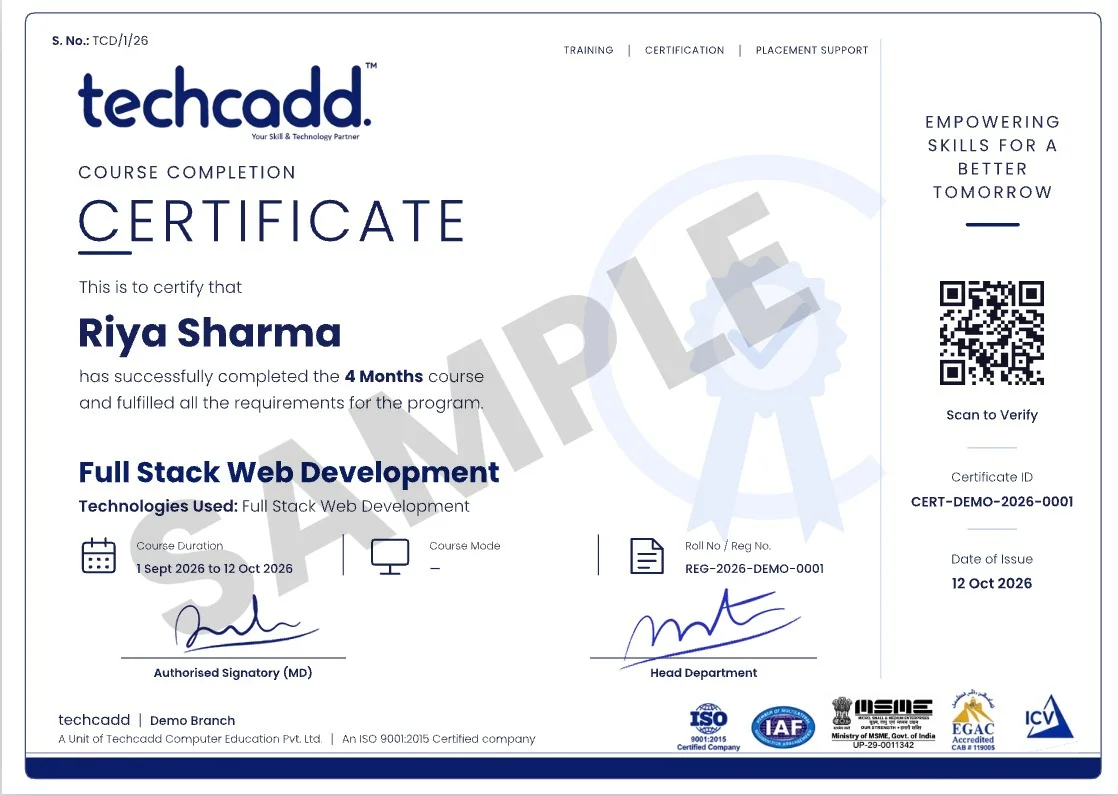
  • Course completion certificate

    Issued in your name on completion of the Artificial Intelligence syllabus, with a reference number an employer can verify with us.

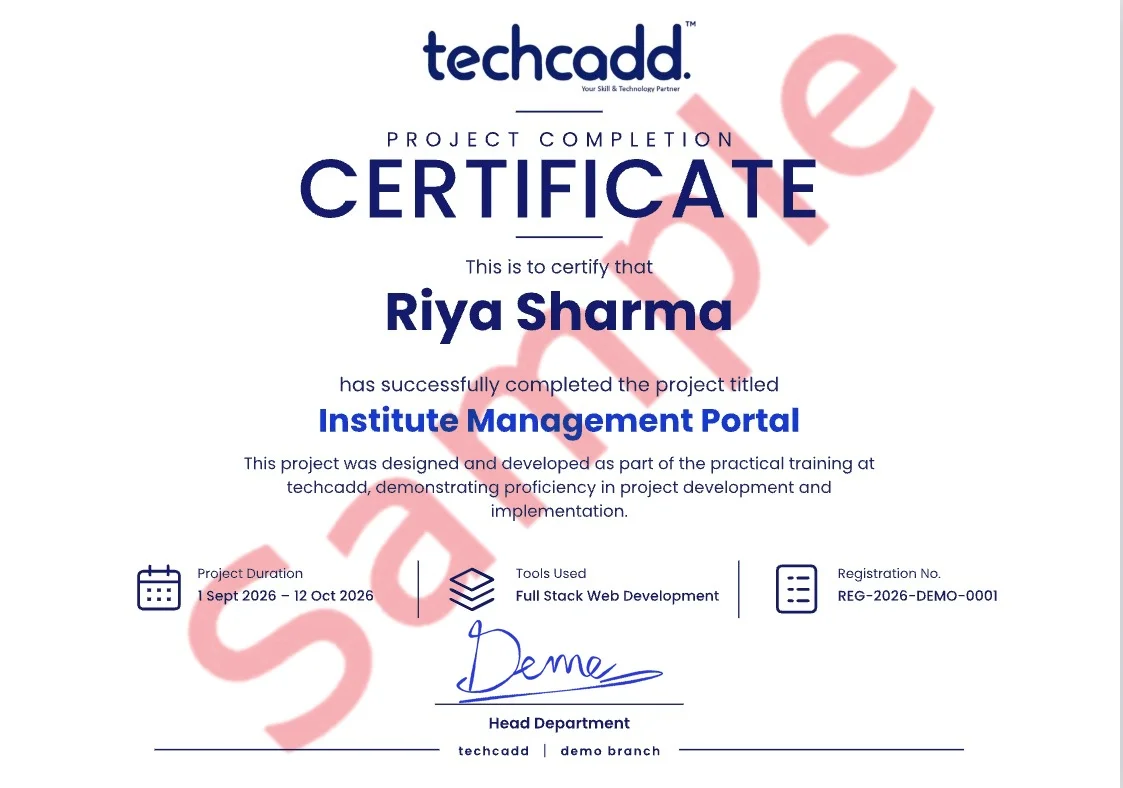
  • Project certificate

    A separate certificate for the capstone you submit, naming the project so the work is attached to the credential.

  • Internship letter

    Students who complete the live-project phase receive an internship letter covering the duration and the work delivered.

  • Portfolio you own

    Every file, repository and deployed link stays yours — the part of the credential a reviewer can actually open.

techcadd has been training in Ludhiana since 2007. The certificate carries that record; the AI work you did carries the rest.

Sample techcadd course completion certificate
Course completion
Sample techcadd project completion certificate
Project & internship

Where it takes you

Where this course takes you

The route from your first module to the roles Artificial Intelligence opens — and the work that has to exist at each step.

  1. 01Learning
  2. 02Projects
  3. 03Portfolio
  4. 04Industry readiness
  5. 05Career opportunities
  • AI Engineer

    Build, evaluate and ship models as part of a product team.

  • Machine Learning Engineer

    Take models from experiment to reliable production service.

  • Computer Vision Engineer

    Work on detection, recognition and image understanding systems.

  • NLP Engineer

    Build search, classification and language features on text data.

  • Data Scientist

    Answer business questions with models and communicate the findings.

  • AI Research Assistant

    Support applied research with implementation and experimentation.

Salary outlook

What AI work pays in Ludhiana and beyond

Indicative ranges for the roles an **Artificial Intelligence course in Ludhiana** opens — locally, in the metros hiring from Punjab, and on the remote market that now competes with both.

Indicative annual packages by role and market
RoleLudhiana & PunjabDelhi NCR & BengaluruRemote & freelance
AI / ML EngineerEntry₹3.0–5.5 LPA₹5–12 LPA₹40k–1.1L / project
Data Analyst (AI-assisted)Entry₹2.4–4.5 LPA₹4–9 LPA₹25k–70k / project
AI DeveloperEntry to mid₹3.6–6.5 LPA₹6.5–15 LPA₹45k–1.3L / project
AI Specialist / ConsultantMid (2–4 yrs)₹6–11 LPA₹11–24 LPA₹90k–2.6L / project

Ranges are indicative, drawn from what our own students report and from openings we see through the placement cell. Actual offers depend on your portfolio, the interview and the company — nobody can promise you a number, and we do not.

  • AI developer, machine learning engineer, data analyst, NLP or computer vision associate, AI specialist and — for students who pair it with the business side — AI consultant. The first role is usually broader here than its title suggests.

  • Most students see the first meaningful revision at 18–24 months, once there is delivered work behind them. What moves it is specialisation: the people who pick one of NLP, vision or applied ML and go deep tend to overtake the ones who stay general.

  • Increasingly, yes. Model work reviews cleanly over a call, and a repository with a clear README and honest metrics travels. Freelance AI work from Punjab is most commonly automation, document processing and dashboard-plus-model builds for small businesses.

  • In and around Ludhiana: IT services and software firms, manufacturing and auto-component units adding predictive maintenance and quality inspection, hosiery and textile exporters on demand forecasting, hospitals and labs, agri-tech around PAU, logistics, and the education sector. Mohali and Chandigarh add the product companies.

  • Strongly. An M.Tech, MCA or an overseas AI/data-science masters all weigh a practical portfolio, and the project work here — with real datasets and written-up results — is the part most applicants from Punjab are missing.

Why this programme

Why choose an Artificial Intelligence course in Ludhiana?

Artificial Intelligence is becoming an important part of modern technology, business, automation, and digital transformation. Choosing an Artificial Intelligence Course in Ludhiana helps students and professionals develop practical knowledge of technologies increasingly used across industries — a structured program gives a clear pathway from fundamentals to practical applications rather than theory alone.

  1. Build Future-Ready Technical Skills

    AI is a rapidly developing field combining programming, data, algorithms, automation, and intelligent systems. Learning it helps students understand how machines analyse information, identify patterns, generate content, make predictions, and support decision-making — through Python, Machine Learning, Deep Learning, NLP, Computer Vision, and Generative AI.

  2. Learn Python for AI Development

    Python is widely used in AI and Machine Learning because of its extensive libraries and beginner-friendly syntax. Students learn programming fundamentals before progressing toward data handling, model development, and AI applications — a strong Python foundation makes practical AI projects far easier to understand.

  3. Gain Practical Learning Experience

    A major reason to choose professional AI training in Ludhiana is the chance to practise concepts through projects and assignments. Practical learning shows how AI concepts apply outside the classroom, and projects involving datasets, prediction, classification, text processing, image analysis, or Generative AI become valuable portfolio additions.

  4. Explore Multiple AI Technologies

    Artificial Intelligence is not one technology. A comprehensive program introduces Machine Learning, Deep Learning, Natural Language Processing, Computer Vision, and Generative AI — and exploring them lets learners find where their interest lies and identify possible career directions.

  5. Develop a Strong Portfolio

    A certificate alone may not demonstrate what a learner can do; projects provide the evidence. During training students create work demonstrating programming ability, data processing, model implementation, and problem-solving. A well-organised portfolio helps when applying for internships, entry-level opportunities, freelance projects, or further technical education.

  6. Prepare for AI-Related Career Opportunities

    Depending on education, technical ability, and specialization, students may explore roles such as AI Developer, Machine Learning Engineer, Junior Data Analyst, AI Specialist, Python Developer, or Generative AI professional. Career outcomes depend on individual skills, experience, projects, and continuous learning.

  7. Learn Modern AI and Generative AI Tools

    Modern AI learning involves more than traditional machine learning. Generative AI tools are used for text, images, automation, research, coding assistance, and productivity — understanding them keeps students familiar with current developments and how AI applies to real workflows.

  8. Suitable for Students and Career Changers

    The program is useful for 12th-pass students, graduates, college students, job seekers, working professionals, and technology enthusiasts. Beginners start with foundational concepts, while learners with programming experience can move faster into advanced topics.

  9. A Student-Oriented Learning Environment

    techcadd is a practical choice for students looking for AI training in Ludhiana with a focus on skill development. A student-oriented environment, practical assignments, project-based learning, coding practice, and career guidance help learners build confidence as they progress through the course.

If your goal is to understand Artificial Intelligence, develop practical technical skills, build projects, and prepare for the evolving technology industry, an Artificial Intelligence Course in Ludhiana provides a structured starting point for that learning journey.

Future scope

The road ahead for AI

A course ends; the field does not. Here is the honest version of what the next few years look like for AI — where the roles go, and what is shifting underneath them while you learn.

  1. Year 0–1

    Get in on proof of work

    Entry roles such as AI Engineer open as soon as you have projects that run. At this stage nobody is asking about your marks — they are asking you to walk through something you built.

  2. Year 2–4

    Specialise and get paid for it

    The generalists plateau; the specialists do not. Depth in one part of AI — the part your first job leans on hardest — is what moves you towards machine learning engineer work.

  3. Year 5+

    Own the decisions

    Architecture, standards, hiring and mentoring. The technical skill is assumed by now; what you are paid for is judgement, and judgement only comes from having shipped things that mattered.

Sectors hiring for this skill set

  • IT services
  • Product startups
  • Banking & fintech
  • Healthcare
  • E-commerce
  • Manufacturing
  • EdTech
  • Government & PSUs

The comparison

Why students pick techcadd for Artificial Intelligence

Every institute in Ludhiana claims industry training and placement support. These are the differences you can actually check on a demo visit — ask any of them of anyone, including us.

techcadd compared with a typical institute, feature by feature
What to ask abouttechcaddTypical institute
Who teachesTrainers who still do AI work outside the classroomFull-time faculty teaching from a fixed deck
1-on-1 classesOne-to-one teaching available on every course — the pace is yours, and your work is looked at by nameOne group class moving at one pace, whoever that pace happens to suit
Project work5 real projects plus a capstone you deploy and defendGuided exercises copied from the board
CurriculumReviewed every batch against what working teams shipUpdated when the printed syllabus is reprinted
How a module endsA lab task that has to run before you move onNotes to revise before an exam
Doubt supportTrainer sits with your code; open lab hours between classesAsk at the end of class if there is time left
What you leave withCompletion certificate, project certificate, internship letter — all verifiableOne printed certificate
After the coursePortfolio review, mock interviews, referrals, continued doubt supportThe course ends and so does the contact

Written about the market, not about any particular institute in it. Visit two or three, sit through a demo class at each, and ask all eight of these questions — that is the only version of this table worth trusting.

Student Voices

What Artificial Intelligence learners say

Feedback from students who completed the Artificial Intelligence programme at techcadd Ludhiana.

Google Reviews4.8from 181 Google reviewsGoogle Verified
SK

Simranjeet Kaur

Artificial Intelligence / B.Sc. IT graduate

I joined with no background in this. By the third month I was building AI work on my own, and the project reviews are where I actually learnt to do it properly.

Posted on Google
HS

Harman Sethi

Artificial Intelligence / Now working as an intern in the field

The classes are practical. Every session ends with a task that has to work, so you cannot fake understanding. That habit helped me most in interviews.

Posted on Google
AV

Ankit Verma

Artificial Intelligence / BCA final year

Doubt support was the difference for me. My trainer sat with my work, found the mistake and made me fix it myself instead of handing over the answer.

Posted on Google
NS

Navjot Singh

Artificial Intelligence / Career switch from operations

I came for the skill and left with a portfolio — projects I could actually demo on a call, not a certificate I had to explain.

Posted on Google

Real, unedited feedback from techcadd learners on Google.

Frequently asked questions

Questions before you enrol

The 15 things people ask most often about the Artificial Intelligence course at techcadd Ludhiana.

  • An Artificial Intelligence Course in Ludhiana teaches students how AI systems work and how to build practical AI applications. Depending on the curriculum, topics include Python, Machine Learning, Deep Learning, data analysis, NLP, Computer Vision, and Generative AI.

  • 12th-pass students, college students, graduates, job seekers, working professionals, and technology enthusiasts can consider the course. Beginners can start with foundational programming and AI concepts.

  • AI can seem complex initially, but beginners can learn it step by step. Starting with Python, basic mathematics, data concepts, and simple Machine Learning projects makes the process considerably easier.

  • Previous programming experience helps but is not always necessary. Beginners can first learn Python fundamentals and then progress toward Machine Learning and other AI technologies.

  • Python is one of the most commonly used languages for AI and Machine Learning. Its extensive libraries and relatively simple syntax make it suitable for beginners and experienced developers alike.

  • An AI training program covers Python, data handling, statistics, Machine Learning, Deep Learning, NLP, Computer Vision, Generative AI, AI tools, model evaluation, and practical projects.

  • Yes. A practical AI program includes assignments, coding exercises, datasets, and real-world projects. Project work helps students apply concepts and build a portfolio demonstrating their skills.

  • Depending on the curriculum, students work with Python, NumPy, Pandas, Scikit-learn, TensorFlow, Keras, OpenCV, Jupyter Notebook, Google Colab, and selected Generative AI tools.

  • Yes. Generative AI can be included as part of a broader AI learning pathway. Students explore prompt engineering, AI-assisted content generation, AI applications, and the responsible use of Generative AI tools.

  • Depending on education, technical skills, projects, and experience, learners can explore roles such as AI Developer, Machine Learning Engineer, Python Developer, Junior Data Analyst, AI Specialist, or Generative AI professional. Career outcomes vary from person to person.

  • Yes. Students in Ludhiana can use AI training to develop technical skills alongside their academic education. Practical projects and programming experience help them prepare for internships, further studies, and technology-oriented career opportunities.

  • Compare the curriculum, practical training, trainer experience, project work, tools covered, learning support, course duration, certification, and career guidance before enrolling. Choose a program that matches your current skill level and career goals.

  • Yes. techcadd offers technology-focused training programs designed around practical skill development. Contact the Ludhiana centre directly to confirm the current AI curriculum, batch schedule, duration, fees, and available training mode.

  • Yes. Working professionals can learn AI to upgrade their technical knowledge, understand automation and data-driven applications, or explore a transition into AI-related roles. A structured course provides a learning path alongside professional responsibilities.

  • Artificial Intelligence is the broader field of creating systems that perform tasks associated with intelligent behaviour. Machine Learning is a major approach within AI that enables systems to learn patterns from data — so every ML system is AI, but not all AI is ML.

Talk to our experts

Build practical AI skills with techcadd

Ready to start your journey into Artificial Intelligence? Learn practical AI concepts, Python programming, Machine Learning, Deep Learning, Generative AI, and modern AI tools through a structured, student-focused approach — whether you are a 12th-pass student, graduate, job seeker, working professional, or technology enthusiast.

  • CourseArtificial Intelligence Course
  • Duration6 months
  • ModeClassroom & online batches
  • Centretechcadd Ludhiana

Would rather talk now? +91 98881 22667

Taken from the page you are on — this enquiry reaches the Artificial Intelligence counsellor directly.

Loading the security check…

We never share your number. Expect a call within working hours.

Ready to get started?

Start building your career today.

Talk to a counsellor today. One call is usually enough to know which track fits your degree, your schedule and the job you want.

Call now+91 98881 22667
  • Free career counselling
  • No registration fee
  • Placement support included
InternshipJoin