Networking & Linux Foundations
The foundational knowledge required to understand and secure networks.
You finish with
A configured Linux server and a network diagram.
Cyber SecurityIndustry-Ready
The 6-month training that builds practical, hands-on cybersecurity skills, not just theoretical knowledge.
This is a 6-month, project-led industrial training programme that takes you from networking and system administration fundamentals to performing ethical hacking, securing cloud environments, and responding to security incidents. You build with Linux, Python, and security tools — in small batches, with mentor-reviewed deliverables, live labs, and placement support in Ludhiana.
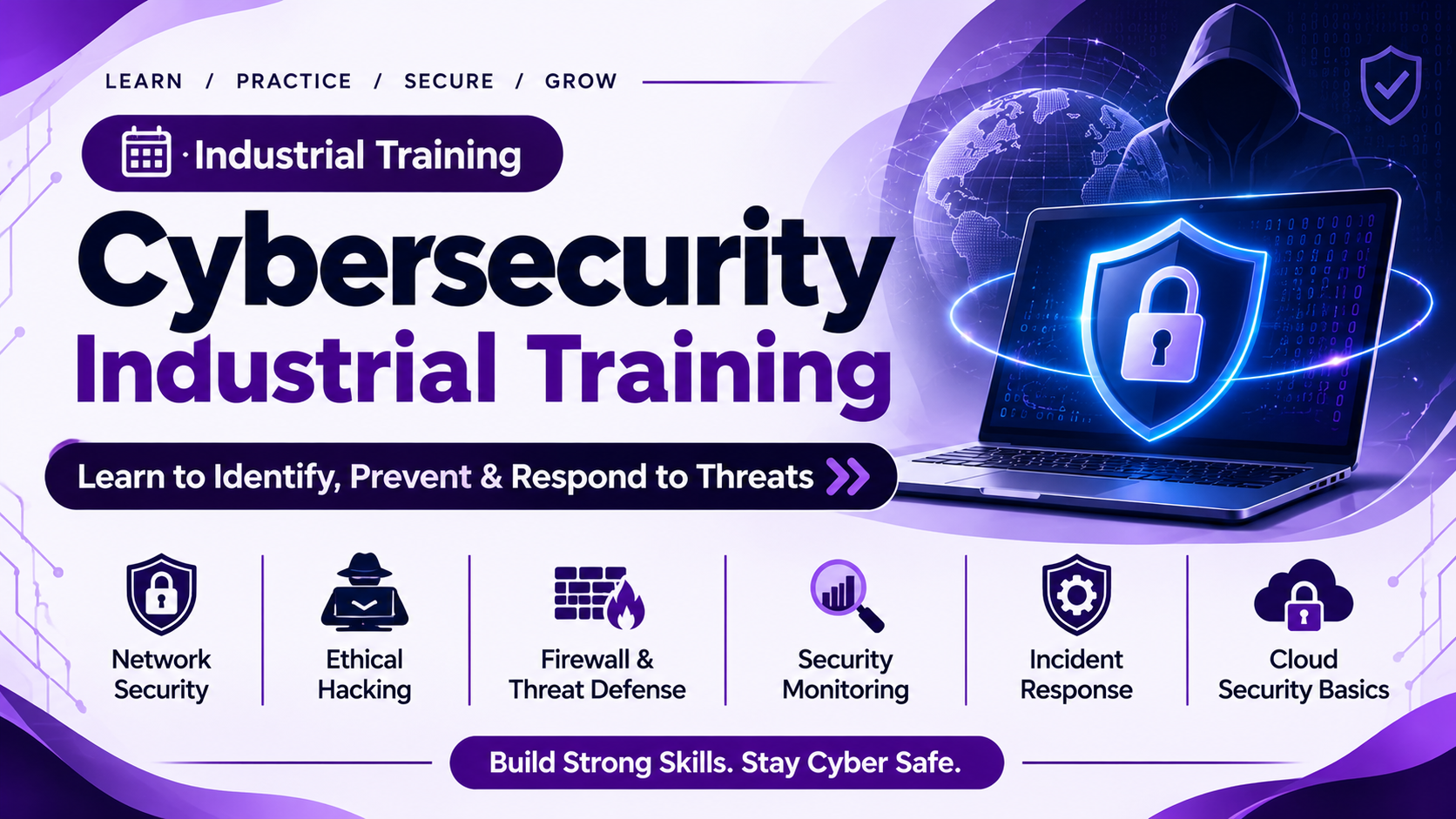
Admissions open
Free demo class & counselling
Batch slots
Course overview
This Cybersecurity Industrial Training in Ludhiana is a project-led programme covering networking, Linux, ethical hacking, Python automation, and SOC operations across 5 stages and 24 weeks. The learning arc runs in three stages: foundations (networking, Linux, security basics), applied offensive/defensive work (ethical hacking, vulnerability assessment), and a closing operations stage (SOC, incident response, cloud security). Students finish with a portfolio of security reports and a capstone project, and interview readiness built on hands-on lab work they have actually completed. The final stage is a professional capstone and career-preparation block — portfolio building, interview practice, and placement support — so the programme ends with something an employer can review, not just a certificate.
Curriculum
The syllabus is a 5-stage ladder, not a parallel list: each stage has topics, tools, a real-world use, and a deliverable, and later stages build directly on earlier ones. Progression runs from networking and Linux fundamentals through ethical hacking and Python automation to SOC operations and cloud security, closing with a capstone.
The foundational knowledge required to understand and secure networks.
You finish with
A configured Linux server and a network diagram.
Finding and exploiting vulnerabilities in a controlled lab environment.
You finish with
A vulnerability assessment report.
Using Python to automate security tasks and analyze logs.
You finish with
A Python security automation script.
Monitoring for threats and responding to security incidents.
You finish with
An incident response report.
Bringing all the skills together to perform a complete security audit.
You finish with
A comprehensive security audit and capstone project.
What you learn
The Cybersecurity Industrial Training in Ludhiana at techcadd is designed to help students move from basic networking concepts to performing ethical hacking, securing systems, and responding to threats.
Master TCP/IP, the OSI model, and Linux system administration to build a solid foundation for cybersecurity.
Learn to find and exploit vulnerabilities using industry-standard tools like Nmap, Metasploit, and Burp Suite.
Use Python to automate security tasks, analyze logs, and write custom scripts for vulnerability scanning.
Learn to monitor networks, detect threats using Wireshark and SIEM tools, and respond to security incidents.
Bring all your skills together by performing a complete security audit on a simulated enterprise network and preparing for interviews.
Tools you’ll work with
The case for it
A course is worth the time you give it only if you finish with work you can show and skills you can defend.
You learn cybersecurity the way it is used in the field, with the workflow, tools (Nmap, Metasploit, Wireshark), and standards a security team expects.
Every stage produces a real artifact, from a network scan to a fully documented incident response report, rather than just tutorial notes.
You learn to use industry-standard tools to find vulnerabilities and secure systems in a safe, controlled lab environment.
You don't just read about attacks. You analyze simulated breaches and write the reports that security teams use to respond.
Why this course
Six things we hold ourselves to for every Cybersecurity Industrial batch that starts in Ludhiana.
every stage produces a deliverable you can show, not just notes.
a complete security audit and incident response report.
deliverables are reviewed by trainers who still do client work.
hands-on use of security tools in isolated lab environments.
Why TechCadd
techcadd runs this training as a ladder of deliverables, not a lecture series — every stage ends with something built, reviewed, and added to your portfolio.
trainers bring current project experience into the batch, not just slides.
every stage produces a real artifact in a safe lab environment.
review and feedback are possible because batches stay small.
you learn to hack and defend in a lab, not just study theory.
Who can join
This training fits a specific starting point: you want to build practical cybersecurity skills, and you are ready to work through 5 stages with hands-on labs and deliverables rather than watch a course passively.
start with networking and Linux, and finish with a practical capstone you can show at your first interview.
upskill into cybersecurity without leaving your job, using weekday or weekend batches.
move from an IT support or networking role into security through a structured ladder.
learn to secure your own organization's infrastructure and respond to threats.
Not sure which of these you are, or whether the timing works around what you already do? That is exactly what the call is for. Ask about Cybersecurity Industrial
Technology ecosystem
Cybersecurity Industrial is the centre. These are the tools you use around it in a working team.
Hands-on projects
Each one lands in your portfolio with the working files, the process and something a reviewer can open.
Certification
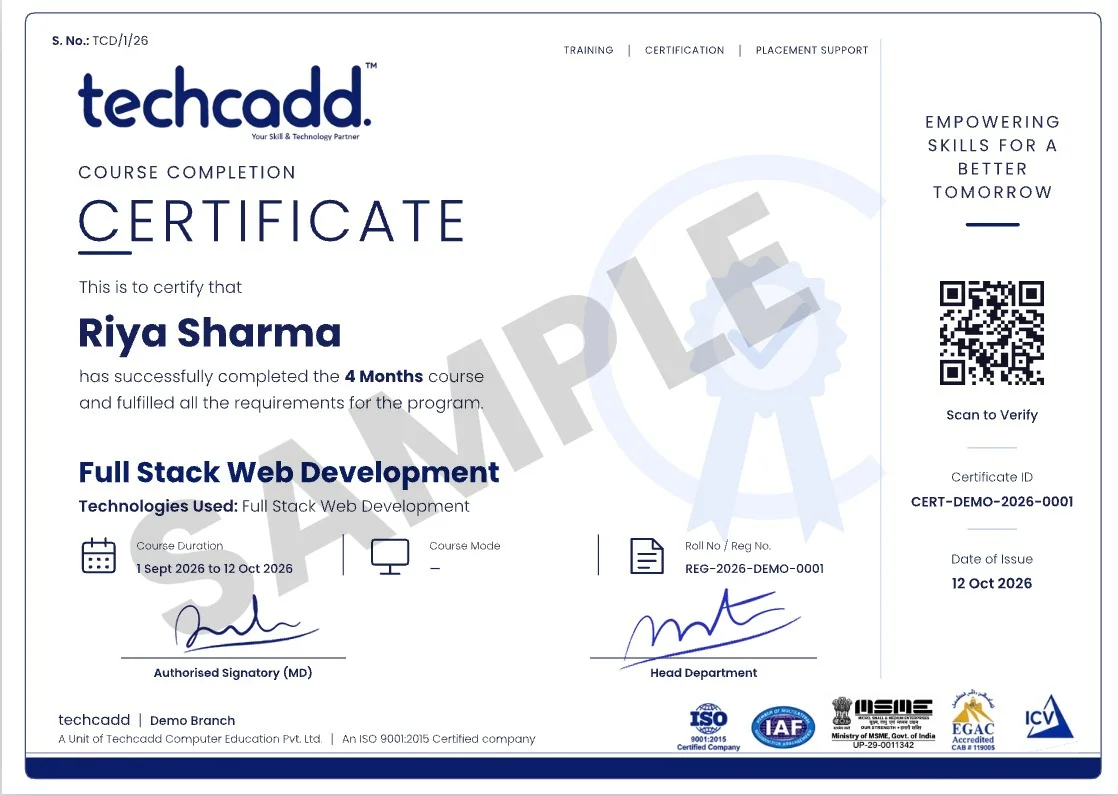
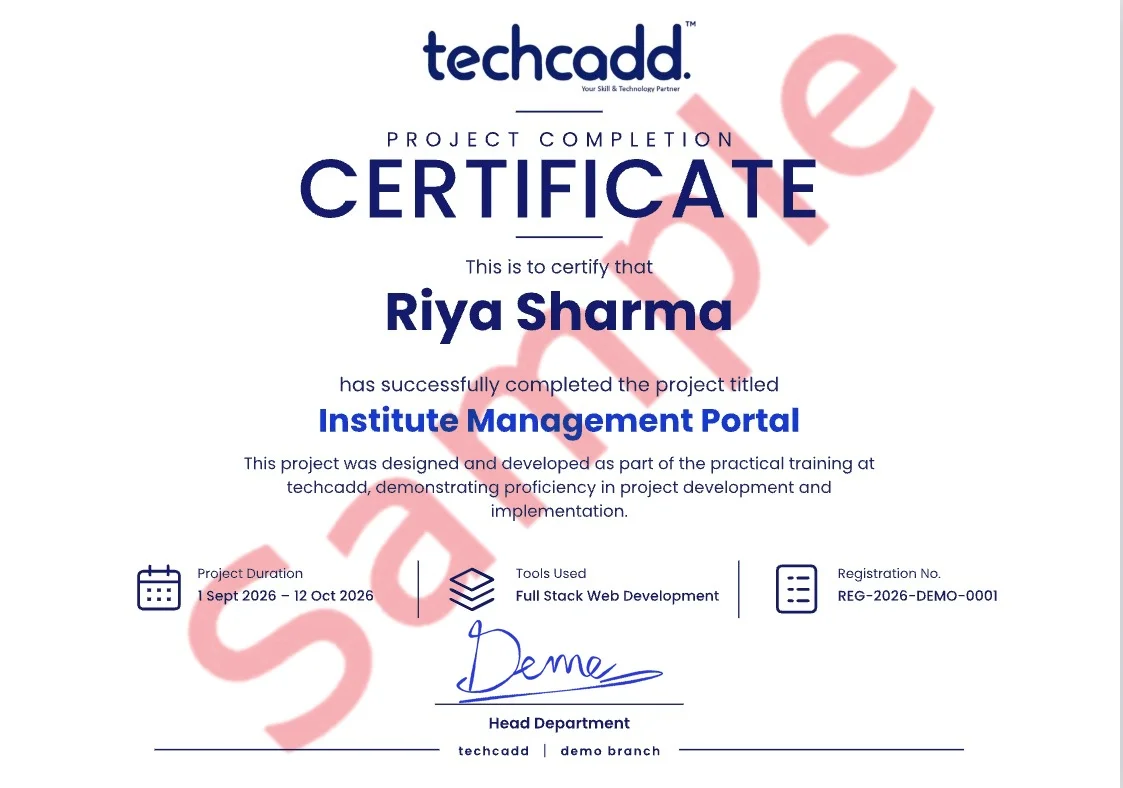
Finish the Cybersecurity Industrial programme at techcadd Ludhiana and you leave with more than a line on a CV — a verifiable certificate, and the project work that makes it mean something in an interview.
Issued in your name on completion of the Cybersecurity Industrial syllabus, with a reference number an employer can verify with us.
A separate certificate for the capstone you submit, naming the project so the work is attached to the credential.
Students who complete the live-project phase receive an internship letter covering the duration and the work delivered.
Every file, repository and deployed link stays yours — the part of the credential a reviewer can actually open.
techcadd has been training in Ludhiana since 2007. The certificate carries that record; the Cybersecurity Industrial work you did carries the rest.
Where it takes you
The route from your first module to the roles Cybersecurity Industrial opens — and the work that has to exist at each step.
employers check whether you can monitor networks, analyze alerts, and identify threats.
employers check your ability to triage alerts, investigate incidents, and use SIEM tools.
employers check your ability to find and exploit vulnerabilities using tools like Nmap and Metasploit.
employers check your ability to configure firewalls, secure networks, and analyze traffic.
employers check your ability to investigate a breach and write a response report.
Salary outlook
Indicative ranges for the roles this course opens — what a fresher out of Ludhiana is offered, what the metro and remote markets pay for the same skills, and how that moves with two or three years of work behind you.
| Role | Ludhiana & Punjab | Delhi NCR & Bengaluru | Remote & freelance |
|---|---|---|---|
| Cybersecurity AnalystEntry | ₹2.4–4.2 LPA | ₹4–8 LPA | ₹20k–45k / project |
| SOC AnalystEntry to mid | ₹3.6–6.5 LPA | ₹6.5–14 LPA | ₹35k–90k / project |
| Penetration Tester Entry to mid | ₹3.6–6.5 LPA | ₹6.5–14 LPA | ₹35k–90k / project |
| Network Security EngineerMid | ₹3.6–6.5 LPA | ₹6.5–14 LPA | ₹35k–90k / project |
Ranges are indicative, drawn from what our own students report and from openings we see through the placement cell. Actual offers depend on your portfolio, the interview and the company — nobody can promise you a number, and we do not.
Cybersecurity Analyst, SOC Analyst, Penetration Tester , Network Security Engineer and related positions, depending on which part of the syllabus you go deepest on.
The first jump usually comes at 18–24 months, once you have shipped work you can point to. Depth in one area moves it faster than breadth across many.
Yes, and a good number of our students do. Remote and contract work is the reason Ludhiana candidates now compete for the same briefs as metro ones — the portfolio travels, the address does not matter.
IT services, manufacturing and export units running automation, e-commerce and D2C brands, healthcare, education, and the agencies serving all of them. Punjab hiring is broader than it looks from a job board.
It helps with the practical half. The projects and tooling carry into an M.Tech, MCA or a specialisation abroad, and the portfolio is often what separates two applicants with the same marks.
Future scope
A course ends; the field does not. Here is the honest version of what the next few years look like for Cybersecurity Industrial — where the roles go, and what is shifting underneath them while you learn.
Entry roles such as Cybersecurity Analyst open as soon as you have projects that run. At this stage nobody is asking about your marks — they are asking you to walk through something you built.
The generalists plateau; the specialists do not. Depth in one part of Cybersecurity Industrial — the part your first job leans on hardest — is what moves you towards soc analyst work.
Architecture, standards, hiring and mentoring. The technical skill is assumed by now; what you are paid for is judgement, and judgement only comes from having shipped things that mattered.
Teams expect Cybersecurity Industrial work to be done alongside AI tooling. It raises the floor on output and raises the bar on what counts as a junior — which is exactly why the fundamentals in this course are taught the hard way.
What used to be one narrow role now touches data, deployment and the product decision behind it. Every extra layer of Cybersecurity Industrial you understand is another kind of room you get invited into.
Remote and hybrid hiring means Ludhiana, Jalandhar and Chandigarh candidates now compete for the same roles as Bengaluru ones. Location has stopped being the ceiling it used to be.
Hiring has moved to portfolios, take-home tasks and live problem solving. A certificate opens a shortlist; work that runs is what gets you through the round after it.
Sectors hiring for this skill set
The comparison
This comparison covers how the training is structured and delivered, not marketing claims.
| What to ask about | techcadd | Typical institute |
|---|---|---|
| Live lab work | Every stage, from week one | Often only at the end, if at all |
| Mentor review | Deliverables reviewed each stage | Often limited to final project |
| Practical hacking | Taught as a core working tool | Often theory-heavy |
| SOC operations | Taught as a working tool | Often not covered |
Written about the market, not about any particular institute in it. Visit two or three, sit through a demo class at each, and ask all eight of these questions — that is the only version of this table worth trusting.
Student Voices
Feedback from students who completed the Cybersecurity Industrial programme at techcadd Ludhiana.
Simranjeet Kaur
Cybersecurity Industrial / B.Sc. IT graduate
I joined with no background in this. By the third month I was building Cybersecurity Industrial work on my own, and the project reviews are where I actually learnt to do it properly.
Harman Sethi
Cybersecurity Industrial / Now working as an intern in the field
The classes are practical. Every session ends with a task that has to work, so you cannot fake understanding. That habit helped me most in interviews.
Ankit Verma
Cybersecurity Industrial / BCA final year
Doubt support was the difference for me. My trainer sat with my work, found the mistake and made me fix it myself instead of handing over the answer.
Navjot Singh
Cybersecurity Industrial / Career switch from operations
I came for the skill and left with a portfolio — projects I could actually demo on a call, not a certificate I had to explain.
Real, unedited feedback from techcadd learners on Google.
Frequently asked questions
The 7 things people ask most often about the Cybersecurity Industrial course at techcadd Ludhiana.
The complete Cybersecurity Industrial programme runs for 6 months depending on the batch you choose. Weekday, weekend and fast-track options are available, along with shorter modules for students who only need the fundamentals.
School students after 12th, college students from any stream, graduates and working professionals changing track. The first module assumes no prior experience.
No. The course starts from the basics. If you already have some background, your trainer will move you faster through the first module so you reach the project work sooner.
Linux, Wireshark, Nmap, Metasploit, Burp Suite, Python and Git & Github — plus the day-to-day tooling and workflow that surrounds them in a real team.
Yes. Each module closes with a lab project, and the course ends with a capstone you can put on your portfolio and defend in an interview.
Placement support includes resume and portfolio review, aptitude and role-specific practice, mock interviews and interview referrals through our hiring network.
Yes. You receive a techcadd Cybersecurity Industrial completion certificate, and a separate project certificate for the capstone you submit.
Next batch
Send this form and a counsellor calls you back about this course specifically — batch dates, fees and whether it fits what you already know.
Would rather talk now? +91 98881 22667
Ready to get started?
Talk to a counsellor today. One call is usually enough to know which track fits your degree, your schedule and the job you want.
Call now+91 98881 22667