Python & Machine Learning Foundations
The Python programming and basic ML skills needed before starting deep learning.
You finish with
A data analysis notebook and a basic ML model.
Artificial IntelligenceMost In-Demand
The deep learning skillset Punjab's growing tech and AI sector is hiring for right now.
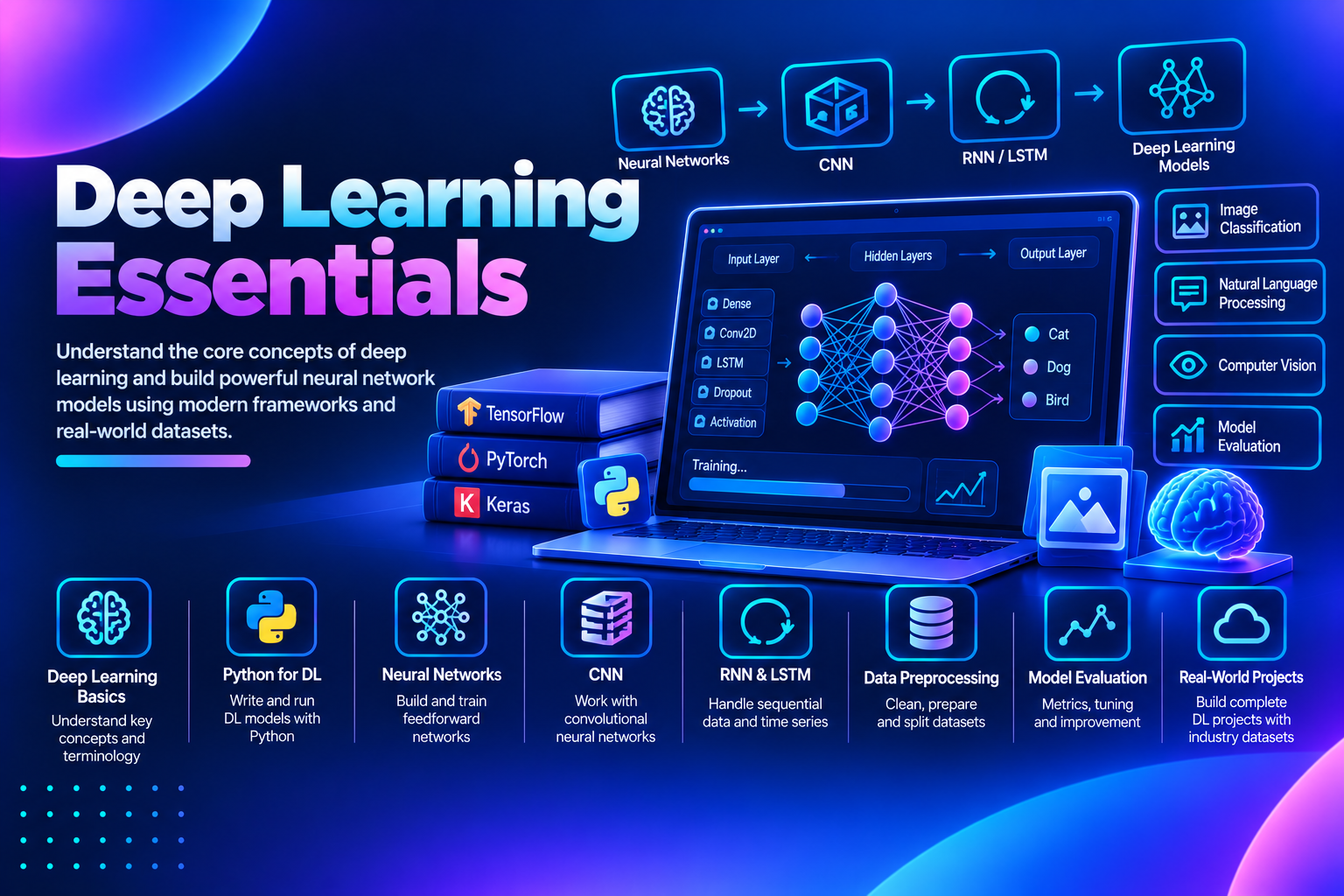
This programme covers deep learning essentials through live projects, small batches, and mentor-reviewed deliverables. You will build practical skills in neural networks, CNNs, RNNs, computer vision, and NLP, with dedicated placement support at the end.
Admissions open
Free demo class & counselling
Batch slots
Course overview
This Deep Learning Essentials Course in Ludhiana is a structured programme covering neural networks, from foundational machine learning through to advanced CNNs, RNNs, computer vision, and NLP. The learning arc moves from foundations (Python, ML basics, neural network fundamentals) to applied work (CNNs for vision, RNNs for sequence data, NLP) to a capstone project where you build and evaluate a complete deep learning model. Students finish with a portfolio of module deliverables, a documented internship certificate, and interview readiness for junior Deep Learning Engineer and Machine Learning Engineer roles in the local market.
Curriculum
The syllabus is structured as a ladder, not a set of parallel tracks. Each plan builds on the previous one, and longer plans repeat the full module list of shorter plans before adding their own advanced modules. This means you can start at the level that matches your experience and progress upward without gaps.
The Python programming and basic ML skills needed before starting deep learning.
You finish with
A data analysis notebook and a basic ML model.
How neural networks learn from data.
You finish with
A basic feedforward neural network.
Building and training deep learning models using modern frameworks.
You finish with
A fully trained and evaluated deep learning model.
How to process and classify images using CNNs.
You finish with
An image classification model using a CNN.
How to model sequential data like text or time series.
You finish with
A sequence prediction model.
Applying computer vision techniques to real-world images.
You finish with
A working computer vision application.
Bringing deep learning and NLP together into a complete project.
You finish with
A complete deep learning capstone project with documented results.
What you learn
The Deep Learning Essentials Course in Ludhiana at techcadd is designed to help students move from basic machine learning concepts to practical, advanced neural network skills.
Build core Python skills, work with data, and train basic machine learning models using Scikit-learn.
Understand how artificial neural networks work, including forward propagation, backpropagation, and optimisers.
Learn how to process images and build image classification models using CNNs and transfer learning.
Build, compile, and train deep learning models using TensorFlow and Keras.
Model sequential data like text and time series using RNNs, LSTMs, and GRUs.
Apply OpenCV for image processing and build NLP pipelines for text classification and embeddings.
Bring everything together to build, evaluate, and document a complete deep learning project.
Tools you’ll work with
The objective is practical knowledge rather than memorised concepts — every module produces a portfolio-ready deliverable you can show to employers.
The case for it
A course is worth the time you give it only if you finish with work you can show and skills you can defend.
You learn deep learning the way it is used in production, with the workflow and standards a working AI team expects.
You build real neural networks, train CNNs on image data, and write sequence models instead of just studying the theory.
You work with actual image and text datasets to solve problems you will face on the job.
Every module ends with a tangible project, giving you a professional portfolio to show employers.
Why this course
Six things we hold ourselves to for every Deep Learning Essentials batch that starts in Ludhiana.
Every module produces a deliverable that goes into your portfolio, from a simple neural network to a trained CNN.
You work on real image and text datasets with real constraints, not simulations or case studies.
Every project is reviewed by mentors who still work on client projects, not just teach.
Limited seats per batch ensure you get individual attention and feedback on your work.
Why TechCadd
What genuinely differs about this course at techcadd is that every module ends with a deliverable that goes into your portfolio, not a test score.
Your instructors are active AI professionals, not full-time trainers, so you learn what the industry actually uses.
You work on real image and text datasets with real constraints, not simulations or case studies.
Limited seats mean you get individual feedback on every deliverable.
With campuses in Ludhiana, Mohali, Chandigarh, Phagwara, Hoshiarpur, Amritsar, and Jalandhar, techcadd has a local presence and a track record of over 10,000 students trained.
Who can join
This course fits anyone who wants to build a career in deep learning but needs a structured path from fundamentals to job-ready skills.
You get a complete foundation in deep learning, starting with Python and ML basics and progressing to complex neural networks, with a portfolio you can show employers.
You can upskill in CNNs, RNNs, and computer vision through weekend batches, with deliverables that apply directly to your current work.
You start from the basics and build up to a capstone project, giving you a demonstrable skill set even if your background isn't in tech.
You learn to build and train deep neural networks, from image classification to text processing, without depending on external teams.
Not sure which of these you are, or whether the timing works around what you already do? That is exactly what the call is for. Ask about Deep Learning Essentials
Technology ecosystem
Deep Learning Essentials is the centre. These are the tools you use around it in a working team.
Hands-on projects
Each one lands in your portfolio with the working files, the process and something a reviewer can open.
Certification
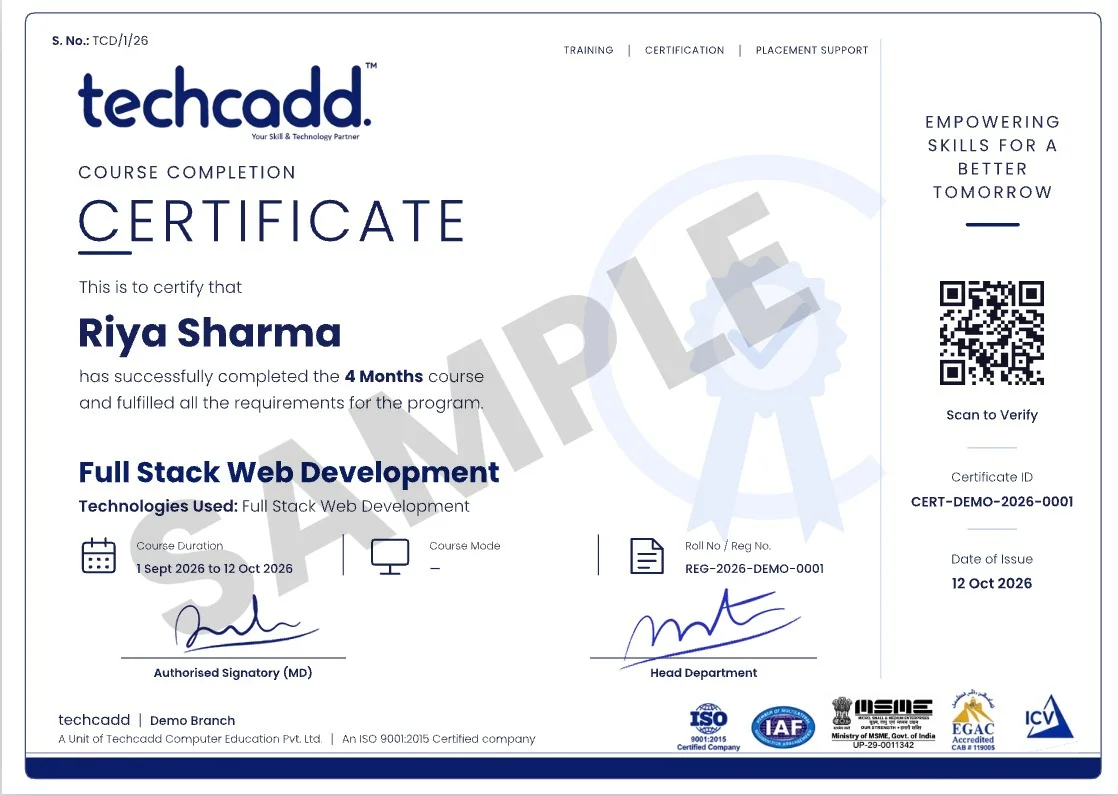
Finish the Deep Learning Essentials programme at techcadd Ludhiana and you leave with more than a line on a CV — a verifiable certificate, and the project work that makes it mean something in an interview.
Issued in your name on completion of the Deep Learning Essentials syllabus, with a reference number an employer can verify with us.
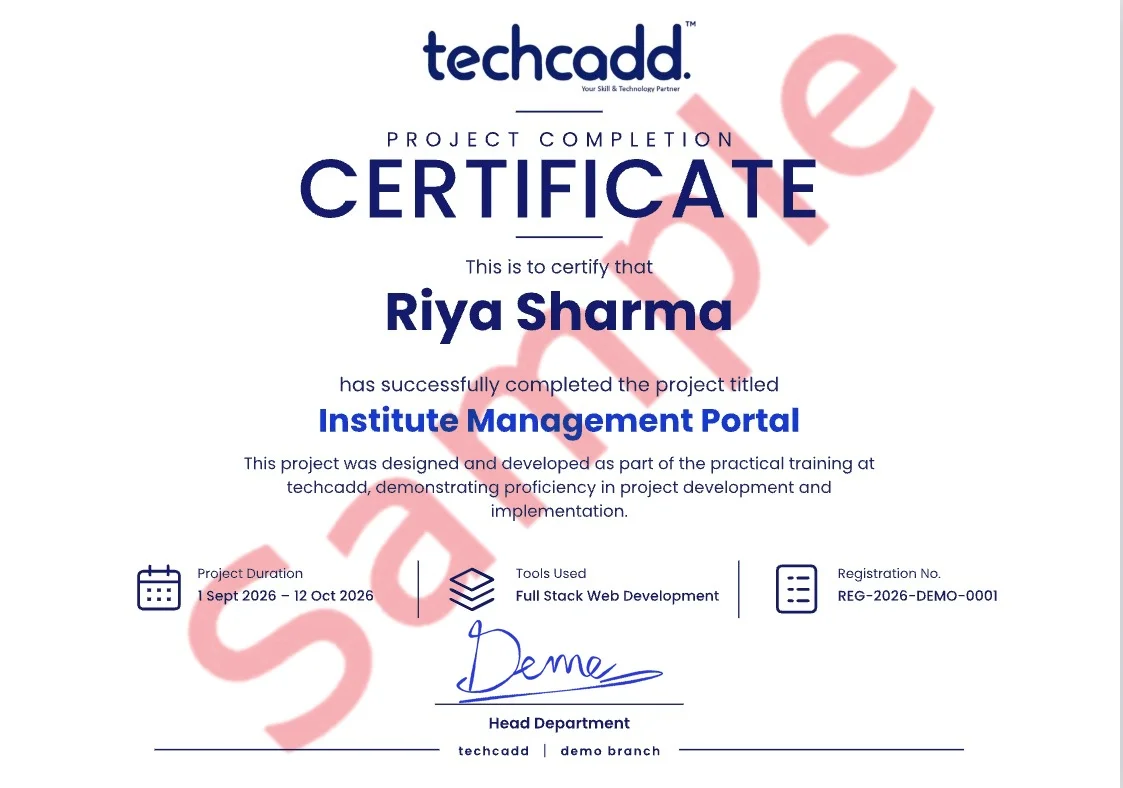
A separate certificate for the capstone you submit, naming the project so the work is attached to the credential.
Students who complete the live-project phase receive an internship letter covering the duration and the work delivered.
Every file, repository and deployed link stays yours — the part of the credential a reviewer can actually open.
techcadd has been training in Ludhiana since 2007. The certificate carries that record; the Deep Learning Essentials work you did carries the rest.
Where it takes you
The route from your first module to the roles Deep Learning Essentials opens — and the work that has to exist at each step.
Employers check your ability to design, train, and evaluate neural networks.
Employers check your ability to build and deploy ML models on real data.
Employers check your ability to build image classification and object detection models.
Employers check your ability to build sequence models and text processing pipelines.
Employers check your ability to apply deep learning to real-world problems.
Salary outlook
Indicative ranges for the roles this course opens — what a fresher out of Ludhiana is offered, what the metro and remote markets pay for the same skills, and how that moves with two or three years of work behind you.
| Role | Ludhiana & Punjab | Delhi NCR & Bengaluru | Remote & freelance |
|---|---|---|---|
| Deep Learning EngineerEntry | ₹2.4–4.2 LPA | ₹4–8 LPA | ₹20k–45k / project |
| Machine Learning EngineerEntry to mid | ₹3.6–6.5 LPA | ₹6.5–14 LPA | ₹35k–90k / project |
| Computer Vision EngineerEntry to mid | ₹3.6–6.5 LPA | ₹6.5–14 LPA | ₹35k–90k / project |
| NLP EngineerMid | ₹3.6–6.5 LPA | ₹6.5–14 LPA | ₹35k–90k / project |
Ranges are indicative, drawn from what our own students report and from openings we see through the placement cell. Actual offers depend on your portfolio, the interview and the company — nobody can promise you a number, and we do not.
Deep Learning Engineer, Machine Learning Engineer, Computer Vision Engineer, NLP Engineer and related positions, depending on which part of the syllabus you go deepest on.
The first jump usually comes at 18–24 months, once you have shipped work you can point to. Depth in one area moves it faster than breadth across many.
Yes, and a good number of our students do. Remote and contract work is the reason Ludhiana candidates now compete for the same briefs as metro ones — the portfolio travels, the address does not matter.
IT services, manufacturing and export units running automation, e-commerce and D2C brands, healthcare, education, and the agencies serving all of them. Punjab hiring is broader than it looks from a job board.
It helps with the practical half. The projects and tooling carry into an M.Tech, MCA or a specialisation abroad, and the portfolio is often what separates two applicants with the same marks.
Future scope
A course ends; the field does not. Here is the honest version of what the next few years look like for Deep Learning Essentials — where the roles go, and what is shifting underneath them while you learn.
Entry roles such as Deep Learning Engineer open as soon as you have projects that run. At this stage nobody is asking about your marks — they are asking you to walk through something you built.
The generalists plateau; the specialists do not. Depth in one part of Deep Learning Essentials — the part your first job leans on hardest — is what moves you towards machine learning engineer work.
Architecture, standards, hiring and mentoring. The technical skill is assumed by now; what you are paid for is judgement, and judgement only comes from having shipped things that mattered.
Teams expect Deep Learning Essentials work to be done alongside AI tooling. It raises the floor on output and raises the bar on what counts as a junior — which is exactly why the fundamentals in this course are taught the hard way.
What used to be one narrow role now touches data, deployment and the product decision behind it. Every extra layer of Deep Learning Essentials you understand is another kind of room you get invited into.
Remote and hybrid hiring means Ludhiana, Jalandhar and Chandigarh candidates now compete for the same roles as Bengaluru ones. Location has stopped being the ceiling it used to be.
Hiring has moved to portfolios, take-home tasks and live problem solving. A certificate opens a shortlist; work that runs is what gets you through the round after it.
Sectors hiring for this skill set
The comparison
This comparison covers the key differences between techcadd's Deep Learning Essentials Course and typical alternatives.
| What to ask about | techcadd | Typical institute |
|---|---|---|
| Live project work | Every module, from week one | Often only at the end, if at all |
| Batch size | Small, limited seats | Large, lecture-style batches |
| Mentor background | Active AI professionals who do client work | Full-time trainers, often not current practitioners |
| Deliverables | Portfolio-ready projects every module | Tests and certificates |
Written about the market, not about any particular institute in it. Visit two or three, sit through a demo class at each, and ask all eight of these questions — that is the only version of this table worth trusting.
Student Voices
Feedback from students who completed the Deep Learning Essentials programme at techcadd Ludhiana.
Simranjeet Kaur
Deep Learning Essentials / B.Sc. IT graduate
I joined with no background in this. By the third month I was building Deep Learning Essentials work on my own, and the project reviews are where I actually learnt to do it properly.
Harman Sethi
Deep Learning Essentials / Now working as an intern in the field
The classes are practical. Every session ends with a task that has to work, so you cannot fake understanding. That habit helped me most in interviews.
Ankit Verma
Deep Learning Essentials / BCA final year
Doubt support was the difference for me. My trainer sat with my work, found the mistake and made me fix it myself instead of handing over the answer.
Navjot Singh
Deep Learning Essentials / Career switch from operations
I came for the skill and left with a portfolio — projects I could actually demo on a call, not a certificate I had to explain.
Real, unedited feedback from techcadd learners on Google.
Frequently asked questions
The 7 things people ask most often about the Deep Learning Essentials course at techcadd Ludhiana.
The complete Deep Learning Essentials programme runs for 3,6 or 9 months depending on the batch you choose. Weekday, weekend and fast-track options are available, along with shorter modules for students who only need the fundamentals.
School students after 12th, college students from any stream, graduates and working professionals changing track. The first module assumes no prior experience.
No. The course starts from the basics. If you already have some background, your trainer will move you faster through the first module so you reach the project work sooner.
Python, Numpy, Pandas, Scikit-learn, Tensorflow, OpenCV, Matplotlib, Seaborn, Jupyter, VS Code, git and Github — plus the day-to-day tooling and workflow that surrounds them in a real team.
Yes. Each module closes with a lab project, and the course ends with a capstone you can put on your portfolio and defend in an interview.
Placement support includes resume and portfolio review, aptitude and role-specific practice, mock interviews and interview referrals through our hiring network.
Yes. You receive a techcadd Deep Learning Essentials completion certificate, and a separate project certificate for the capstone you submit.
Next batch
Send this form and a counsellor calls you back about this course specifically — batch dates, fees and whether it fits what you already know.
Would rather talk now? +91 98881 22667
Ready to get started?
Talk to a counsellor today. One call is usually enough to know which track fits your degree, your schedule and the job you want.
Call now+91 98881 22667